Incidents in East Sea and rule-based approach
A famous expert said that working groups need to be set up to operationalize relevant international conventions.
Some ASEAN littoral states have fallen victim to Chinese harassment of civilian oil exploration in the South China Sea (called East Sea by Vietnam), triggering concern over the compliance of international treaties of which China is a signatory.
| China Coast Guard and Royal Malaysian Navy are involved in another standoff over hydrocarbon exploration in the South China Sea. Photo: CSIS/AMTI |
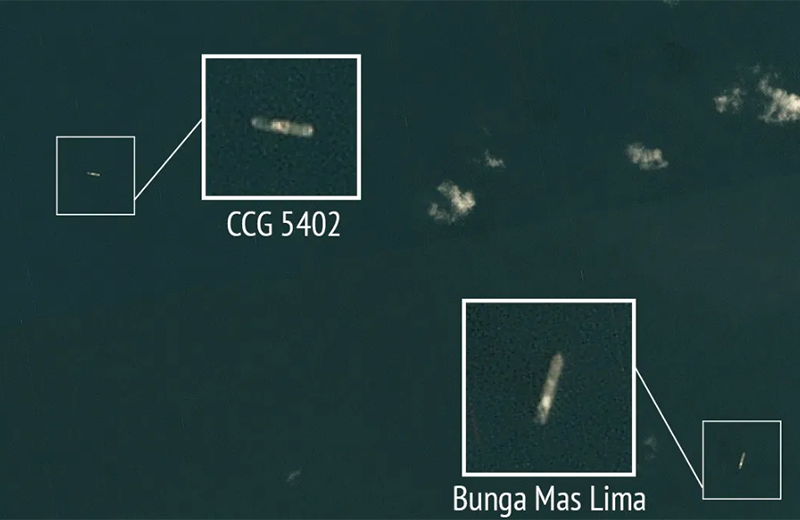
The latest incident occurred on November 19 when China Coast Guard (CCG) and Royal Malaysian Navy (RMN) involved in another standoff over hydrocarbon exploration in the resources-rich sea, according to Washington-based Center for Strategic & International Studies (CSIS)’ Asia Maritime Transparency Initiative (AMTI).
The incident came after two weeks of increasing tensions between the Malaysia navy and the CCG in the area when CCG ship 5402 harassed a drilling rig and its supply ships operating just 44 nautical miles from Malaysia’s Sarawak State. Malaysia responded by deploying a naval vessel that continued to tail the Chinese ship.
AMTI said this is the closest to shore it has ever documented such Chinese harassment.
Recent history suggested that China could escalate the standoff with further deployments, but it might also de-escalate in recognition that harassment of drilling operations so close to Malaysian shores is a significant provocation, AMTI said.
Repeated harassment
Carl Thayer, Emeritus Professor at Australia's University of New South Wales, said during 2019, CCG vessels were involved in constantly harassing civilian oil exploration vessels in Vietnam’s and Malaysia’s exclusive economic zones (EEZs).
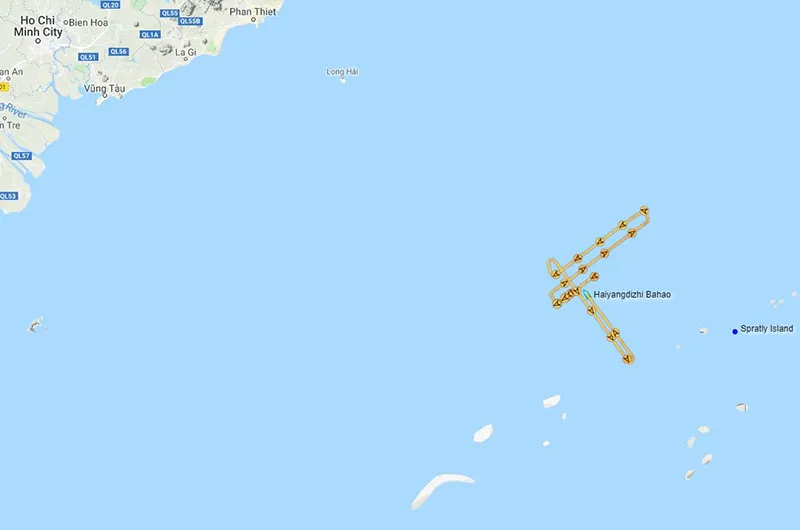
Chinese survey ship Haiyang Dizhi 8 continues operations in Vietnam’s exclusive economic zone on July 20, 2019. Photo: Ryan Martinson |
From October 2019 to April 2020, Petronas, the Malaysian state-owned oil company, engaged the services of the drillship West Capella to operate in oil and gas blocks off the coast of Sabah within Malaysia’s EEZ and briefly in a block where Malaysia’s claims an extended continental shelf outside its EEZ.
In December 2019, China responded by dispatching two CCG vessels, Haijing 5202 and Haijing 5403, to patrol where the West Capella was operating. China later dispatched the Haijing 5203 from Hainan to Luconia Shoals off the coast of Sarawak where it alternately harassed the West Capella and other on-going oil operations in the area from December 2019 to January 2020. China dispatched a fourth coast guard vessel, the Haijing 5305, to harass the West Capella in January.
In response, in January, the Royal Malaysian Navy dispatched the KD Jebat, a Lekiu-class guided missile frigate, to protect the West Capella and its supply vessel. According to AMTI, China’s campaign of harassment was a “dangerous, ongoing game of chicken involving law enforcement, militia, and civilian vessels.”
In mid-April 2020, when China deployed a survey ship to Malaysia’s EEZ accompanied by CCG escort, the US Navy, and reportedly the Australian Navy, sailed to the area to monitor the standoff when ended when the West Capella completed its operations.
From early July to late October 2019, China precipitated a four-month confrontation with Vietnam by deploying the Haiyang Dizhi 8 (HD8) ship to conduct surveys in waters near Vanguard Bank inside Vietnam’s EEZ.
The HD8 was accompanied by an escort comprising CCG vessels and maritime militia trawlers and fishing boats.
The CCG continually harassed oil exploration operations by the Japanese survey rig Hakuryu5 under contract with Rosneft Vietnam in the Red Orchid bloc 06-01.
Rule-based approach required
Vietnam's former Deputy Foreign Minister Pham Quang Vinh said “Security and safety in the East Sea (referring to the South China Sea) is a common interest.”
Meanwhile, Collin Koh Swee Lea, a research fellow at Singapore’s S. Rajaratnam School of International Studies, said it has always been the position of ASEAN member states to maintain balance and regard UNCLOS 1982 as the legal basis of all activities at sea, noting that it’ll surely be joined by many other member states.
| State parties to international conventions/codes on maritime security. Source: Prof. Carl Thayer |
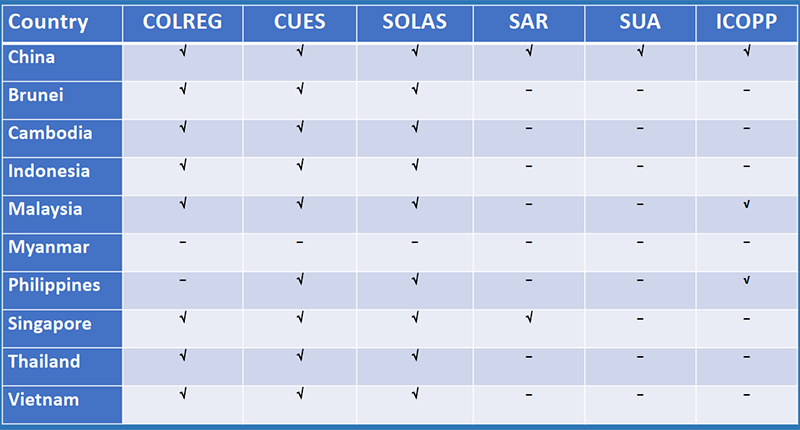
Legend: COLREG: International Regulations for Preventing Collisions at Sea (1972); CUES: Code for Unplanned Encounters at Sea (2014); SOLAS: International Convention for the Safety of Life at Sea (1974); SAR: International Convention on Maritime Search and Rescue (1979); SUA: Convention for the Suppression of Unlawful Acts against the Safety of Navigation (1988); and ICOPP: International Convention on Oil Pollution Preparedness, Response and Co-operation (1990)
According to Prof. Thayer, building codes would help prevent incidents at sea.
In the case of China and ASEAN member states in the South China Sea, in August 2018, the foreign ministers from ASEAN member states and China announced they had reached agreement on a Single Draft Code of Conduct in the South China Sea (COC) Negotiating Text (SDNT).
The SDNT, which was the outcome of submissions by nine states Brunei, Cambodia, China, Indonesia, Malaysia, Philippines, Singapore, Thailand and Vietnam, is divided into two parts. The first one looks at incidents in the South China Sea since the adoption of the SDNT and the second part reviews submissions in the SDNT that specifically discuss how to prevent incidents at sea.
Prof. Thayer said in a presentation at the 12th International Conference on the South China Sea held in mid-November in Hanoi that much work needs to be done if the SDNT is to be effective in addressing incidents at sea.
In the document, the professor name regional state parties to international conventions/codes on maritime security. Among 10 ASEAN member states, Myanmar signed no conventions while Laos is not included as it is a landlocked country.
Three conventions/codes that China and almost all ASEAN countries signed include COLREG – International Regulations for Preventing Collisions at Sea (1972); CUES – Code for Unplanned Encounters at Sea (2014), and SOLAS – International Convention for the Safety of Life at Sea (1974).
Vietnam’s submission suggested that the parties to the SDNT “shall not… blockade vessels carrying provisions or personnel for rotation… [and] conduct simulated attacks that aim guns, missile launches, inter alia, at targets of other countries.”
In should be noted that the heads of government of China and the ten ASEAN member states issued a Joint Statement on the Code for Unplanned Encounters at Sea (CUES) in the South China Sea on September 7, 2016 in which they declared:
1. We reaffirm our commitment to CUES in order to improve operational safety of naval ships and naval aircraft in air and at sea, and ensure mutual trust among all Parties;
2. We agree to use the safety and communication procedures for the safety of all our naval ships and naval aircraft, as set out in CUES, when they encounter each other in the South China Sea; and
3. We affirm that this effort contributes to our commitment to maintaining regional peace and stability, maximum safety at sea, promoting good neighborliness and reducing risks during mutual unplanned encounters in air and at sea, and strengthening cooperation among navies.
Prof. Thayer emphasized that as a matter or priority, working groups need to be set up to develop “processes, guidelines and protocols” to operationalize relevant international conventions. And provision should be made for a protocol to allow third parties to accede to the final Code of Conduct (COC) in the South China Sea.