Institutional reform and decisive governance – key drivers for public investment disbursement
In this field, leadership accountability becomes crucial and it must be based on measurable outcomes, including disbursement rates, project progress and public satisfaction, while ensuring that those with responsibility also have the authority and tools to act.
THE HANOI TIMES — Institutional bottlenecks are the root cause of Vietnam’s slow public investment disbursement, said Dr. Nguyen Si Dung, Member of the Prime Minister’s Advisory Council for Policy and former Deputy Head of the National Assembly Office.
In an interview with The Hanoi Times on Vietnam’s public investment progress, Dung said public investment can only be fast, accurate and effective when institutions, organization and human capacity operate in harmony.

Building Belt Road No.4 in Tien Thang Commune, Hanoi. Photo: Pham Hung/The Hanoi Times
Institutional reform needed
According to Dung, the key to change lies in shifting governance thinking. “We must move from policy issuance to policy operation, from project management to public investment governance, and from input control to output evaluation,” he said.
“When institutions function smoothly, public investment flows will naturally reach the right place at the right time, bringing the highest efficiency,” he stated.
As of October 16, Vietnam’s public investment disbursement rate stood at just 50.7%, despite strong government efforts.

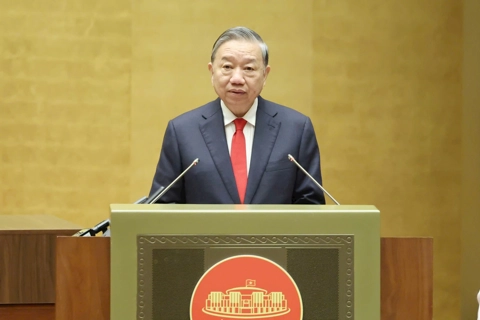
Dr. Nguyen Si Dung, Member of the Prime Minister’s Advisory Council for Policy and former Deputy Head of the National Assembly Office.
Dr. Dung said the problem lies not in a lack of determination but in structural constraints within the institutional and administrative system governing public investment.
Vietnam’s Law on Public Investment remains overly rigid at the input stage and insufficiently flexible at the output stage. Each project must pass through multiple layers of approval, prolonging preparation and locking capital in administrative procedures.
This “pre-check and command” approach restricts initiative among project owners.
Decentralization and delegation have yet to come with clear accountability. Localities receive funding but lack authority to adjust project lists or resolve emerging issues, forcing them to seek central approval and delaying progress.
A growing fear of making mistakes has also created a “soft barrier” that discourages action. With unclear legal frameworks, many officials prefer inaction over risk-taking. Meanwhile, implementation capacity remains uneven, with limited project management skills and weak use of digital monitoring tools.
According to Dr. Dung, delays in capital allocation or project preparation reflect deeper institutional weakness. “Slow disbursement is a symptom, institutions are the root cause,” he stated.
The current allocation system remains administrative rather than performance-based. Many projects receive funding before meeting technical or readiness conditions, leaving capital “available but unspent.”
The project lifecycle is also fragmented, as planning, approval, bidding and implementation are managed by different agencies with little coordination. Weak linkages between planning, budgeting and investment further delay execution even when capital is available.
The expert called for a shift from pre-control to post-evaluation and performance accountability.
“When both decision-makers and implementers fear risk, the whole system slows down. We must move from project management to investment governance, focusing on transparency and results.”
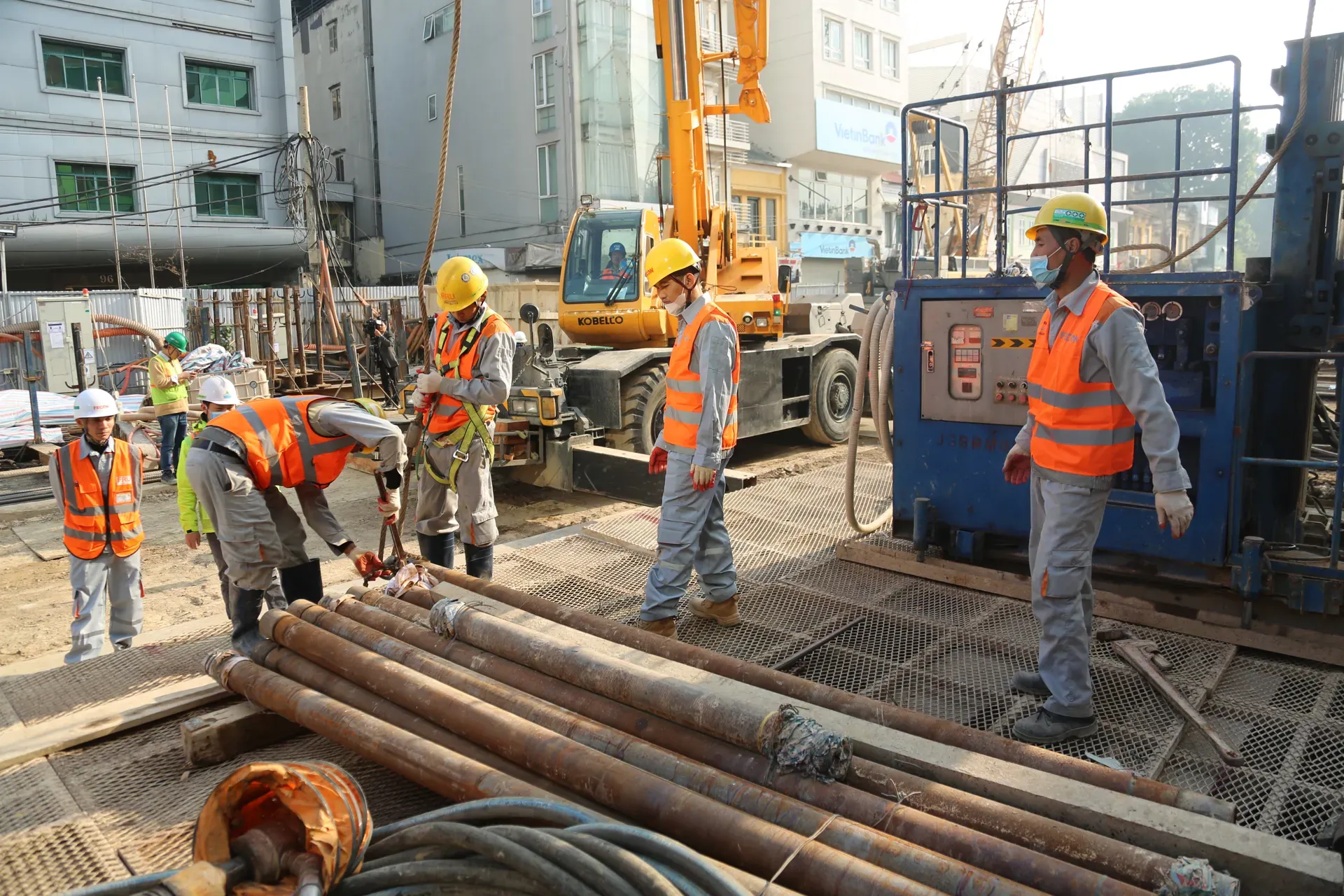
Workers at the Nhon-Hanoi Station metro project in Hanoi. Photo: Pham Hung/The Hanoi Times
Importance of land clearance
The government has allowed land clearance to be separated into independent projects and given stronger autonomy to local authorities. However, Dr. Dung said policy design is only the necessary condition; effective governance and public consensus are the sufficient ones.
He noted that land laws and compensation frameworks remain unstable, with large gaps between legal and market prices. Many provinces lack professional land development centers, resulting in unclear accountability.
While local authorities now have more power, they often lack digital land databases, accurate maps and qualified specialists. “Being empowered without sufficient capacity” has caused persistent delays, he said.
Dr. Dung emphasized that land clearance is not only a technical or financial issue but also a matter of trust. “If people see transparency and fairness, they will cooperate. Fast land clearance must be both transparent and humane,” he said.
Leadership responsibility matters in public investment
Prime Minister Pham Minh Chinh has repeatedly stressed discipline and leadership responsibility in public investment management. Dr. Dung compared the system to a train, where institutions are the tracks, organizations the engines and leaders the drivers who determine speed and direction.
He said leadership accountability must be tied to transparent performance indicators such as disbursement rates, project progress and public satisfaction. “We must shift from evaluating effort to evaluating outcomes.”
Leaders also need sufficient authority to act. “Responsibility cannot exist without power. Those entrusted with authority must have the tools to act and be accountable to the end,” he added.
Another key factor is building pride and purpose among officials. “Public investment is not just about spending money but about shaping the future by building bridges, roads and the foundations for national growth,” Dr. Dung said.
He recommended that localities use digital tools to manage investment projects in real time, improving transparency and efficiency across all stages from planning to completion.

Good investment helps Hanoi balance its growth and environmental protection. Photo: Pham Hung/The Hanoi Times
Public investment important for growth in 2026–2030
Vietnam’s medium-term public investment plan for 2026–2030 is expected to reach VND8.31 quadrillion (US$316 billion) to drive double-digit economic growth.
To make public investment a true growth engine, Dr. Dung proposed five strategic directions.
The first is to build the right “launchpads” with regional logistics, energy transmission, digital infrastructure and growth-driving urban areas.
The second is to shift from project management to portfolio governance, allocating funds only to mature projects with complete documentation and measurable outcomes.
The third is to use public funds to attract private investment through public-private partnerships, infrastructure funds and municipal bonds.
The fourth is to combine empowerment with accountability by making disbursement results and project quality measurable and public.
The fifth is to invest in productivity by encouraging innovation, technology development and higher labor efficiency.
“Institutional reform and decisive governance are the keys to faster disbursement and to building Vietnam’s long-term growth capacity for the next decade,” said Dung.