Interactive heritage routes bring Hanoi’s ancient stories to life for global tourism
Hanoi introduces four digital heritage itineraries using interactive maps and the H-Heritage app, offering travelers a rich cultural experience rooted in traditional beliefs and historic relics.
THE HANOI TIMES — From nearly 100 ancient relics in Hanoi and more than a year of research by leading experts from France and Vietnam, four heritage journeys linked to traditional Vietnamese religious beliefs have been launched. They give visitors a chance to explore the profound cultural values of 28 significant relics across the capital.
For the first time, a large archive of French, Sino-Vietnamese and Vietnamese documents has been revived through the “Hanoi Heritage Tourism Itineraries” project. Each relic is digitally reconstructed on interactive maps and integrated into the H-Heritage app, allowing tourists to explore history with just a smartphone.
As the main coordinator involved in the entire research process, Dr. Nguyen Thi Hiep from the French International Technical Cooperation Agency talks to The Hanoi Times that she was truly moved on the day the project was launched.

Dr. Nguyen Thi Hiep (French International Technical Cooperation Agency), main coordinator of the Hanoi Heritage Tourism Journey project. Photo: Mai Mai/The Hanoi Times
As the person in charge of a project to awaken the heritage of the capital, how do you assess the results of this project?
The project was carried out in a short time with a modest budget, but I am very satisfied with the results because of the goals achieved and the project’s value in training.
First, we had the opportunity to train students majoring in tourism, history, culture and architecture in several survey methods and heritage-related theories.
Regarding research, we conducted a group study covering 10 in-depth topics. In digital technology, we developed a website, an interactive map and an app guiding visitors through heritage experience routes.
Due to limited time and budget, we were only able to test four routes. We hope to continue receiving support from relevant Vietnamese authorities to expand the tours, with each stop representing a historical site. This approach helps bring heritage closer to tourists and enables heritage to interact with the community.
I believe the project covers all levels, from recreational tourism experiences to cultural and religious exploration in Vietnam. The four routes we implemented are linked to four traditional Vietnamese beliefs, which I analyzed in depth and detail.
In addition, the project aims to support extracurricular training, becoming a tool for teachers. Each journey is tied together by a compelling and memorable story. For example, the vocational training journey will include eight locations associated with eight traditional trades, deeply connected to the labor culture of ancient Hanoi as well as traditional Vietnamese culture.
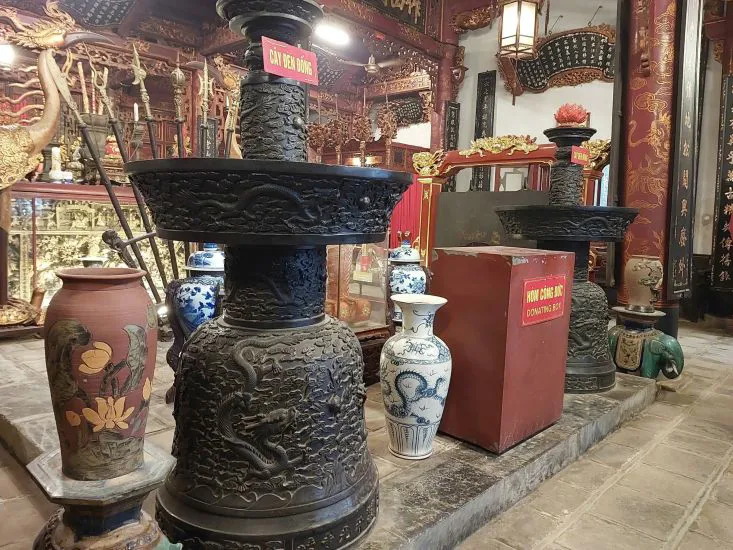
A pair of bronze lamps at Quan Thanh Temple, also known as Tran Vu Temple, was also built in 1010 under the Ly Dynasty with the purpose of worshiping Tran Vu genie, a North protector of Hanoi. Photo: Ngo Minh/The Hanoi Times
With the initial results you just mentioned, how do you assess the role of scientific units and especially the participation of universities in this project?
Our project involves the University of Social Sciences and Humanities with its history and tourism faculties, the Faculty of Interdisciplinary Sciences of Hanoi National University with its heritage faculty and the University of Architecture. These are three very important universities in this field.
We collaborated with them to conduct field trips and have students take part in presentations. We found it effective in training students by allowing them to go into the field and learn what knowledge they need at each historical site along a journey.
I think the project could later continue to collaborate with the University of Culture, the tourism faculties of other universities, the Hanoi Department of Tourism and the Ministry of Culture, Sports and Tourism to expand the heritage network nationwide.
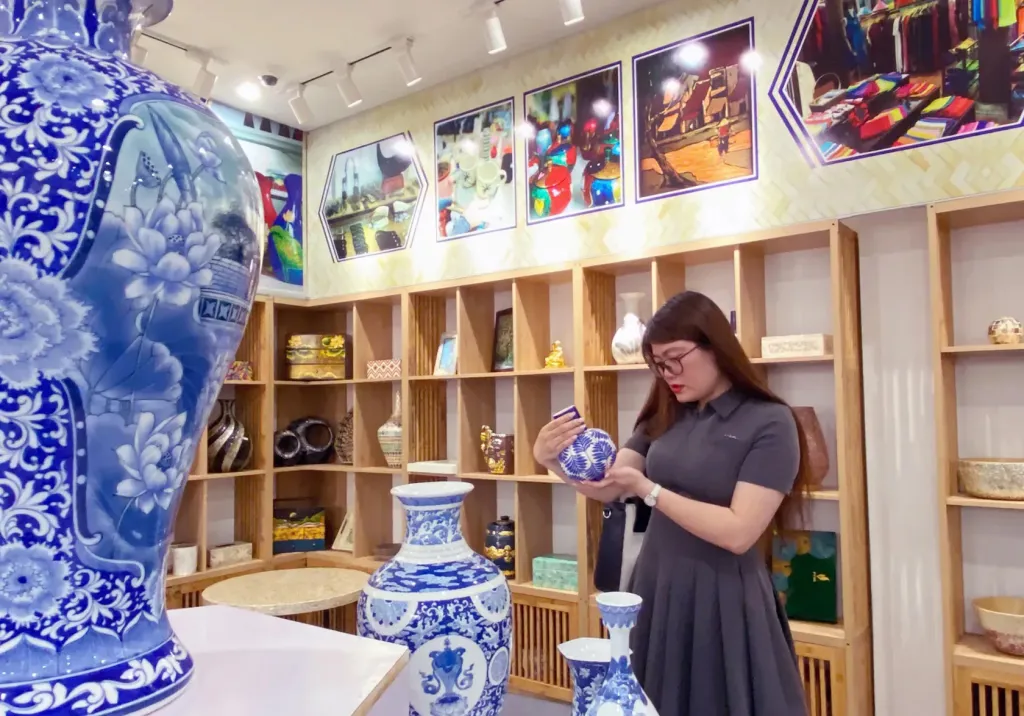
Exploring the craft village of Bat Trang helps visitors learn more about pottery making. Photo: Hoai Nam/The Hanoi Times
What outstanding criteria were used to build these journeys and were there any difficulties encountered during implementation?
These four routes were chosen first because they are connected to traditional Vietnamese beliefs. The first is the worship of the guardian deities of Thang Long (Hanoi's four fortresses). The second is the worship of the founding fathers of the oldest traditional crafts in Hanoi and Vietnam.
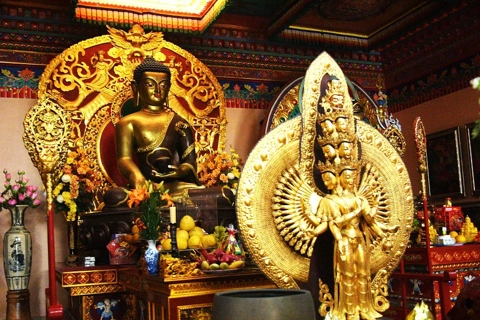
The third is the worship of the Mother Goddess, recognized by UNESCO as a world intangible cultural heritage and a unique belief in Vietnam. The fourth is the Zen Buddhist temple route.
In the future, we aim to create new itineraries featuring traditional craft villages and ancient Vietnamese churches built during the French colonial period. These are the itineraries we hope to continue developing.
We will need to work with city authorities and relevant agencies to further expand the scope of these new itineraries.
For example, we are researching the possibility of creating a heritage tour that combines French colonial architecture with ancient villas or a tour of Buddhist temples influenced by Indian or Chinese traditions.
We also want to explore a tour of traditional craft villages in ancient Hanoi and surrounding areas.
Thanks for your time!
|
Digital heritage journeys connect tradition with modern urban life The “Hanoi Heritage Tourism Itineraries” program kicked off on December 3, offering digital tools such as an online map, the H-Heritage mobile app and QR codes to help visitors explore heritage sites more easily. The program is part of the FEF-R Patrimoine project funded by the French Ministry for Europe and Foreign Affairs in cooperation with Vietnamese partners. It aims to support Hanoi in protecting and promoting its cultural assets amid rapid urbanization. Over the past year, nearly 40 experts and about 100 students in history, architecture, geography, anthropology and information technology worked together to survey monuments, document heritage sites, build GIS maps and develop digital platforms. Their work produced bilingual research publications, printed maps in multiple languages, a photography book and a complete digital mapping system. From more than 100 surveyed locations, the team selected 28 representative monuments and organized them into four themed journeys: the Four Sacred Temples, Mother Goddess Temples, Craft Ancestor Communal Houses and Pagodas of Hanoi. These curated routes highlight the city’s spiritual traditions, craft heritage and Buddhist influence, linking related sites through unified storytelling. All collected data has been digitized and integrated into the H-Heritage app, allowing residents, students and tourists to explore heritage information directly on their smartphones. The program also serves as an interactive educational tool, giving young people more opportunities to learn about Hanoi’s history through engaging and hands-on experiences. |