Investment in Hanoi’s urban railway line No.2 to increase by US$650 million
The No.2 urban railway line is expected to play a crucial role in the public transportation network, easing the ever-increasing severe traffic congestion in the capital's central area.
In its latest proposal to the Government, the Hanoi People's Committee has proposed to increase the investment capital for the urban railway line No.2, section Nam Thang Long – Tran Hung Dao, by VND16 trillion (US$650 million) to VND35.58 trillion ($1.5 billion).
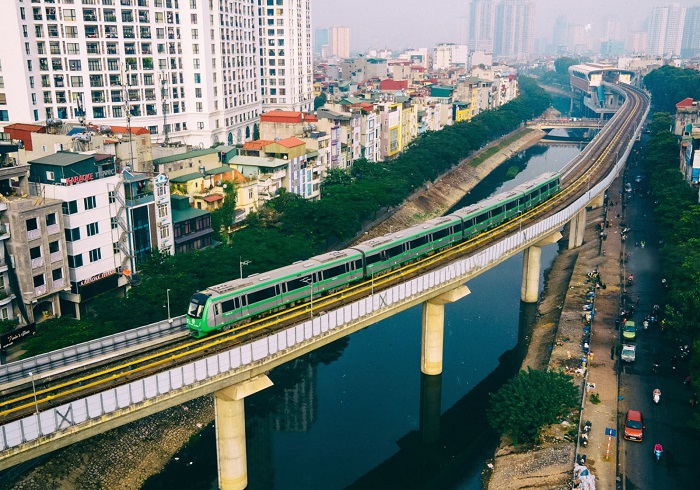
| Cat Linh - Ha Dong urban railway in Hanoi. Photo: Viet Linh/The Hanoi Times |
The project’s feasibility study report was approved by the Hanoi People's Committee in November 2008. The railway line was originally expected to be operational by 2015, but the completion timeline has continuously been revised.
In terms of construction scale, the total length of the route remains the same as previously approved at 11.5 kilometers. However, the lengths of the elevated and underground sections have been adjusted. Specifically, the elevated section has increased from 8.5 kilometers to 8.9 kilometers, while the underground section has decreased from 3 kilometers to 2.6 kilometers.
Simultaneously, in this proposal, Hanoi expected the project to be operational by 2029, with the following two years dedicated to operation and maintenance training.
Additionally, the Hanoi People's Committee stated that the plan to construct the underground station C9 beneath Dinh Tien Hoang Street – a key component of the project, which is located in front of the Hanoi Power Corporation, the Northern Power Corporation, and the headquarters of the Hanoi People's Council and People's Committee, only adjusts the position of the station body and its structure to ensure technical safety within the corridor of the route.
Along with this, the construction plan for station C9 does not violate the Hoan Kiem Lake Heritage Protection Zone II, does not affect the safety of cultural structures, and preserves historical, cultural, and architectural values.
According to Conclusion No.49 of the Politburo, Hanoi is tasked with completing nearly 405 kilometers of urban railway over the next 12 years, requiring a budget allocation of approximately $37 billion.
A report from the Hanoi Urban Transport Management Board stated that station C9 has been reevaluated with three location options, taking into account feedback. Among these, option 1, after adjustment, has been submitted to the Prime Minister. In this scenario, underground station C9 will be located outside Protection Zone II of Hoan Kiem Lake's heritage, constructed as a 4-tier stacked station. The structure of the station body aligns with the boundary of Protection Zone II, with a length of 202.4 meters, a width of 15 meters, and a depth of approximately 31 meters.
The station is situated on a curve with a radius of 800 meters, below Dinh Tien Hoang Street, in front of the Hanoi Power Corporation, the Northern Power Corporation, and the headquarters of the Hanoi People's Council and People's Committee.
The station will be equipped with two access points at the originally proposed locations. To provide sufficient space for the cooling tower, a 13-meter-high ventilation system, and a power generator room, an additional 705 square meters of land will need to be acquired from the Hanoi Power Corporation (an increase of 260 square meters from the original proposal). Additionally, approximately 25 square meters of land will be taken from the Hanoi People's Council and People's Committee to ensure smooth construction.
Project No.2 of the urban railway system - Noi Bai - Nam Thang Long - Hoang Hoa Tham - Bo Ho - Hang Bai - Dai Co Viet - Thuong Dinh plays a crucial role in connecting Noi Bai Airport to the city center, serving as a central axis and connecting with the beltway.
The project has a length of 11.5 kilometers, of which 2.6 kilometers are elevated and 8.9 kilometers underground, with 3 elevated stations (C1 to C3) and 7 underground stations (C4 to C10). The project utilizes ODA funds from Japan and was approved by the Hanoi People's Committee in the Feasibility Study Report under Decision No. 2054/QD-UBND on November 13, 2008.
The No.2 urban railway line is expected to play a crucial role in the public transportation network, alleviating the worsening traffic congestion in the central area of the capital.