John McCain - Biggest symbol of Vietnam-US relations
The late senator made tireless efforts to advocate the reconciliation of the former foes to help result in fruitful relationship like today.
Senator John McCain remains one of the major symbols in the normalization of relations between the US and Vietnam over the past two decades, said Prof. Carl Thayer, one of the leading Vietnam experts.
| Sen. John McCain meets Mai Van On, who saved him in the Vietnam War, in Hanoi in 1996. Photo: AP |
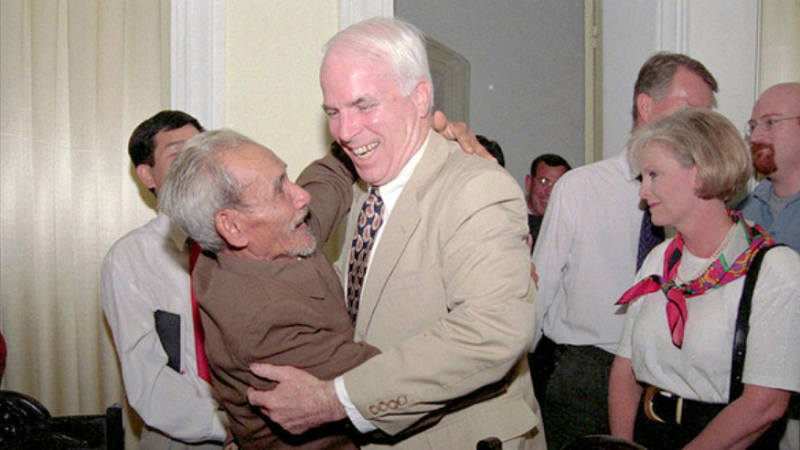
The Vietnam War veteran showed no rancour against his captors or the Vietnamese government while advocating reconciliation, Emeritus Professor Carl Thayer at the University of New South Wales, Canberra, said on the occasion of the second anniversary of the death of Senator John McCain and the 25th anniversary of the US-Vietnam relations.
According to Prof. Thayer, the late senator made significant contributions to the bilateral relations for three major reasons.
First, he was a prisoner of war from 1967 to 1973, yet he showed no antagonism towards his captors or the Vietnamese government.
Second, once he was elected to the US Congress, first as a Representative and then as a Senator for the Republican Party, he worked in a bipartisan fashion with representatives of the Democratic Party, such as Senator John Kerry. It is notable that when President Bill Clinton announced the normalization of relations with Vietnam in July 1995, Senator John McCain stood by his side.
Third, he regularly visited Vietnam on numerous occasions and became prominent as an advocate of reconciliation. Senator McCain was able to share his experiences with the American people as well as the establishment.
| President Bill Clinton and Sen. John McCain at the moment announcing the normalization of the two countries in 1995. Photo: AFP |
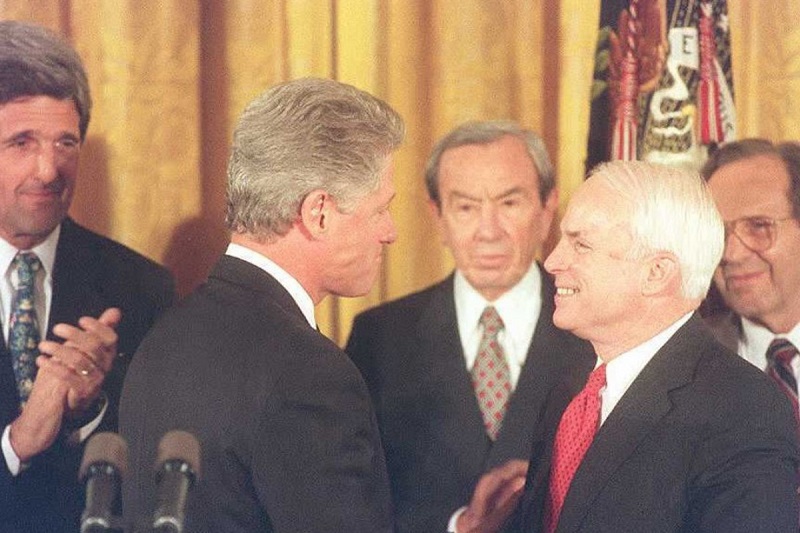
Prof. Thayer went on to say that two main factors motivating John McCain in building the relations between the two countries include his humanity and patriotism.
John McCain spent long years as a prisoner of war that gave him time for introspection. Like other American veterans – John Kerry, Chuck Hagel and Pete Peterson – he came to the view that Vietnam was a place not a war. He empathized with the Vietnamese people as well as American veterans and advocated reconciliation.
Meanwhile, he felt that the US as a great power should put the Vietnam War behind itself, and as a matter of national interest assist Vietnam to develop and make a contribution to stability and development in Southeast Asia, especially after Vietnam became a member of the Association of Southeast Asian Nations (ASEAN). It was in America’s national interest to see ASEAN succeed.
Notably, efforts made by John McCain and John Kerry during this process has helped change the way Americans thought about Vietnam and the Vietnam War, Prof. Thayer emphasized.
He explained that the US was bitterly divided during the Vietnam War. After the war ended, US-Vietnam relations were held hostage by a powerful lobby group that demanded Vietnam provide a full accounting for American Prisoners of War (POWs) and Missing in Action (MIAs).
| Sen. John Kerry, chairman of the Senate Select Committee on POW/MIA Affairs, and Sen. John McCain during a hearing of the committee on Capitol Hill in Washington, on June 24, 1992. Photo: John Duricka/AP file |
.jpg)
Senators John McCain and John Kerry both had credibility as Vietnam War veterans and were able to turn American policy into a positive direction moving from post-war reconciliation to cooperation.
Senator McCain, a Republican, was able to lend his prestige and support to Democratic Presidents, Bill Clinton and Barrack Obama. For example, the senator spoke on the floor of the Senate in favour of the Bilateral Trade Agreement between the US and Vietnam, Prof. Thayer noted.
Mark Green, executive director of the McCain Institute for International Leadership, said John McCain’s legacy is respecting human dignity, forging against long odds a better future for former adversaries, overcoming old enmities and discredited policies, having the character to move past the debilitating wounds of war.
“McCain’s leadership was visionary but clear-eyed, steadfast, and based upon a conception of a future that would benefit both peoples, rather than a plan to settle old grievances. He and like-minded advocates in the U.S. and Vietnam started a new chapter in the history of relations between our two countries that would encourage subsequent generations to rewrite the book on our relations — from their hopeful, if wary, beginnings to a growing partnership,” he added.
| Vietnamese and foreign people place flowers to pay respect to John McCain at a sculpture near Truc Bach lake in Hanoi depicting the capture the then-US Navy pilot McCain whose fighter jet was shot down in 1967. Photo: Dan Tri |
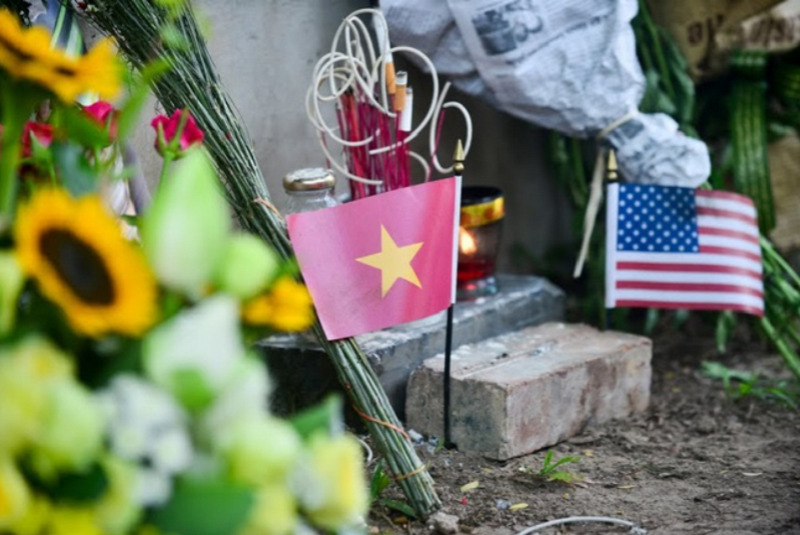
Ha Kim Ngoc, ambassador of Vietnam to the US, in February 2020 chose Arizona as the first destination to celebrate the 25th anniversary of the normalization. He said the choice is for the late senator as Arizona is the place where John McCain spent most of lifetime and political career.
Pham Quang Vinh, who was ambassador of Vietnam to the US in 2014-2018, said John McCain paid significant attention to building the next generation of parliamentarians following his and his contemporaries’ efforts in relations with Vietnam.
Former Ambassador of the US to Vietnam Ted Osius said McCain tried to offer opportunities to enhance the bilateral relations to young senators like Cory Gardner, Sheldon Whitehouse, Jack Reed, Joni Ernst, and Dan Sullivan.
Thanks to efforts of Americans like late Senator McCain, the US-Vietnam relationship has become a symbol of how two former adversaries can mend ties and move toward prosperity together.
In terms of economics, two-way trade between the US and Vietnam grew from US$1.5 billion in 2001 to over US$77.6 billion in 2019.