Journey of bringing Vietnamese youth voices to YouthCOP Bangladesh 2025
Vietnamese youth emphasize the need for real participation in climate action and policymaking, highlighting education, financial empowerment and institutional mechanisms for long-term environmental leadership.
THE HANOI TIMES — The younger generations must speak up and take part in finding solutions for their own future as they face the most severe impacts of climate change, said Ly Nhac Linh, Project Operations Manager of ActionAid Vietnam.
Speaking to The Hanoi Times, Linh emphasized that young people need greater and more direct participation in climate action efforts.
“Vietnamese youth always want a real mechanism to join climate processes,” she said. “Participation must be guaranteed both institutionally and financially so that their voices are heard and turned into action.”
Her message aligns with Vietnam’s main approach to climate response: creating systems where youth engagement is a responsibility within climate governance, not a symbolic gesture.
Education, financial empowerment and policy binding

Ly Nhac Linh, Project Operations Manager of ActionAid Vietnam, shares her insights on opportunities and challenges for youth in climate adaptation. Photos: Hoang Nam/The Hanoi Times
“We need to strengthen climate education as a foundation for long-term transformation,” Linh said. “Education is where awareness meets innovation. It helps young people understand climate risks and design effective solutions.”
Among ActionAid Vietnam’s initiatives to promote environmental and climate education is asaplearn.org – the first Vietnamese e-learning platform for environmental education in local languages.
The platform has attracted more than 12,000 young participants, mostly Vietnamese. Over 100 youth-led projects have been carried out, from waste reduction campaigns to community-based adaptation models in flood-prone areas.
Currently, the platform has expanded across Southeast Asia to overcome language barriers that often limit inclusive climate learning. By 2028, ActionAid Vietnam expects 50,000 young people to join the platform, making education a driver of a just and green transition.


Young delegates join a working session and discuss ways for climate change response, sustainable development and green transition.
ActionAid Vietnam and its local partners have also launched several environmental and social projects to raise community awareness of climate change.
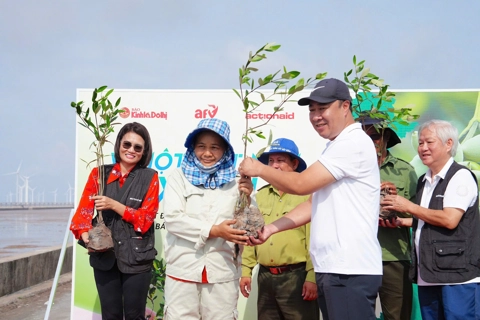
In June 2025, ActionAid Vietnam, the Vietnam Aid for Social Protection Foundation (AFV) and Kinh te & Do thi (Economic & Urban) Newspaper planted 2,025 white mangrove trees in Lai Hoa Commune, the southern city of Cantho, to protect coastal dikes, prevent erosion and preserve land.
Earlier, in August 2024, the “Action for a Green Vietnam” program planted about 160,000 trees in Ca Mau, Quang Nam and Dak Nong provinces, including 120,000 mangroves in Ca Mau to combat coastal erosion.
In March 2024, ActionAid Vietnam and ChildFund Korea launched a project in Bac Lieu and Soc Trang provinces for 2024–2026 to promote low-emission agriculture, solid waste management and biogas use.
Linh said financial empowerment is another key factor, proposing a Youth-led Initiative Fund to support young people in developing and running community-based climate projects.

“The fund would be transparent, co-managed by youth and government representatives and open to groups in remote or vulnerable regions,” she said.
“This proposal stems from Vietnam’s experience,” she said.
Over the past few years, ActionAid Vietnam has supported more than 100 youth initiatives on renewable energy, sustainable agriculture and disaster preparedness. Many started locally but later inspired national discussions on community resilience.
“A formal funding mechanism would create a lasting structure for youth leadership,” the ActionAid Vietnam representative added.
Nguyen Viet Linh, a student at the Vietnam National University of Forestry, shared the same view. He said Vietnamese youth need clear and binding mechanisms to ensure their involvement in environmental and climate policymaking.
He called for youth quotas and structured consultation processes in frameworks such as the Law on Environmental Protection 2020, the National Green Growth Strategy and Vietnam’s updated Nationally Determined Contributions (NDCs).

“Young Vietnamese are becoming more proactive in joining international peers in climate action and environmental protection,” Viet Linh said.
Vietnamese youth contributions at YouthCOP Bangladesh 2025
Nhac Linh and Viet Linh were among the Vietnamese delegates who contributed ideas at the Youth Conference on Climate Change (YouthCOP) Bangladesh 2025, held ahead of COP30 in Belem, Brazil during November.
Vietnamese youth joined regional peers to shape a shared vision for climate justice, focusing on education, innovation and institutionalized participation in policymaking.
Held in early September in Dhaka, the YouthCOP Bangladesh 2025 brought together hundreds of young people from across Asia to share ideas for a just transition.
Their contributions reflected Vietnam’s growing awareness that youth must move from advocacy to influence, as well as the country’s practical experience and long-term vision toward achieving Net Zero by 2050.
Representing ActionAid Vietnam, Nhac Linh described the event as a commitment to meaningful engagement.

Nguyen Trung Hoang Nam and Nguyen Hoang Huy, two young journalists from Kinh te & Do thi Newspaper, said they were “deeply grateful and honored to participate in YouthCOP Bangladesh 2025” where they represented Vietnamese youth and shared ideas for climate action, sustainable development and green transition.
Speaking for the host country, Nazmul Ahsan, Lead for Youth and Climate Justice at ActionAid Bangladesh, said YouthCOP has become a national platform that connects policymaking with youth participation.
He noted that young people from the most climate-affected areas are now seen as active contributors who can shape national and global strategies.
Through discussions and simulations, he added, YouthCOP has helped form a new generation of young negotiators who understand both the science and politics of climate decisions.
Farah Kabir, Country Director of ActionAid Bangladesh, emphasized that examining International Court of Justice (ICJ) rulings through a gender lens is vital to ensure fairness in the climate transition.
She said Bangladesh’s experience shows that inclusive leadership can drive more equitable outcomes.

Kabir also highlighted that YouthCOP has encouraged hundreds of young women to engage in community-level climate projects, making gender justice a key part of the country’s transition.
“The real test of youth participation is whether it leads to policy change,” Linh from ActionAid Vietnam said.
Her remark resonated throughout the event, stressing the need for transparency and accountability in how governments integrate youth voices into national and international climate agendas.
By combining learning, leadership and advocacy, Vietnam’s delegation showed that young people can be strategic partners in the fight against climate change.
Their contributions at YouthCOP Bangladesh went beyond sharing success stories, offering practical pathways to make youth participation systemic, effective and future-oriented.
|
Highlights from YouthCOP Bangladesh 2025 • Hosted by ActionAid Bangladesh and the Brighters Society of Bangladesh, YouthCOP 2025 took place from September 6 to November 8 in Dhaka. • The event gathered hundreds of young people from across Asia to discuss just transition, gender justice, social inclusion and climate finance. • Vietnamese delegates participated in panel discussions, mock negotiations and youth demand roundtables, sharing experiences from Vietnam’s climate initiatives. • The Vietnamese delegation visited ActionAid Bangladesh headquarters and historical landmarks such as Lalbagh Fort. • The conference concluded with the Youth Demand Charter, a joint declaration to be presented at COP30 in Belem, Brazil held from November 10 to November 21, 2025. |