Lai Chau Border Guards bring digital tools closer to daily life along the frontier
In some of Lai Chau Province’s most remote border villages, a smartphone and a stable signal are becoming as essential as roads and electricity.
THE HANOI TIMES — As the sun still sleeps, Lieutenant Colonel Quan Anh Tuan, Commander of Ma Thu Lang Border Post in the northern mountain province of Lai Chau, stands at the unit gate, his gaze fixed on the slope leading down to Len Chu Village.
He said he has grown accustomed to the biting cold and to early descents into the village while mist still blankets the trail.

Border guard officers guide ethnic minority residents in using smartphones. Photos: Border Guard Command of Lai Chau Province.
“Our mission no longer ends with guarding the border,” he said. “We now help people keep pace with digital life. If residents are to understand technology, officers must be present, patient and persistent.”
Mornings at Ma Thu Lang Border Post begin with the howl of wind rising from the deep valley below. The path turns slick and dangerous on rainy days. On sunny days, brown dust follows every step.
Even so, Tuan and his comrades carry tablets, portable signal transmitters and printed guides to online public services.
Later, Tuan stopped at the wooden house of Lieu A Thong, a middle-aged resident of Len Chu whose life has long centered on farming and the steady rhythm of the seasons.
Thong once had no familiarity with smartphones. Since border guards began guiding him, his old device has become a reliable tool.
“Before, paperwork meant a full day on the road. If it rained, I had to wait longer. Now officers teach me to submit documents online. A few taps and it’s done,” said Thong through a voice of pride.
He then opens the public services app with care, his eyes bright with the quiet thrill of learning something new.
What pleases him most is video calling his grandchild, who studies vocational skills in the lowlands. When the child’s face appears on the screen, hundreds of kilometers shrink into a single moment.
Learning to use mobile banking has further changed Thong’s routine. It allows him to trade livestock and farm products faster and with greater clarity.
“Payments arrive quickly, records stay clear and losses or disputes rarely happen,” he told The Hanoi Times.
Digital transformation in remote areas
Lieutenant Colonel Quan Anh Tuan said many residents still approach technology with caution because they fear mistakes.

Leaders of the Border Guard Command of Lai Chau Province present smartphones to residents of Si Lo Lau Commune for daily use.
“We teach step by step, from turning on the phone to searching for information. Some need three or four lessons, but once they succeed, their confidence grows. Closing the digital gap means helping people shed the feeling of being left behind.”
In many border villages of Lai Chau, routine paperwork once required long walks across steep terrain just to ask about entry rules or basic legal matters.
Limited infrastructure made time the greatest burden. Connectivity gaps added to the strain. Several villages still lack 3G or 4G coverage, while others depend on unstable signals and electricity.
According to Colonel Le Cong Thanh, Deputy Political Commissar of the Border Guard Command of Lai Chau Province, three border villages remain entirely outside mobile network coverage. Residents there still rely on physical travel and paper documents for even simple procedures.
Lai Chau’s border belt is home to 10 ethnic groups, most of them minorities living in scattered mountain settlements.
Weak infrastructure, combined with risks such as drug trafficking, illegal crossings and early marriage, led provincial authorities to assign border guards a leading role in digital transformation to ease daily life in border communities.
The effort began within the force itself. Border units adopted digital signatures, online meetings and electronic document processing.
Secure internal networks now reach border posts, improving coordination and freeing personnel for community work.
At the village level, border guards bring digital skills directly to residents through hands-on training in smartphone use, digital payments and online public services.
“Green Beret Teachers” teams, made up of 150 trained officers and soldiers, provide one-on-one guidance so households can use basic digital tools safely and confidently.
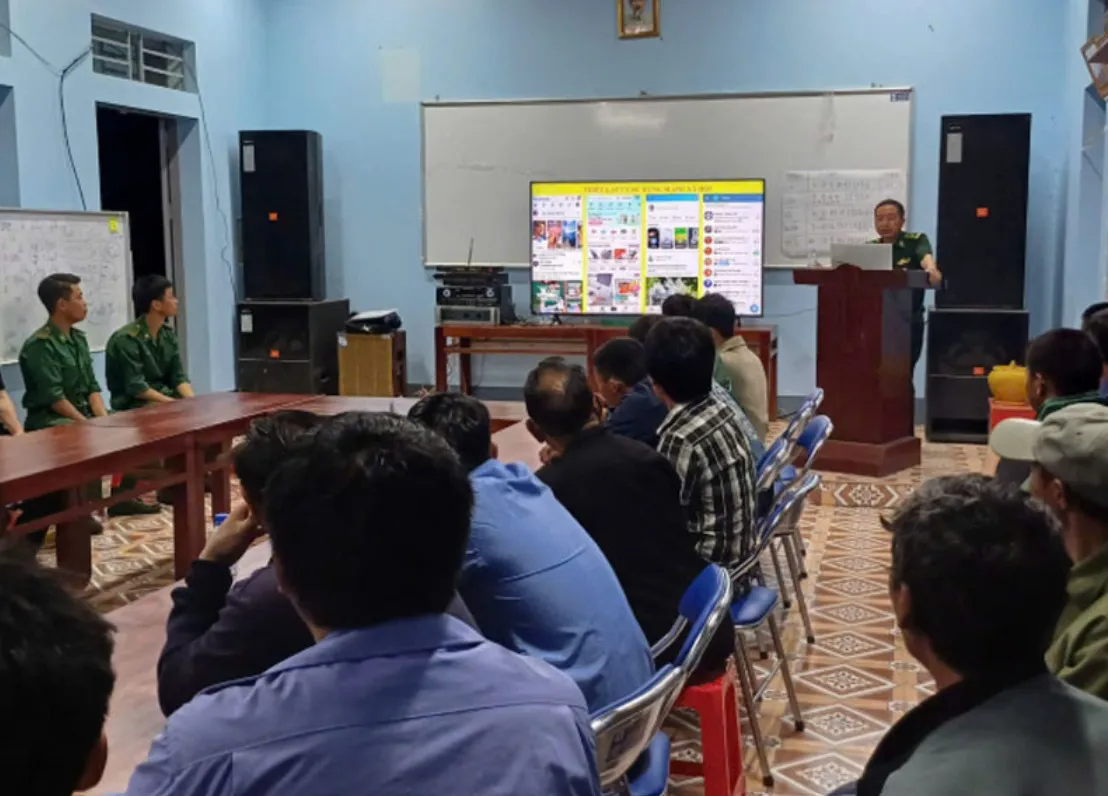
Results have emerged steadily. More than 1,000 households now use smartphones. Over 20,000 residents have received basic digital training. Social media increasingly supports small-scale trade and community tourism.
For families unable to afford devices, donated smartphones have prevented new digital gaps in already isolated areas.
Digital access reshapes security and legal awareness
Digital tools have also changed how residents engage with security and public order.
At 13 border posts, anonymous reporting systems using QR codes and online forms now operate at commune offices, health stations, schools and shared public spaces.
Residents can provide information discreetly without fear of exposure.
By late October 2025, these channels had received dozens of reports, several of which proved decisive.
Information from residents helped uncover drug-related operations and illegal transport cases, showing that lower access barriers encourage community participation in maintaining order.
Legal access has followed the same path. At posts such as Dao San, QR codes linking to legal information appear at village centers, cultural houses and school gates.
Instead of relying on second-hand explanations, residents can now consult regulations directly on their phones.
For people like Lieu A Thong, clarity matters. Independent access to procedures has reduced uncertainty and strengthened confidence that business activities comply with regulations.
The next step focuses on institutional access.

Le Cong Thanh, Deputy Political Commissar of the Border Guard Command of Lai Chau Province, works with a delegation from the Journalists’ Association of Hanoi. Photo: Hoang Nam/The Hanoi Times.
The Border Guard Command of Lai Chau Province is completing a digital legal library that will allow residents and officers to search regulations on border management, entry and exit and public order through phones or computers.
When paired with online public services at the commune level, these tools are expected to further reduce travel needs and reliance on intermediaries.
In Lai Chau’s borderlands, digital transformation does not arrive as a dramatic leap. It unfolds through small, practical changes that save time, reduce risk and give residents greater control over daily decisions.
Over time, these steady gains may shape life along the frontier as deeply as any new road or power line.
For Lieutenant Colonel Quan Anh Tuan, the work may appear modest, but it demands patience and commitment.
Border guards now look beyond patrol duties, recognizing that a village fluent in technology becomes safer, more confident and more closely connected to public authorities.
In Lai Chau’s borderlands, digital transformation is not framed as a leap into the future. It is unfolding as a series of small, practical changes that save time, reduce risk, and give residents more control over everyday decisions.
Over time, those incremental gains may prove as important as any new road or power line in shaping life along the frontier.