Lesser-known ‘treasures’ in Hanoi's largest pomelo hub
Located by the romantic Nhue River, through centuries of development and modernization, Phu Dien Village retains its priceless cultural and historical values.
The exact time when Phu Dien Village was founded remains unknown, but the village appears in geography books from the late 18th century.
An ancient village in the heart of the capital
| Phu Dien Communal House in today's Phu Dien Ward, Bac Tu Liem District. Photo: ditichlichsu-vanhoahanoi.com |
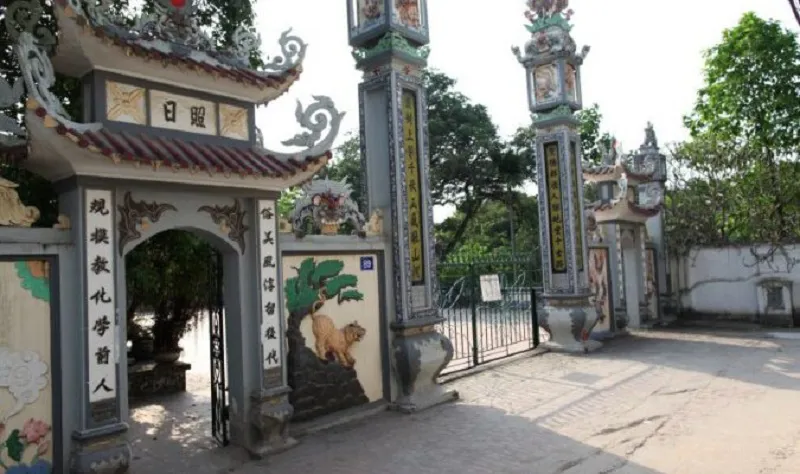
Phu Dien was formerly part of Co Nhue Canton, Bac Tu Liem District - an ancient land in the capital of Thang Long. The villagers were mostly farmers, yet they had an academic tradition with numerous Tu tai or junior bachelors and Cu nhan or senior bachelors, as well as some scholars who passed regional and national exams.
Not only studious but the people of Phu Dien were also known for their bravery and willingness to sacrifice themselves for the country. During the American war in Vietnam (1965 - 1975), the whole village contributed a total of 844 soldiers, who fought bravely for the independence of Vietnam.
Upon stepping through the three-entrance gate, visitors will see a 5,000-square-meter lake. This place is not only where seniors meet and chat every afternoon, but also overflows with the memories of generations of Phu Dien people. Even on sunny days, the village is pleasantly cool for any visitor, as if the rows of green trees next to the open surface of the lake breathe new life into the surrounding space.
| Communal house is considered a symbol of culture, spirit and religion of Vietnamese, and Phu Dien Communal House is a typical one. Photo: ditichlichsu-vanhoahanoi.com |
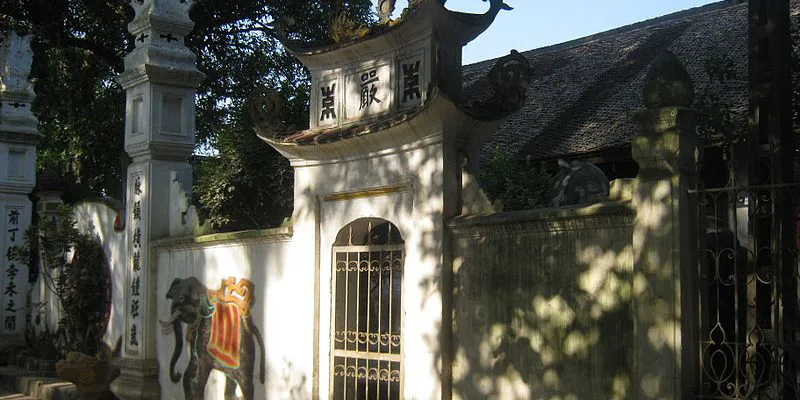
The oldest building in the village is the communal house -in the shape of the Dinh letter in Nom script - built in the mid-18th century at the latest. Inside the house, many precious relics are still kept, including dragon thrones, altar tablets and incense tables. There are also couplets, horizontal inscribed boards and decorative door frames - all lacquered in golden yellow and crimson.
Although not every Phu Dien villager fully understands the history of their land, they all feel great respect and gratitude for the ancestors who contributed to the country and the country. That’s why historical relics are regarded as treasures and are always carefully preserved.
A renowned pomelo-growing land
Canh oranges, Dien pomelos and Xuan Dinh naseberry fruits have long been an indispensable part of Hanoi’s cuisine. ‘Dien pomelos’, in particular, refers to pomelos grown in the land of Dien, which today belongs to the wards of Phu Dien, Phuc Dien and Minh Khai in Bac Tu Liem District.
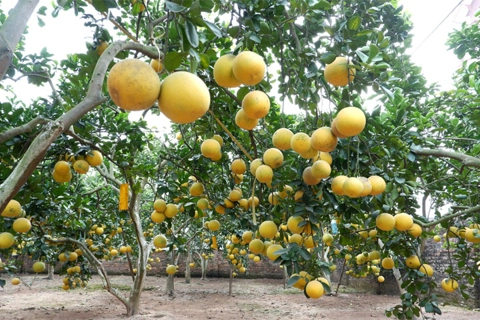
| Farmers in ancient Phu Dien Village harvest pomelos. Photo: Huy Pham/The Hanoi Times |
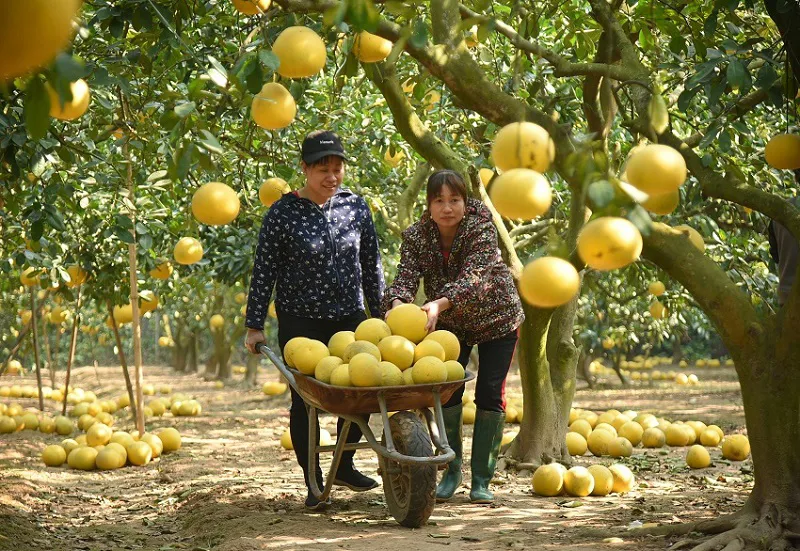
According to elders, Dien pomelos originated from the Doan Hung pomelo variety in Phu Tho Province. During a visit to Doan Hung District in the 20th century, a Dien villager asked for pomelo cuttings here and tried to plant them at home. The different soil properties, combined with a long time of natural cross-breeding, resulted in the Dien pomelo variety, which inherits both the advantages of Doan Hung pomelos and its own unique features.
In the past, the shift to pomelo cultivation was strongly resisted by ư the villagers who were familiar with rice planting. However, in accordance with President Ho Chi Minh's Testament and economic reforms, the Phu Dien Party Committee and the people made joint efforts to make Dien pomelo the main commodity.
Compared to the Doan Hung variety, Dien pomelos are superior in that their segments are firmer. They are also sweet and juicy, not bitter or sour like other varieties from southern Vietnam. In particular, the pomelo’s characteristic aroma is considered “unique” by many customers.
Nguyen Duc Tam, owner of a pomelo plantation for over 30 years in Phu Dien, the cultivation of pomelos here without the know-how and experience would lead to low-quality, unappealing fruits. Growing pomelos is a job that requires patience, as the best fruit only comes from trees that are at least 10 or 15 years old, and each tree gives 100 to 200 fruits a year.
| Dien pomelos are sweet and juicy. Photo: Huy Pham/The Hanoi Times |
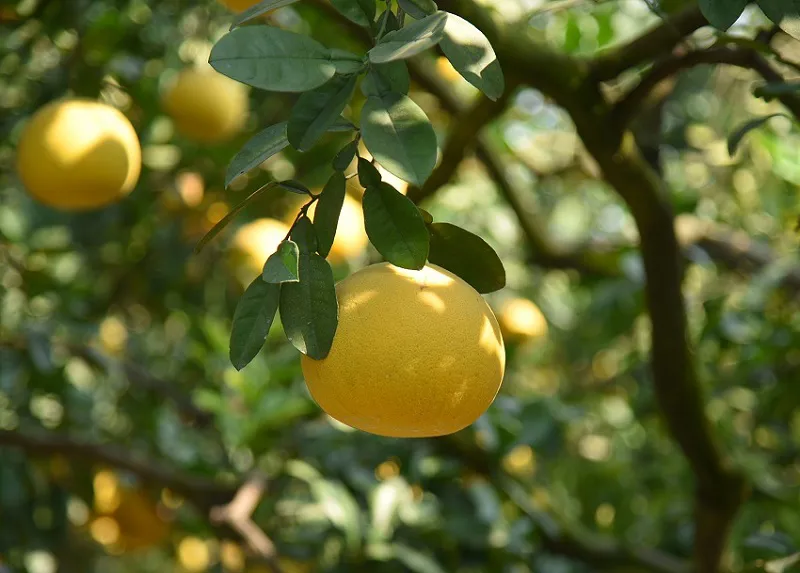
Thanks to Dien pomelos, the lives of Phu Dien villagers in particular and the people of the Dien area in general have improved significantly. For these locals, pomelo trees become an important cultural treasure.
Today, Dien pomelos have spread throughout the provinces and cities across the country, and are no longer a specialty unique to the land of Dien but the original taste should be found in Phu Dien Village.
![[Infographic] Five famous pho eateries in Hanoi](https://cdn-media.hanoitimes.vn/2023/04/24/Five_famous_Pho_eateries_in_Hanoi_thumb.png?w=480&h=320&q=100)