Madam Binh honored for contributions to Vietnam’s peace and diplomacy
The honor highlights Binh’s pivotal role as head of the Vietnamese delegation at the Paris Conference in the early 1970s, where she became a symbol of resilience and diplomacy on the global stage, and later as Vietnam’s first female Vice President.
THE HANOI TIMES — Former Vice President Nguyen Thi Binh, 98, has been awarded the prestigious title of “Hero of Labor” in recognition of her historic contributions to Vietnam’s national liberation and diplomacy.
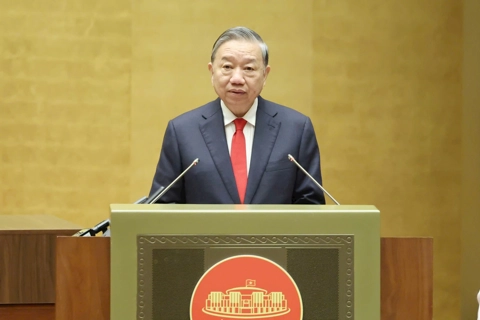
The award was presented on August 25 in Hanoi by Party General Secretary To Lam at the ceremony marking the 80th anniversary of Vietnam’s diplomatic sector (August 28, 1945 – August 28, 2025).
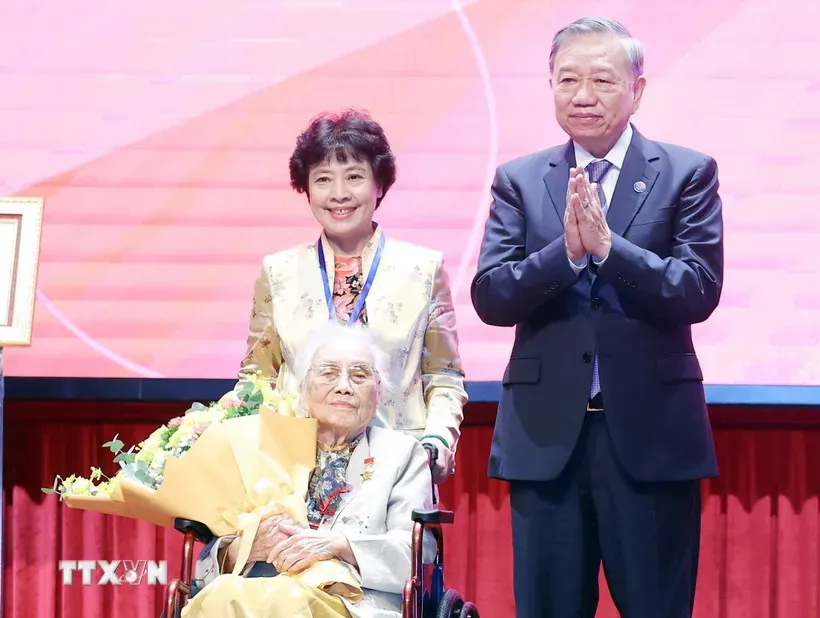
Party General Secretary To Lam presents the “Hero of Labor” title to Nguyen Thi Binh, former member of the Party Central Committee, former Vice President, and former Foreign Minister of the Provisional Revolutionary Government of the Republic of South Vietnam. Photo: Thong Nhat
Mrs. Binh, born Nguyen Thi Chau Sa in 1927 in the central province of Quang Nam, is a revered diplomat best known internationally as “Madame Binh.” From 1969 to 1973, she served as the Foreign Affairs Minister of the Provisional Revolutionary Government of the Republic of South Vietnam and led its delegation to the Paris Conference.
The signing of the Paris Peace Accords on January 27, 1973, which ended the war and paved the way for Vietnam’s reunification, is considered one of the greatest triumphs in the country’s diplomatic history. Her poised yet forceful arguments at the negotiating table became legendary, earning global admiration.
At the ceremony held in Hanoi on August 25, Mrs. Binh said the negotiations with the United States at the Paris Conference were among the most important events in the 80 years of Vietnamese diplomacy.
“Despite nearly five years of hardship, both our delegations worked closely together and fulfilled our mission," she recalled.
She said that the Paris Peace Accords were a “historic victory that led to the liberation of the South and the reunification of Vietnam.”
Looking to the future, the former Vice President expressed optimism as she witnessed Vietnam today enjoying peace, independence and unity, with a clear path of deep international integration and the goal of becoming a strong, prosperous and developed nation.
“With its proud 80-year tradition, I believe our diplomatic service will continue to grow, earning the trust of the Party, the State and the people,” said Mrs. Binh.
Mrs. Binh’s recognition highlights not only her personal contributions but also the enduring strength of Vietnam’s diplomatic tradition, one that continues to play a vital role in shaping the country’s path forward.
A Heart for the Nation – the imprint of Madam Binh
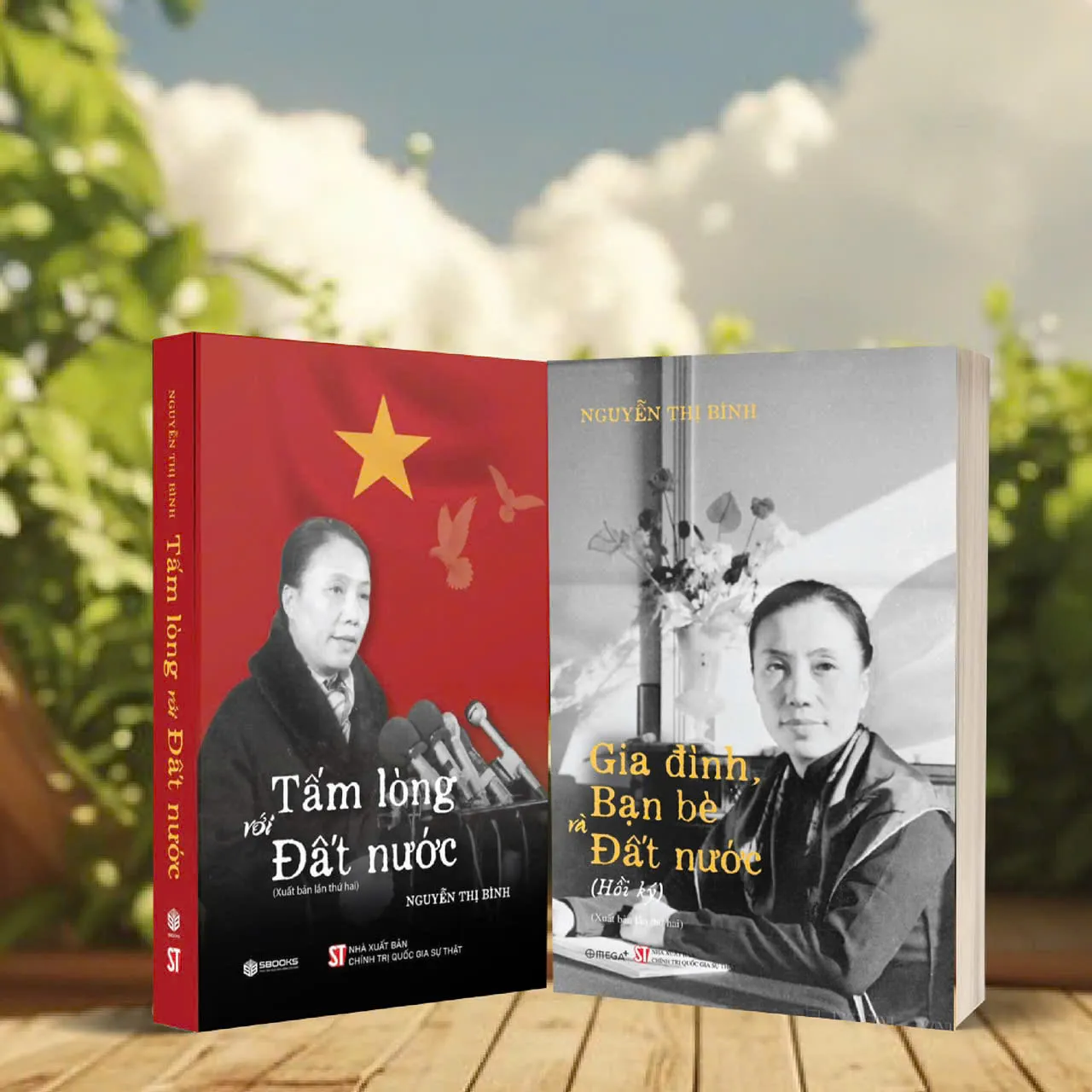
The book Tam long voi Dat nuoc (A Heart for the Nation", left, and the memoir Gia dinh, Ban be va Dat nuoc (Family, Friends and the Country) reflect Nguyen Thi Binh’s lasting imprint throughout her lifelong dedication to the Vietnamese revolution. Photo: hanoimoi.com
The book A Heart for the Nation, republished in 2025 by the National Political Publishing House (Su That) and exclusively distributed by Sbooks, is a powerful anthology of writings, speeches, and interviews by former Vice President Nguyen Thi Binh, spanning her lifelong dedication to Vietnam’s revolutionary cause.
Covering more than 600 pages and divided into three main sections, the volume takes readers on a journey from diplomacy to education, from the struggle for independence to the building of a nation.
Its pages resonate with sincerity, depth and historical weight, reflecting the mindset of a leader with strategic vision, profound humanity, and an unwavering devotion to Vietnam and its people.
One of the book’s most compelling sections revisits the Paris Conference, a watershed in Vietnam’s diplomatic history. As head of the delegation of the National Liberation Front of South Vietnam and the Provisional Revolutionary Government, Nguyen Thi Binh was the only woman at the negotiating table.
“In the history of world diplomacy, the Paris Conference on Vietnam, from May 1968 to January 1973, was the longest negotiations to end a war in the 20th century,” she said.
With over 200 public sessions, 45 high-level private meetings, 500 press conferences and 1,000 interviews, the numbers alone reveal not only the intensity of the diplomatic battlefield but also the persistence, resilience and intellect of Vietnam’s revolutionary diplomacy.
Yet Mrs. Binh’s legacy extends beyond diplomacy. From 1976 to 1987, as Minister of Education in the aftermath of war, she left an indelible mark on the nation’s schools.
Under her leadership, Vietnam for the first time designated November 20 as Vietnamese Teachers’ Day, while honorary titles such as “People’s Teacher” and “Outstanding Teacher” were formally recognized.
These policies both honored educators and reflected her vision of placing people at the center of national development, with education as the cornerstone of sustainable growth.
The book’s appeal also lies in its personal moments, quiet reflections and private struggles intertwined with the nation’s collective journey.
In 1992, when nominated for the post of Vice President, she initially declined, having prepared for retirement. But she asked herself, “Whatever I do, it is for the country, not for any other purpose.” This simple answer captures the ethic of service and the lifelong sense of responsibility of a revolutionary who gave everything without seeking personal gain.
Her memoirs are not self-congratulatory. Instead, they embody humanism and civic duty. “My life is tied to the life of the nation,” she wrote. “I see our country as a ship. After navigating many rapids, the ship of the Fatherland has reached the open sea, with a new horizon ahead.”
A Heart for the Nation also reflects Mrs. Binh’s political style, which is closed to the people, simple in manner, yet sharp in thought and steadfast in principle. Across its pages, she addresses critical issues such as judicial reform, building a state governed by law and advancing women’s leadership in national governance.
Her insights are presented not as abstract theory, but as lessons distilled from lived experience, grounded in empathy and responsibility as a citizen deeply invested in the nation’s destiny.
Perhaps most inspiring is the book’s message for the future. Even in her 90s, Mrs. Binh continues to write articles, attend forums, campaign for children’s and educational funds, advocate for peace and contribute policy advice - never ceasing her service.
A Heart for the Nation is not only a memoir but also a testament to a life lived in service, a wellspring of inspiration for future generations, and a reminder of the enduring strength of Vietnam’s diplomacy, education and spirit.