National Single Window betters administrative procedure settlement in Vietnam
The implementation of the National Single Window helps save costs for enterprises for almost all procedures compared to the previous traditional approach.
The implementation of the National Single Window (NSW) shortens the time needed to carry out administrative procedures (APs) in Vietnam, according to Dau Anh Tuan, director of the Legal Department under the Vietnam Chamber of Commerce and Industry (VCCI).
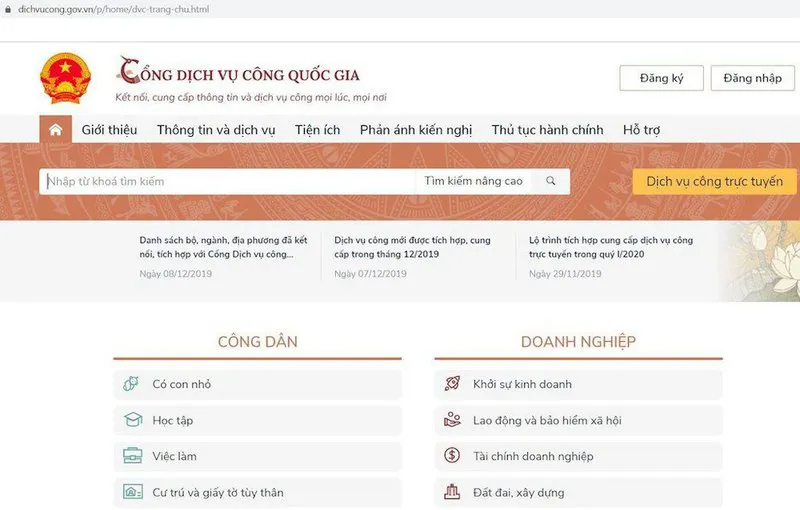
| Interface of the NSW portal. |
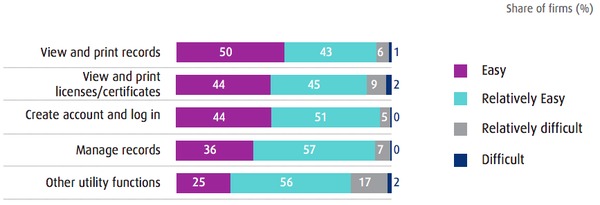
“While there are still technical issues, more than 90% of the businesses having tried the fundamental functions of the NSW rated them as easy/relatively easy to use,” Tuan said at the launch of the report assessing businesses' satisfaction with APs carried out through the NSW, a joint effort of the VCCI, the Ministry of Finance and the USAID Trade Facilitation Program, on June 22.
| Comparison of the general level of ease among functional groups. |
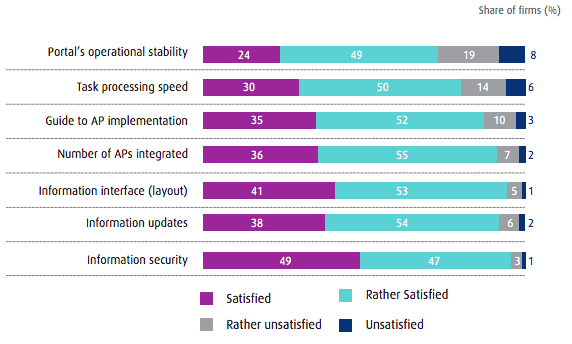
However, Tuan suggested the NSW portal needs to upgrade its technical infrastructure. Specifically, about 27% of enterprises were not satisfied with the unstable performance of the portal due to connection errors. About 20% of them deemed that the processing speed was slow. Other issues, such as unclear guidance on APs, low number of APs being incorporated into the portal, confusing interface, or infrequent updates, were also mentioned. However, the percentage of dissatisfied businesses is low (between 9% and 13%).
According to the report, the 12 APs most frequently conducted on the NSW portal of five ministries and agencies that were chosen for assessment are the Ministry of Industry and Trade (MoIT), Ministry of Transport (MoT), Ministry of Agriculture and Rural Development (MARD), Ministry of Science and Technology (MoST), and Ministry of Health (MoH).
| Satisfaction level concerning selected technical specifications of the portal. |
With the NSW, the time spent by businesses has been reduced for 10 out of 12 APs. The number of days saved in comparison with the traditional approach is between one and three days, and the number of days for handling procedures is generally within the time limit prescribed in legal documents.
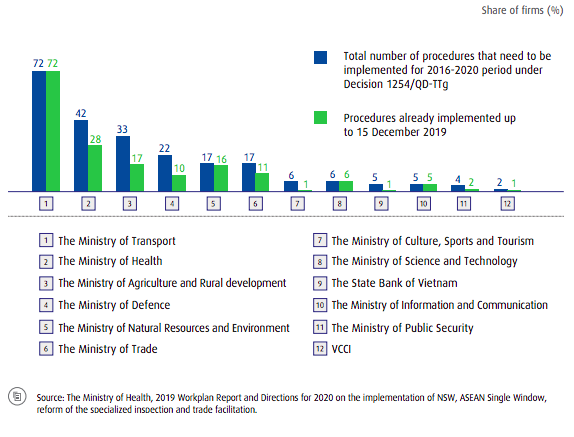
| Progress of integration of APs into the NSW by ministries/agencies. |
Contrary to the common trend, there is a considerable percentage of businesses saying time has not been shortened for carrying out two procedures of the MoH, namely “Issuing licenses to import medical equipment and appliances” and “Issuing receipt numbers for the notification of imported cosmetic products.” The median number of days required for an enterprise applying for “licenses to import medical equipment and appliances” is still as long as 30 days.
| Comparison of numbers of working days when businesses implement APs by the traditional method and through the NSW portal. |
.png)
Meanwhile, the procedure for “issuing receipt numbers for the notification of imported cosmetic products” costs businesses an average of one day more compared to the direct filing of documents to MoH in person previously. More than half of the surveyed businesses did not get the last two procedures handled within the time limit set out in legal documents.
| Percentage of cost reductions as a result of implementation of each administrative procedure via the NSW Portal compared to the traditional method (%). |
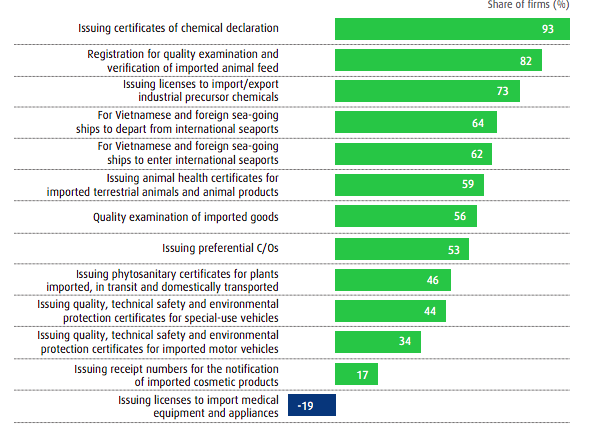
Tuan from VCCI commented that the implementation of the NSW also helps save costs for enterprises for almost all procedures compared to the previous traditional approach, thereby facilitating businesses in the course of completing international trade and transport procedures.
Costs have reduced by more than half for 8 APs, with the highest reduction for “issuing certificates of chemical declaration” (93% reduction), “registration for quality examination and verification of imported animal feed” (82% reduction), or “issuing licenses to export/import industrial precursor chemicals” (73% reduction). Meanwhile, “issuing licenses to import medical equipment and appliances” is the only AP countering the trend when the cost increased by 19% on average compared to that of the traditional approach.
E-payment required on NSW
To ensure greater efficiency of NSW, Tuan said it is essential for e-payment to be integrated into the portal.
| Level of businesses’ readiness for e-payments. |
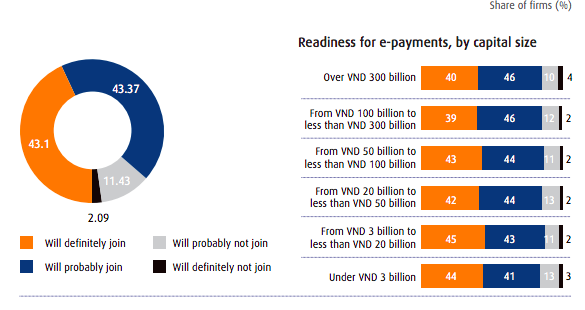
In reality, it has become more and more common for enterprises to use e-payment in business transactions (86% of enterprises), yet at present they still use cash quite frequently in administrative transactions with state authorities.
Moreover, 86,48% of businesses reported that they would certainly be “ready to participate” or “may participate immediately” if the NSW portal applies e-payment. A majority of businesses selected the year 2020 as a suitable time for implementation of e-payment (71.31%). 19.04% of businesses thought the year 2021 would be suitable, and only 9.66% of them selected a point in time after 2021.
Value-added services should also be added to the NSW portal, such as partner search, connected industries, and logistics services to support entities in joining the commodity and service value chain.
Ministries and agencies are suggested to continue implementing solutions that facilitate smooth application of APs on the NSW Portal, Tuan said, in which promoting administrative reform and reducing business compliance costs should continue to be considered the focus.
Collection of data started from end-November 2019 to mid-January 2020 with 3,085 valid responses received from businesses, among which 70% are domestic private businesses, foreign invested enterprises made up 28%, and approximately 2% are state-owned enterprises. Small-scale businesses with less than 50 employees or with registered capital of under VND20 billion (US$854,700) account for 60% of the respondents. Also, among the respondents, more than 80% of them are import-export enterprises, and the less popular field of business is logistics services or customs brokerage. About 53% of enterprises have more than two years’ experience in carrying out APs through the NSW portal. APs are mostly conducted by businesses themselves instead of authorizing a third party, and this is common for two-thirds of the surveyed enterprises. |