New step in Vietnam-US legacy of war settlement
War legacy remediation lays the groundwork for Vietnam-US relations, showcasing reconciliation and reinforcing the Comprehensive Strategic Partnership.
THE HANOI TIMES — As the two countries celebrate 30 years of diplomatic relations, Vietnam and the US have opened a cutting-edge DNA laboratory in Hanoi, reinforcing their strategic partnership.
This laboratory is part of their efforts to address the war legacy, one of the key pillars of their relations.

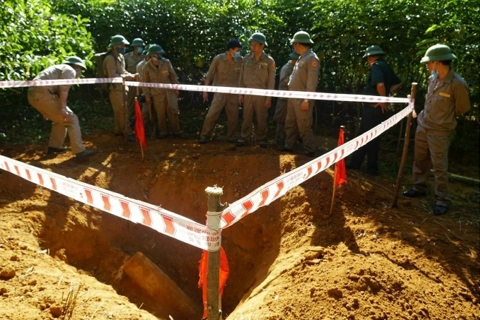
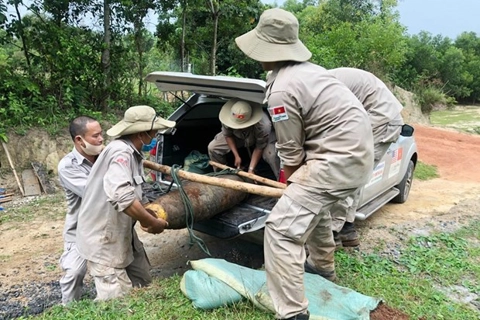
Unexploded ordnance clearance is one of key activities in addressing the US-Vietnam war legacy. Photo: Corps No.12
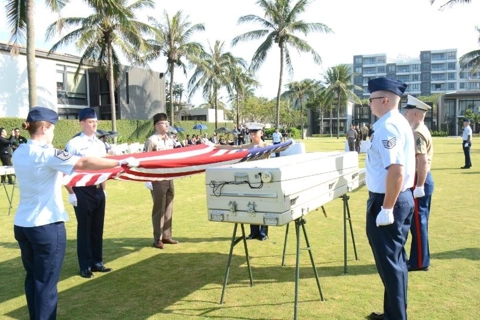
The laboratory marks a groundbreaking step in identifying the remains of Vietnam’s wartime missing.
With the US government funding for equipment and training by the International Commission on Missing Persons (ICMP), the facility reflects the power of science and technology in fostering healing and advancing the two countries’ shared commitment to reconciliation.
A new DNA identification lab at the Vietnam Academy of Science and Technology (VAST) in Hanoi was inaugurated with the attendance of US Ambassador Marc Knapper, US Defense POW/MIA Agency Director Kelly McKeague, VAST Vice President Chu Hoang Ha, and senior officials from key Vietnamese ministries and agencies involved in identifying fallen soldiers’ remains.
“This facility is a testament to what our partnership can achieve,” noted Ambassador Knapper. “As our nations celebrate 30 years of bilateral relations, we reaffirm our shared commitment to addressing war legacies, using cooperation in science and technology to bring answers to families.”
The new laboratory’s advanced DNA analysis will help Vietnamese scientists identify severely degraded remains, including those from high-acidity soil, bringing long-awaited closure to families of the war missing.
In the coming months, the International Commission on Missing Persons (ICMP) will continue training VAST scientists in applying these advanced methods, ensuring the lab becomes a lasting asset in Vietnam’s efforts to identify its fallen.
The lab’s inauguration marks a step forward in addressing wartime legacies, reflecting growing US-Vietnam cooperation built on trust, respect, and a shared commitment to reconciliation.

The launch of the Ba Vi Humanitarian Mine Action Demolition Training Range with the attendance of US Ambassador Marc Knapper (in suits) and Vietnamese offcers. Photo: The US Embassy in Hanoi
Reinforcing joint efforts in addressing war legacy
In a further development, the Ba Vi Humanitarian Mine Action Demolition Training Range (Ba Vi Range) has been handed over to the Vietnam People’s Army to improve Vietnamese unexploded ordnance (UXO) clearance capabilities, a significant stride for both countries in addressing war legacies.
The US$700,000, two-hectare Ba Vi Humanitarian Mine Action Demolition Training Range complies with International Mine Action Standards (IMAS) and designed to train personnel for mine clearance operations in support of Vietnam’s National Program 504.
Speaking at the ceremony in Hanoi, Maj. Gen. Lance Okamura of the US Army Pacific highlighted the range’s role in boosting Vietnam’s capacity for explosive ordnance disposal. Since 2016, the US Army Pacific has supported the Vietnam Mine Action Center (VNMAC) through training and technical assistance.
Senior Lt. Gen. Phung Si Tan reaffirmed that UXO cooperation remains central to advancing the Vietnam–US Comprehensive Strategic Partnership. Ambassador Marc Knapper said the project reflects shared efforts to make Vietnam and the world safer, and acknowledged Vietnam’s growing contribution to global UXO response.
Since 1993, the US has provided over US$250 million for UXO clearance and related programs in Vietnam. These efforts, launched under a 2013 MOU and expanded in a 2023 cooperation plan, have saved lives and improved conditions in central provinces.
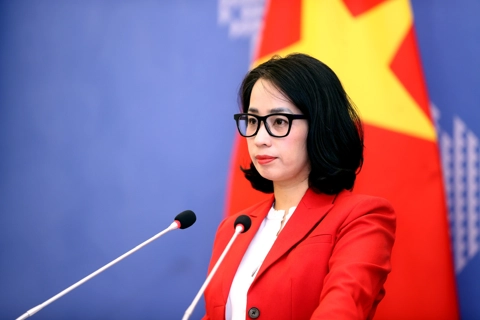
At a press briefing on March 20, Foreign Ministry spokeswoman Pham Thu Hang called war legacy cooperation a cornerstone of reconciliation and trust-building. Key initiatives include dioxin cleanup at Bien Hoa and Danang airports, UXO clearance in Quang Tri and Quang Binh, and support for victims of Agent Orange and UXOs.
The Bien Hoa cleanup project, launched in 2019, is the largest of its kind, valued at over US$450 million. Danang’s remediation was completed in 2018, treating 90,000 cubic meters of toxic soil.
The US also partners with organizations like MAG and NPA in clearing UXOs and funds rehabilitation and livelihoods programs for those affected by wartime legacies.