Ngo Tu Ha - a senior member of the first National Assembly (Part I)
Ngo Tu Ha (1882 - 1973) was one of the first and most important members of the first National Assembly.
Ngo Tu Ha owned the Ngo Tu Ha printing house where the first banknote with the image of President Ho Chi Minh was minted. Ha was one of the most senior deputies of the first National Assembly, a member of the Standing Committee of the legislative body, and the person who read the manifesto of the first National Assembly on March 2, 1946.
From a craftsman to a bourgeois
| The portrait of Vietnamese bourgeois Ngo Tu Ha (1822-1973)/ Documentary photo |
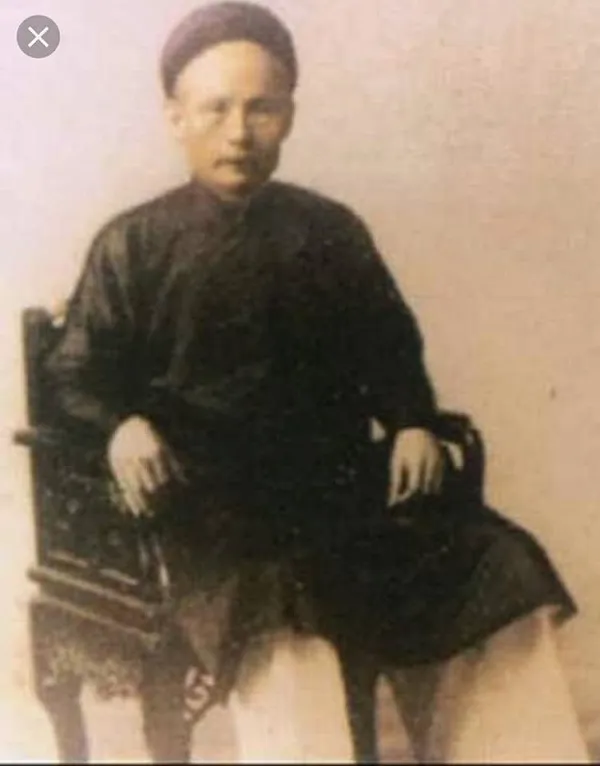
How Ha became a bourgeois was a fascinating story that many people admired and took as a good example. Moreover, he had a great heart for the country and people. Ha donated a lot of his assets to the state, mostly real estate in Hanoi, including the house at 24 - 48 Ly Quoc Su Street, the house at 2/12 Ngo Huyen Street (with an area of more than 2,200sqm), the house at 60 Nguyen Du Street (more than 1,000sqm), the house at 8 Ly Quoc Su Street (84sqm), the house at 4, 339 Thinh Yen Street (more than 2,200sqm), and the house at 31 Hang Bong Street (182sqm).
Before 1945, he also had a printing house in Hue and planned to open another in Saigon. Ngo Tu Ha was a large bourgeois of Hanoi at that time and was voted as one of the 300 most famous people of Indochina in the 1940s by the local Nam Phong newspaper.
A poor young Christian who started his career empty-handed, but with much effort, hard work, and intelligence, he became a successful businessman. Ha's life story was admired by many people.
Ha was born in a peasant family in Quy Hau village, Kim Son district, Ninh Binh province. His mother was skilled at raising silkworms which generated a stable income for the family and supported her children’s schooling.
Ha attended a catholic school where he proved to be a smart boy with a great memory and very good French skills. He was appreciated by priests for his excellent academic results. Instead of accepting a simple life in the poor countryside, at the age of 17, Ha left his home village to Hanoi to study printing at the IDEO Printing House in Hanoi.
The IDEO Printing House was the largest and most modern French printing house in Indochina at that time. Thanks to his intelligence and patience, Ha became a famous printer in Hanoi. He also tried to learn printing house management skills.
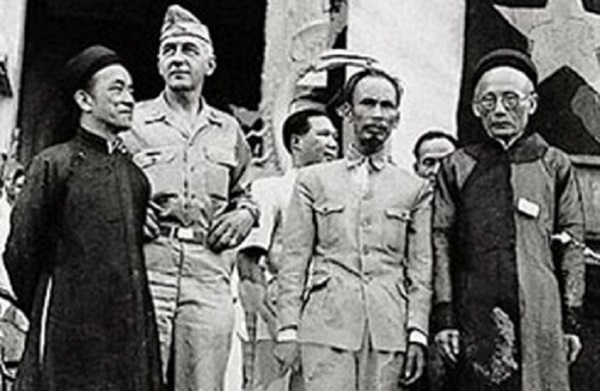
| Ngo Tu Ha (first right) joined in a photo with President Ho Chi Minh/ Documentary photo |
In 1911, Ha decided to open a small printing house on Hang Gai street. After a while, he bought land and set up a larger printing house at 24 Ly Quoc Su street (previously known as Lamblot Street), thanks to his savings and the large support of his family.
When Ha started his business, right after a large shipment of paper and ink arrived in Hanoi from France, the World War I broke out, leading to the closure of the Suez Canal and difficulties for trade between Europe and Asia. Paper prices surged.
Under the circumstance, thanks to the good management of the printing house and printing quality, competitive prices, and his wide network, Ngo Tu Ha printing house attracted many customers, both Vietnamese and French. Ha became the leader of the printing industry in Vietnam at that time.
A famous philanthropist
When he had financial stability, Ha devoted himself to many social activities, movements, and charity for the poor.
Trinh Van Duong, Ha´s grandson, recalls: “Before 1945, he used to go out to socialize, do charity during the day and only return to the printing house late at night. He only slept one or two hours and spent the rest of time on work at the printing house.”
Even though he was busy at work he was very interested in the education of the people, especially the poor. He joined scholar Nguyen Van To’s Association for the Dissemination of the National Language. After the success of the August Revolution in 1945, he participated in the popular education movement launched by President Ho Chi Minh to eradicate illiteracy. His printing house printed a large number of textbooks for the movement.
| Ngo Tu Ha gave a speech at the launching ceremony of the 'Hunger relief campaign' in Hanoi in early 1946/ Documentary photo |
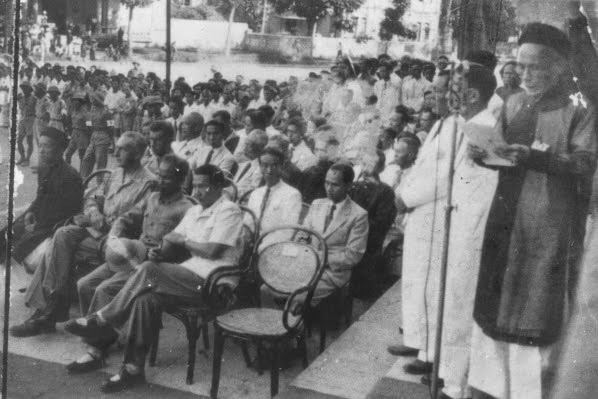
Ha had a warm heart for people. He initiated and participated in many charity activities. His descendants still keep photos of when he pulled a cart to lead a group on the streets of Hanoi to raise money for the hungry and when he and President Ho Chi Minh attended a Mass at Hanoi´s St. Joseph´s Cathedral praying for about two million people who starved to death in the famine in 1945. From the North to the South of the country, Ha´s checks were sent to orphans and poor widows. He also mobilized businesses to do charity so that he was loved and respected by a lot of people.
With his reputation in the printing industry, Ha developed connections with intellectuals and scholars at that time like Pham Quynh, Nguyen Van Vinh, Mai Dang De, Nguyen Van To, Tan Da, Nguyen Khac Hieu, and so on. For them, he was both a good friend and a generous sponsor. His printing house helped scholars and researchers print their books and works. In particular, Dong Thanh Magazine of Ngo Tu Ha printing house was a gathering place for many famous journalists and writers of progressive articles and researches, contributing to affirming Oriental and Vietnamese cultural values.
From a printing businessman to a prominent national bourgeois, Ha became famous among the intellectuals and even French colonial officials. He joined the Viet Minh (League for the Independence of Vietnam), became an advisor to President Ho Chi Minh, was elected a member of the first National Assembly, and read the Manifesto of the National Assembly, making his patriotic career successful and admirable.