Pioneering breakthroughs in a new era for a modern, civilized and happy Hanoi
The 18th Congress of the Hanoi Party Committee marks a decisive milestone for the capital, affirming its pioneering role in Vietnam’s journey toward prosperity, modernization and happiness.
THE HANOI TIMES — Hanoi is the heart of the nation and the flagbearer of renewal, where Vietnam’s aspiration for strength, prosperity and happiness begins. In that special meaning, the 18th Congress of the Hanoi Party Committee, held from October 15 to October 17, 2025, is a major political event for the Party, government, armed forces and people of the capital.
With the motto “Solidarity – Democracy – Discipline – Breakthrough – Development,” the congress aims to uphold Hanoi’s thousand-year tradition of culture and heroism, build a strong and transparent Party, pioneer breakthroughs in the new era and shape a modern, civilized and happy capital, contributing significantly to achieving Vietnam’s two centennial goals.
The Hanoi Times presents an article on this topic by Bui Thi Minh Hoai, Politburo member, Secretary of the Hanoi Party Committee and Head of the Hanoi National Assembly Delegation.
Building new momentum for the capital in a new era
In its history, from landmarks namely the national independence (1945), the city's Liberation Day (1954) and Doi moi (Renewal in 1986), under the Party’s leadership, Hanoi has steadily grown into the national political and administrative center, the heart of the country and a major hub of economy, culture, education, science, technology and international integration.
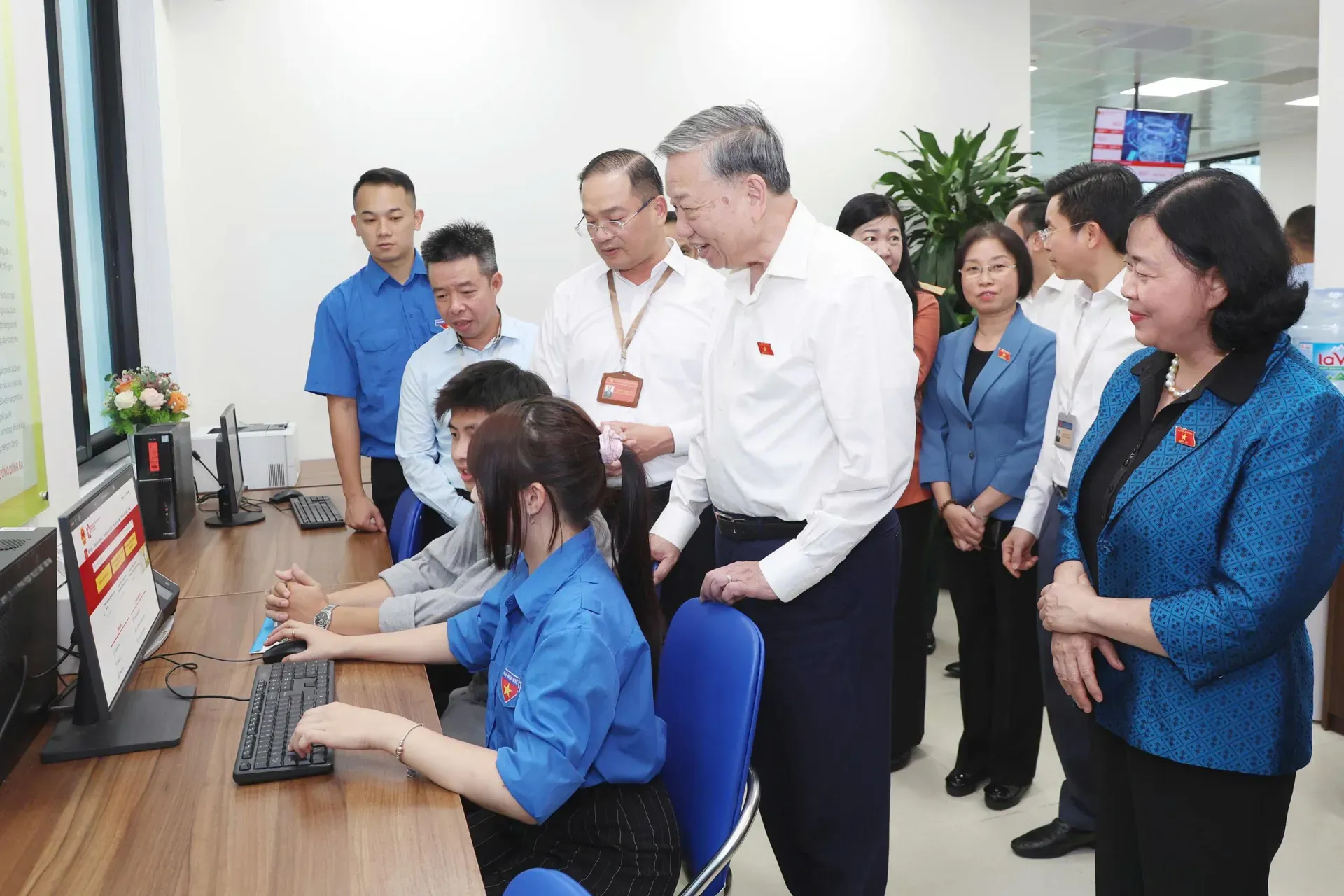
Party General Secretary To Lam and Secretary of the Hanoi Party Committee Bui Thi Minh Hoai visit a public administrative service center in Dong Da Ward. Photo: Thanh Hai/The Hanoi Times
During this proud journey, despite greater-than-expected challenges, the city’s Party, government, armed forces and people united to implement the 17th Congress Resolution, achieving comprehensive and positive results, with 16 out of 20 targets completed, including four ahead of schedule by one to two years.
Building a strong and transparent Party organization is the root of public trust as the capital’s strength comes from both the people and the Party. During the term, Party building and political system reform saw practical innovations suited to Hanoi’s conditions.
Political, ideological and ethical education emphasized integrity and responsibility. The city renewed approaches to public engagement, reflected in thousands of effective “smart mass mobilization” models based on the principle that “the people are the foundation.”
Cadre management reforms included digitalized personnel data and a merit-based placement system, guided by the principle “the right person for the right task”, measuring success by outcomes and citizen satisfaction.
Hanoi exceeded its targets for new Party membership and led the country in recruiting student members – the “red seeds” of future leadership.
Inspection and supervision were strengthened, ensuring timely and strict action in complex cases assigned by the central government. Anti-corruption and anti-waste efforts continued “without rest or exceptions.”
As of August 22, 2025, the city had completed all 136 higher-level Party congresses for the 2025–2030 term ahead of schedule.
Leadership methods continued to evolve as Hanoi demonstrated pioneering thinking and decisive action centered on people’s happiness – a hallmark of a humane and modern capital.
The Hanoi Party Committee reviewed practice, studied theory and proposed policies to the central government, resulting in major documents such as Politburo Resolution No.15-NQ/TW (May 5, 2022) on Hanoi’s development to 2030, the Capital Law 2024, the Capital Master Plan for 2021–2030 with vision to 2050 and the Comprehensive Adjustment of the Capital’s General Planning to 2045 with vision to 2065.
Today, developing Hanoi goes beyond building a city. It is about nurturing the nation’s stature and spreading the Vietnamese aspiration in the new era.
Hanoi took the lead in restructuring administrative units, reducing from 526 to 126, with over 97% citizen approval.
The city’s economy averaged GRDP growth of 6.6% per year, 1.1 times higher than the national rate. Economic size reached about US$63 billion, 1.4 times higher than in 2020, accounting for 41.5% of the Red River Delta and 12.6% of the national economy. Its per capita income reached $7,200.
In new rural development, Hanoi completed its goals two years ahead of schedule, leading the country in this field.
Meanwhile, urban landscapes improved with expanding transport and social infrastructure. The city launched the Ring Road 4 project, operated two metro lines (Cat Linh–Ha Dong and Nhon–Hanoi Station elevated section) and started the Nam Thang Long–Tran Hung Dao line. Construction began on five new Red River bridges: Tu Lien, Ngoc Hoi, Van Phuc, Thuong Cat and Tran Hung Dao.
Hanoi’s breakthroughs lie not in size but in institutional vision, governance mindset and the innovative power of its people. The city leads the nation in IT industry index, e-governance and innovation capacity.
In terms of culture, Hanoi inaugurated Southeast Asia’s largest exhibition center and started building the Pearl Theater.
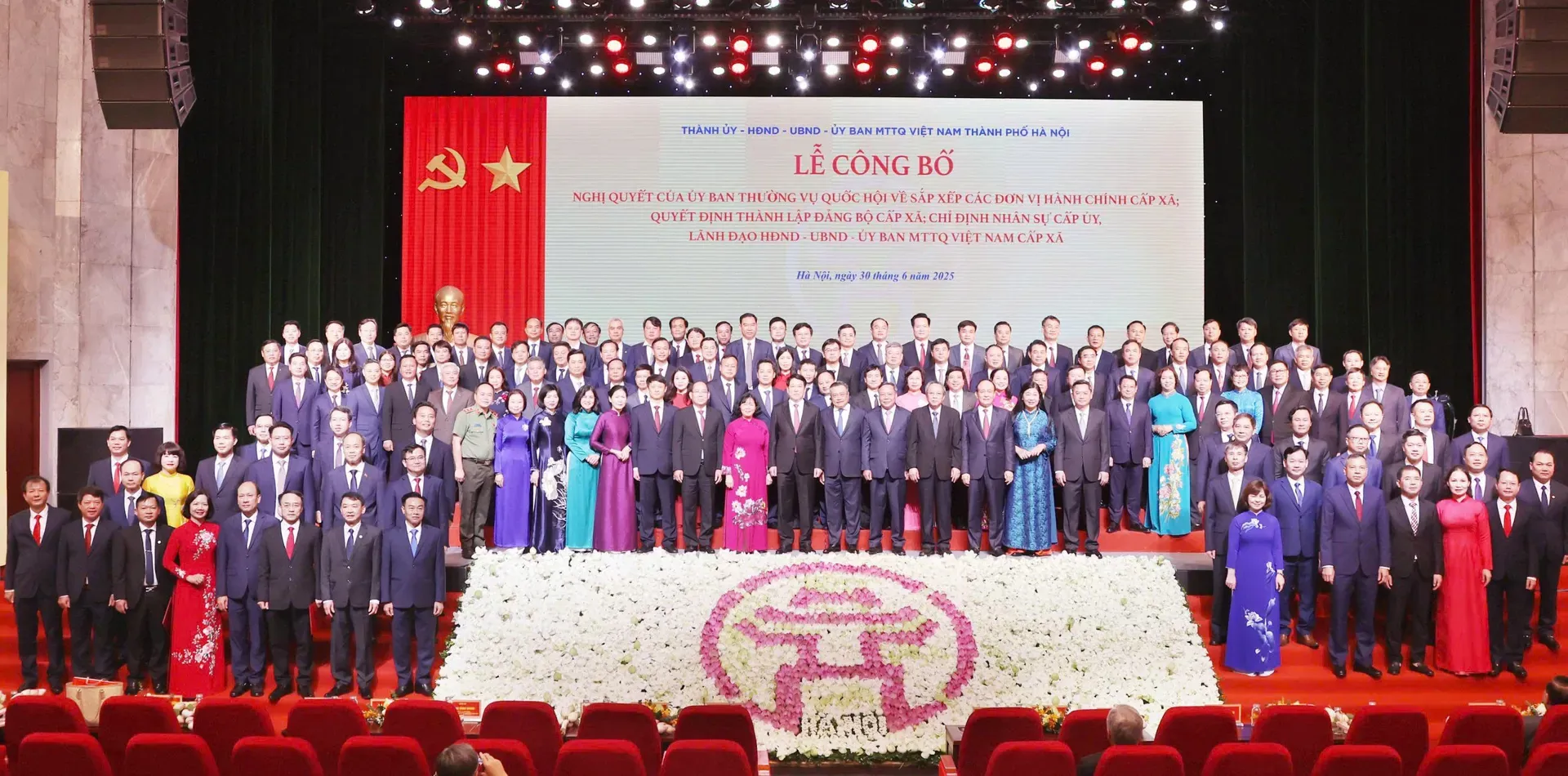
President Luong Cuong, Hanoi leaders and officials from 126 new wards and communes at the launch of the two-tier local government model on June 30. Photo: Thanh Hai/The Hanoi Times
Cultural and social development continued to advance. The Time Out magazine named Hanoi the world’s top cultural destination in 2025.
The city invested heavily in preserving heritage sites and maintained leading positions in healthcare and education. It eradicated multidimensional poverty in 2024, one year ahead of plan.
Placing people at the center of development, Hanoi now has the highest Human Development Index (HDI) nationwide at 0.829. Average life expectancy rose to 76.5 years, one year higher than in 2020.
Following directives from the central government and General Secretary To Lam, Hanoi became the first locality to fund daily school meals for primary students starting in the 2025–2026 school year.
The city also proved resilient in natural disasters and epidemics, notably during the Covid-19 pandemic and Typhoon Yagi in 2024.
Environmental protection remains a top priority. The city launched campaigns to promote hygiene and green living, introduced “urban forest” and “green city” models, expanded parks and gardens and resolved major waste issues with two waste-to-energy plants.
Notably, through bold and synchronized actions, Hanoi has gradually revived the To Lich River.
With the police and military as its core force, the city remains one of the country’s safest destinations.
Hanoi continues to push administrative reform, piloting a one-level Public Service Center to foster a reliable, investor-friendly environment.
The capital now carries the elegance of its millennia-old culture and the spirit of the modern era – graceful, compassionate, creative and responsible.
The grand parade celebrating the 80th anniversary of the August Revolution and National Day became a national festival, stirring pride and inspiration across the country.
While proud of its achievements, the city also recognizes existing shortcomings, which are clearly identified in the draft political report for the 18th Congress.
Building a “Civilized – Modern – Cultural” capital of peace and happiness
Entering a new stage of development, Hanoi faces both opportunities and challenges.
Bottlenecks in infrastructure, population aging, climate change, natural disasters, diseases and the four risks identified by the Party – backwardness, corruption, “peaceful evolution” and “self-evolution” – remain challenging.
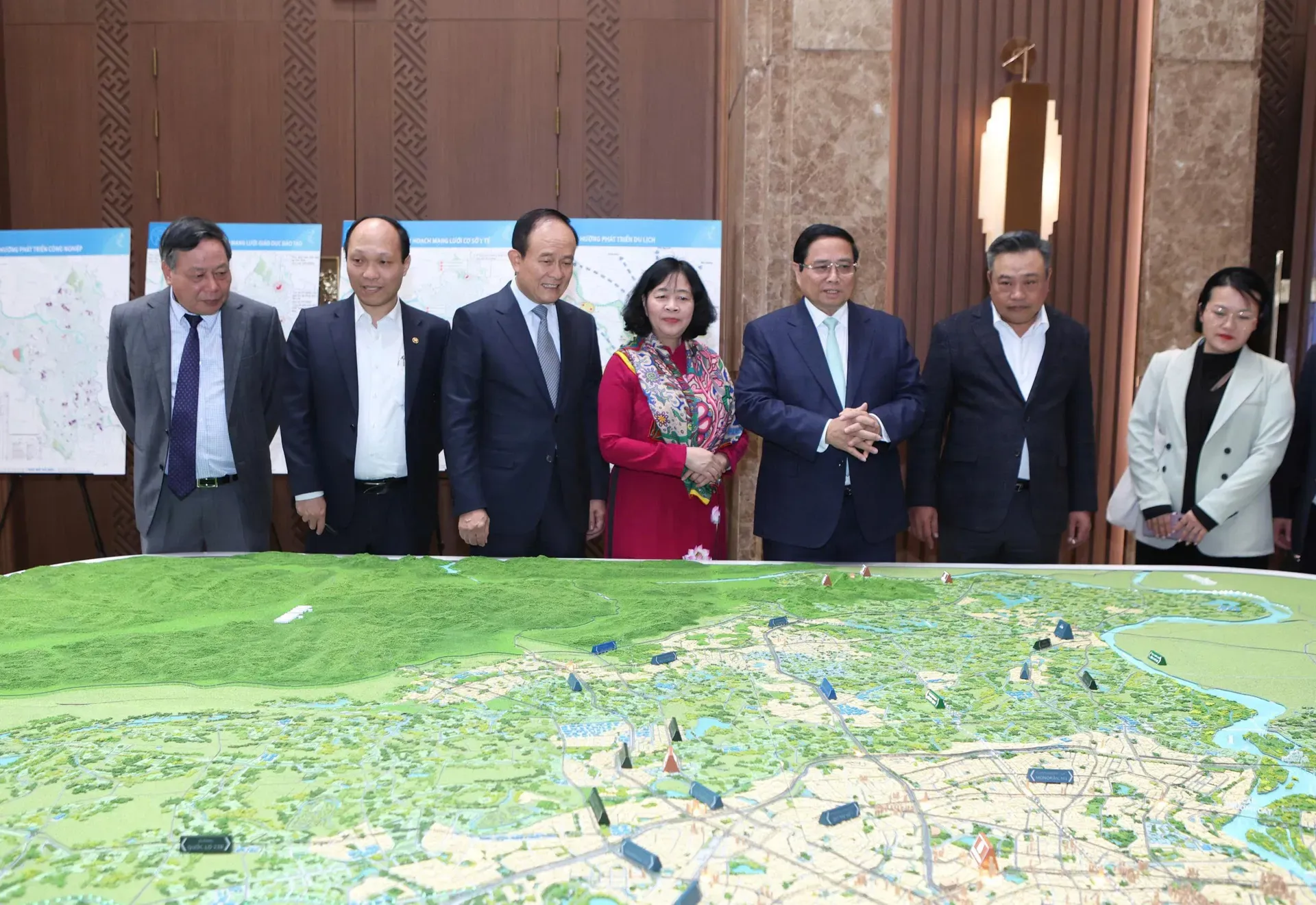
Prime Minister Pham Minh Chinh (third from right), Hanoi Party Chief Bui Thi Minh Hoai (center), Chairman of the Hanoi People's Committee Tran Sy Thanh (second from right) view the capital's future general planning model. Photo: The Hanoi Times
On August 21, during a Politburo meeting with the Hanoi Party Committee on draft documents and personnel proposals, General Secretary To Lam emphasized building a green, smart and livable capital attractive to both domestic and international communities.
Following that direction, Hanoi is implementing seven strategic Politburo resolutions, setting a vision for 2030: a “Civilized – Modern – Cultural” capital that is green, smart, a center of cultural convergence, deep international integration and regional competitiveness.
By then, Hanoi aims to become the growth engine of the Red River Delta and the northern region, a major economic and financial hub, a leading center for culture, education, health, science and innovation, a peaceful and prosperous city where people live happily.
Looking toward 2045, the city envisions becoming a globally-connected metropolis with high living standards, balanced and distinctive development and economic, cultural and social progress comparable to major capitals in the region and the world. The per capita GRDP target is over $36,000.
To achieve this, Hanoi has set 43 key targets by 2030 in economics, society, urban environment and Party building.
The city strives for GRDP growth of at least 11% annually, per capita GRDP over $12,000, a digital economy contributing 40% of GRDP and cultural industries about 8%. Total social investment is expected to reach VND5 quadrillion ($190 billion).
The Human Development Index (HDI) is projected at 0.88, the Happiness Index (HPI) at 9/10 and at least 80% of workers trained.
The city also plans to recruit at least 11,000 new Party members yearly, with over 90% of Party members and organizations performing well.
With a new global mindset and a “Hanoi way” of action, the Political Report for the 18th Congress identifies 10 key tasks and three strategic breakthroughs.
The first is to lead in building an efficient, transparent and people-oriented government.
The city will finalize the implementation of the Capital Law and develop policies to remove bottlenecks, mobilize resources and boost development.
Hanoi will pilot new mechanisms in science, technology, innovation, digital transformation, private economy, education and healthcare.
Decentralization and delegation will follow the principle “local authority decides, implements and takes responsibility.”
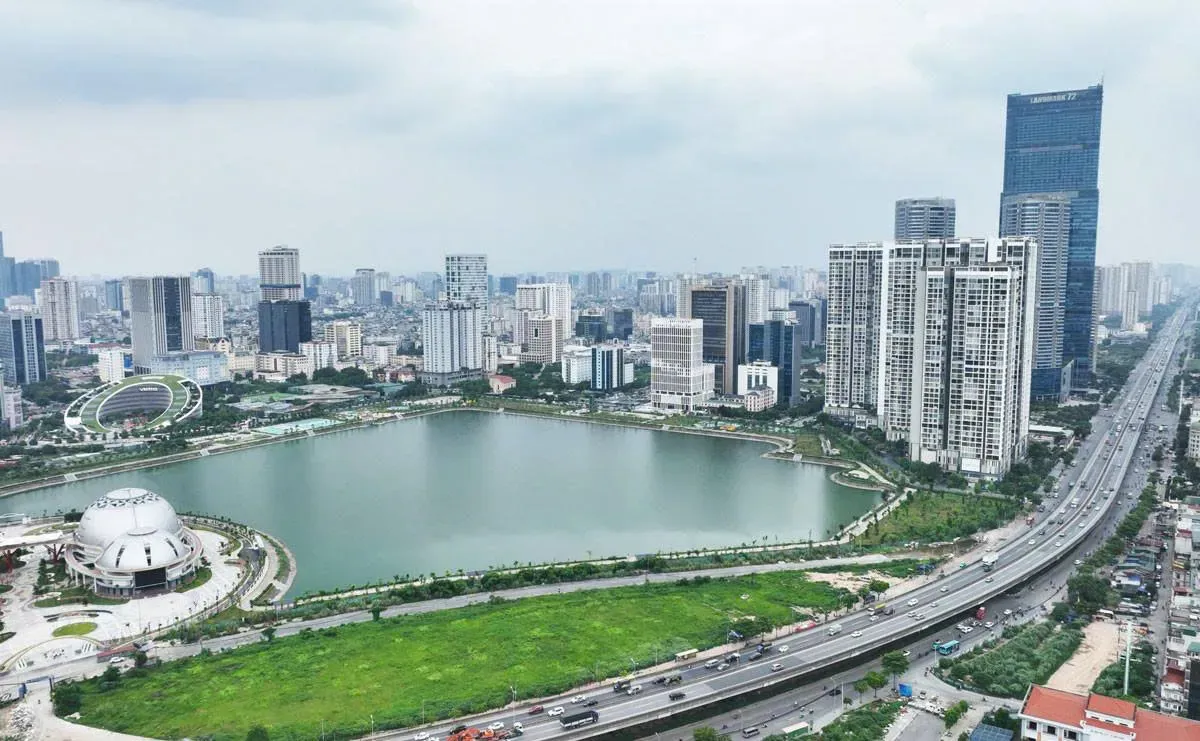
The view of Ring Road 3 running through Tu Liem Ward. Photo: The Hanoi Times
The second breakthrough is to develop and effectively use high-quality human resources and attract talent.
Hanoi focuses on building a team of leaders with vision, dedication and strategic thinking, encouraged to innovate and take responsibility for the common good.
The city will also attract top managers, scientists, experts and skilled workers both domestically and abroad in both public and private sectors.
The third breakthrough is to modernize infrastructure with smart, connected systems.
Hanoi will develop integrated transport networks linking urban and satellite areas and neighboring provinces, build logistics hubs, promote Transit-Oriented Development (TOD) and expand underground spaces.
It will also build digital, scientific and innovation infrastructure with large, connected databases on planning, population, health, culture, education, insurance, land and housing, therefore forming a foundation for sustainable growth and competitiveness in the digital era.
With its pioneering mission in the new era, Hanoi is determined to realize the vision of a “Cultural Capital – Globally Connected – Elegant and Humane – Harmonious and Prosperous – Service-Oriented Government – Contributing Businesses – Trustful Society – Happy People.”
Resolutions must come with concrete actions, defined projects, clear responsibilities and specific timelines, following the “Six Clears” principle: clear people, clear tasks, clear time, clear responsibility, clear results and clear authority.
Every step forward by Hanoi spreads confidence across the nation and affirms Vietnam’s intellect and courage on the global stage.
From ancient Thang Long to today’s Hanoi, one spirit endures: daring to think, act and take responsibility for the people’s happiness.
With the guidance of the Party Central Committee and General Secretary To Lam, along with the support of ministries, provinces and the unity of the city’s Party, government and people, the 18th Congress of the Hanoi Party Committee (2025–2030 term) will be a glorious success, opening the path for the capital to pioneer the nation’s march into an era of prosperity and strength.
As the “City for Peace” and “Creative City”, Hanoi remains a symbol of faith, aspiration and the Vietnamese spirit in this era of national resurgence.
From the spirit of the 18th Congress, a new faith is rising – a belief in a modern yet graceful Hanoi, a dynamic yet culturally profound capital, a globally integrated city that fully preserves its Vietnamese soul.
“Pioneering – Breakthrough – Development – Happiness” is not just a goal but a solemn promise of today’s Hanoi for generations to come.