Prime Minister concludes successful Middle East and Africa trip
Prime Minister Pham Minh Chinh wrapped up a week-long overseas mission on November 23, after attending the G20 Summit and strengthening ties with partners in the Middle East and Africa.
THE HANOI TIMES — Prime Minister Pham Minh Chinh, his spouse Le Thi Bich Tran and the Vietnamese delegation departed South Africa for Hanoi early today (November 24), concluding their participation in the G20 Summit and bilateral activities in the country.
South Africa was the final stop on the Prime Minister’s official trip to Kuwait and Algeria, participation in the G20 Summit and bilateral activities in South Africa on November 16–24.
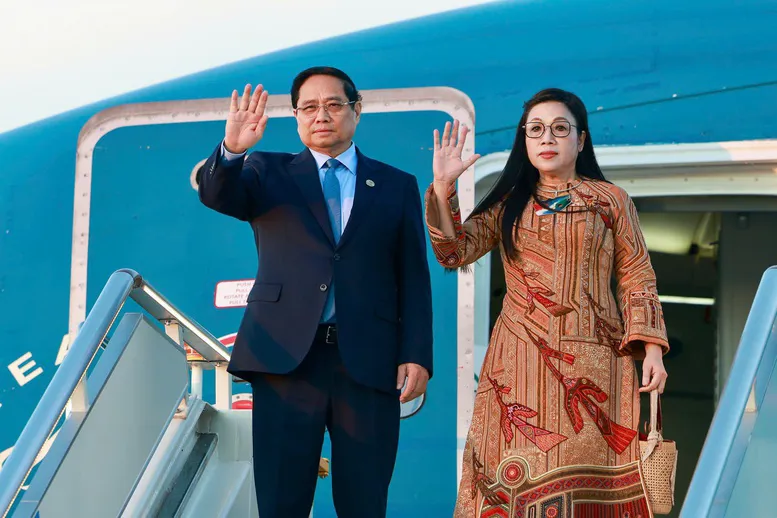
Prime Minister Pham Minh Chinh and his spouse Le Thi Bich Tran leave South Africa for Hanoi, ending a successful tour in Kuwait, Algeria and South Africa. Photos: VGP
The visits were made at the invitation of Kuwaiti Prime Minister Sheikh Ahmed Abdullah Al-Ahmad Al Sabah, Algerian Prime Minister Sifi Ghrieb and South African President Cyril Ramaphosa, Chair of the G20 in 2025.
The mission concluded successfully. The G20 Summit adopted a Leaders’ Joint Declaration and handed over the G20 Chairmanship from South Africa to the United States.
The active participation of the Vietnamese delegation, led by Prime Minister Pham Minh Chinh, contributed to the summit’s outcomes and highlighted Vietnam as a dynamic country committed to peace, cooperation and development in the region and the world.
At the third discussion session of the G20 Summit on November 23, themed “A Just and Fair Future for All”, Prime Minister Pham Minh Chinh identified three major global shifts: green transition, digital transformation and demographic and labor changes.
He said the rapid growth of science and technology, particularly artificial intelligence, is reshaping production methods and labor division, creating huge demand for energy and strategic minerals.
“These changes offer opportunities for countries to advance, but they also carry risks of supply chain disruptions and governance gaps. They require global cooperation and strong leadership from the G20,” he said.
To build a fair and inclusive future for nations and people around the world, the prime minister outlined three strategic priorities.
First, he called for fair, stable and transparent partnerships on strategic minerals with “harmonized interests and shared risks.”
He urged governments to strengthen cooperation, diversify sustainable mineral supply chains and develop deep-processing industries, high-tech manufacturing, recycling and quality jobs that meet environmental, social and governance standards, along with the need to advance high-quality human resource training aligned with modern, efficient and sustainable labor markets.
He urged the G20 to support developing countries in joining and benefiting from education cooperation initiatives, removing barriers and expanding regional and global labor market connections.
The Vietnamese prime minister also proposed global strategies, policies, programs and projects to train skilled workers, create jobs for young people and prepare the workforce for rapid and sustainable development.
The third priority is building an ecosystem for artificial intelligence that serves people without replacing them. He called on the G20 to lead in developing fair, transparent, inclusive, safe and human-centered AI governance standards.
Chinh also requested support for developing countries to build digital infrastructure, databases, technology ecosystems and AI governance capacity to ensure safe, inclusive and sustainable development.
“With the approach of listening and understanding, trusting and acting, developing and sharing, Vietnam is ready to cooperate closely with the G20 and the international community to turn these strategic priorities into concrete and practical programs and projects for shared prosperity,” he said.
At the summit, Prime Minister Pham Minh Chinh and other leaders discussed strategic issues such as strategic minerals, sustainable employment and artificial intelligence.
They noted that the demand for strategic minerals will increase with green and digital transition, while many developing countries have not benefited adequately from their own resources due to limited investment and technology.
Government leaders agreed to implement the G20 Strategic Minerals Framework to strengthen international cooperation and ensure transparent, safe and sustainable mineral supply chains.
They affirmed that sustainable, high-quality employment remains a core objective of growth and must be central to industrial policy.
The world’s top leaders committed to policies that expand job opportunities, education and vocational training for young people, especially those with limited access to development opportunities. They set a target to reduce the share of young people aged 15–29 who are not in school, employment or training by 5% by 2030.
On AI governance, leaders agreed to safeguard human rights, ensure transparency, fairness, responsibility, ethics, privacy and data protection. They recognized the role of the United Nations and relevant forums in promoting international cooperation on artificial intelligence.
The summit welcomed the “AI for Africa” Initiative to strengthen cooperation between the G20 and the African Union on AI.
Strengthening cooperation with partner nations
The mission strengthened political trust, deepened friendship and advanced cooperation between Vietnam and South Africa, Kuwait and Algeria, as well as countries across the Middle East and Africa.
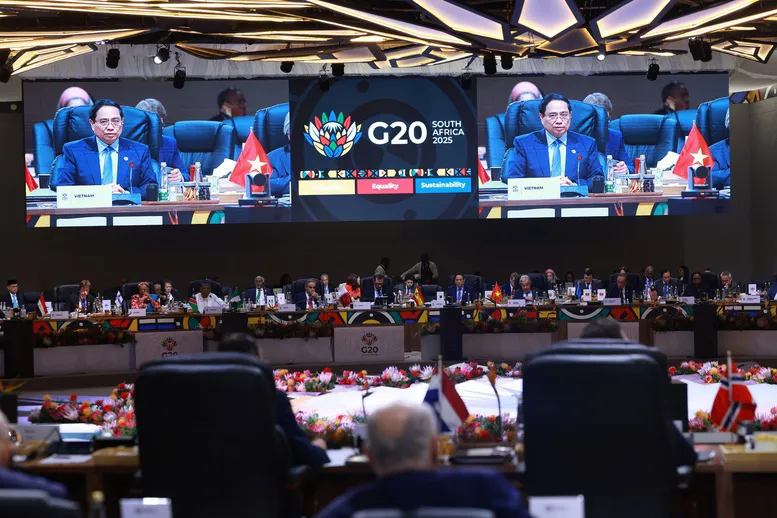
Prime Minister Pham Minh Chinh delivers his remarks at the G20 Summit's third discussion on November 23.
During the trip, Vietnam elevated its relations with Algeria and South Africa to Strategic Partnerships.
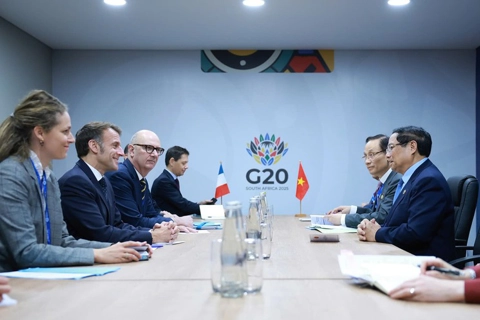
Prime Minister Pham Minh Chinh’s bilateral meetings at the G20 Summit supported the signing of agreements and frameworks for cooperation in trade, investment and other priority fields for both sides and expanded coordination at international organizations and multilateral forums.
Vietnam and Egypt will promote bilateral trade with a focus on tourism and agriculture to raise two-way trade to US$1 billion from $472 million in 2024. With Spain, Vietnam aims to increase the bilateral trade to around $8 billion in the near future.
Vietnam emphasized the importance of EU partners such as France, Germany, the Netherlands, Spain and Norway.
The Prime Minister urged these countries to soon ratify the EVIPA, accelerate EVFTA implementation, lift the IUU yellow card and expand cooperation in science and technology, innovation, digital transformation, green transition, sustainable development, environmental protection and climate response.
He also called for stronger people-to-people links, human resource development cooperation and support for Vietnamese communities abroad so they can contribute more to host countries and serve as bridges for bilateral relations.