Prime minister urges to start building $7.7 billion railway project in December
The $7.7 billion project aims to build a new modern and synchronized railway line that can meet domestic transportation demand and international transit between Vietnam and China.
THE HANOI TIMES — Prime Minister Pham Minh Chinh on September 7 tasked the Ministry of Construction with preparing the feasibility study report and commencing the Lao Cai–Hanoi–Haiphong railway project in mid-December.

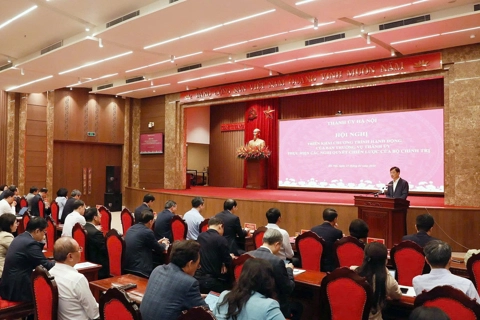
Prime Minister Pham Minh Chinh chairs a Sunday meeting on the Lao Cai-Hanoi-Haiphong railway project. Photo: VGP
He instructed the ministries of Foreign Affairs and Construction to work with Chinese government bodies to organize the first conference of the Vietnam–China Joint Railway Cooperation Committee.
Prime Minister Chinh called on the two ministries to ask for Chinese support in technical transfer, consultant selection, workforce training and the development of a railway industry complex.
The government leader also asked the ministries of Construction and Science and Technology to finalize and publish technical standards and regulations in October.
Chinh requested that the ministries of Construction and Agriculture and Environment resolve issues related to the route, land, forests and the environment, compile an environmental impact assessment and collaborate with local authorities to carry out proper land clearance.
He also directed the ministry to propose a financing mechansim for the project, which includes borrowing from the Asian Infrastructure Investment Bank (AIIB).
Deputy prime ministers will directly oversee specific related fields and the Office of the Government will keep track of the project progress. Prime Minister Chinh requested ministries and agencies to submit weekly reports on assigned tasks.
According to Resolution 187/2025/QH15 of the National Assembly, the Lao Cai–Hanoi–Haiphong railway will have a total length of about 419 kilometers and run through nine provinces and cities in the Northern Region.
The line will start from the rail connection at the border in the northern border province of Lao Cai and end at Lach Huyen Station in the port city of Haiphong. The total investment for the project exceeds VND203 trillion (US$7.7 billion).
The project has already begun large-scale land clearance along the route, aiming to build a new modern and synchronized railway line that can meet the demand for passenger and cargo transport between Vietnam and China.
It is expected to foster rapid and sustainable socio-economic development, strengthen connections within the national and regional railway network and ensure national defense and security.
The effective implementation of this railway line will play an important role in realizing the major socio-economic goals set out in the 13th Party Congress Documents and other key resolutions.
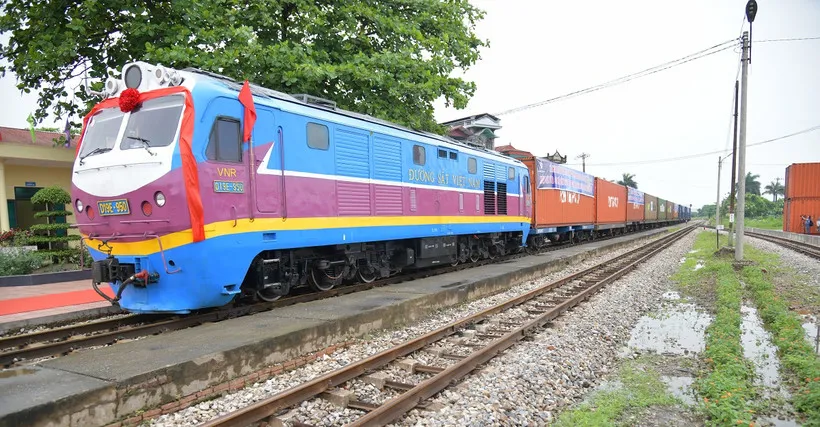
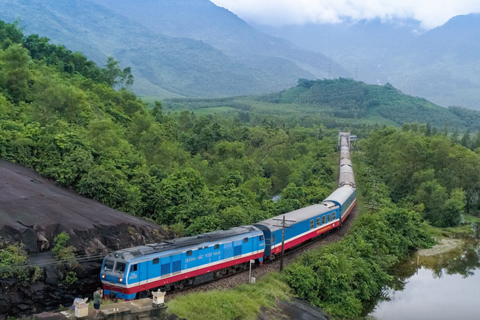
A freight train carrying export goods to China. Photo: Viet Hung/Vietnam+