Xi proposes boosting China–Vietnam railway cooperation
Both Vietnam and China pay much attention to standardize a cross-border railway network, which will boost two-way trade and cultural and people-to-people exchanges.
THE HANOI TIMES — Railway cooperation has become the main issue in meetings between Chinese Party General Secretary and President Xi Jinping and Vietnamese President Luong Cuong and Prime Minister Pham Minh Chinh over the past few days.
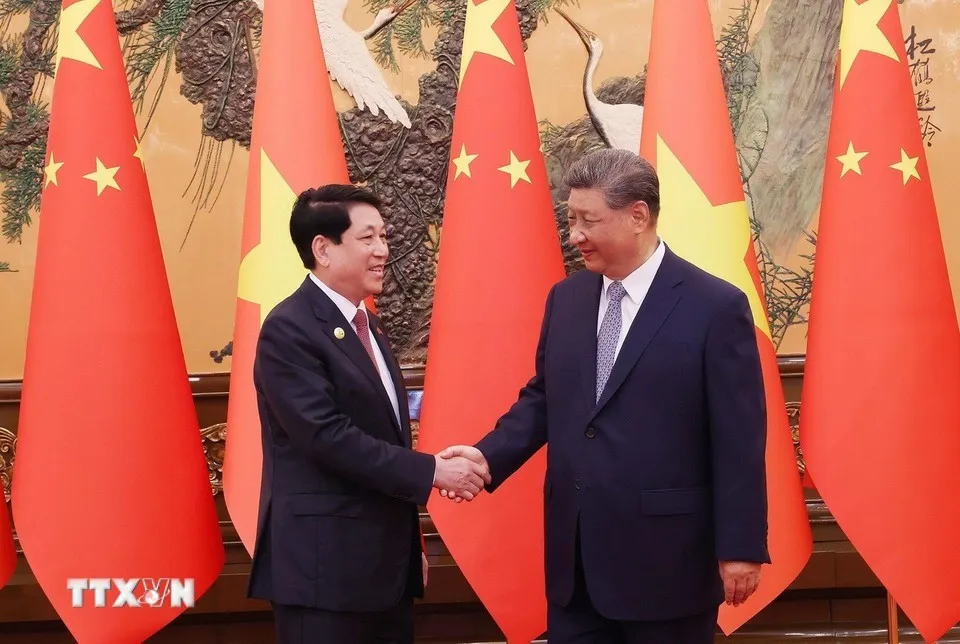
Vietnamese President Luong Cuong and Chinese Party General Secretary and President Xi Jinping in Beijing on September 4. Photos: Vietnam News Agency
Chinese Party General Secretary and President Xi Jinping on September 4 proposed that China and Vietnam convene the first session of the Joint Railway Cooperation Committee soon to advance mutually beneficial collaboration, alongside fostering coordination in emerging fields.
Xi made the remarks during his talks with Vietnamese President Luong Cuong in Beijing, where the latter attended the ceremony marking the 80th anniversary of the world’s victory over fascism.
The same topic was discussed between Xi and Vietnamese Prime Minister Pham Minh Chinh when he visited China for the Shanghai Cooperation Organization (SCO) Summit and working sessions with Chinese leaders from August 31 to September 1.
Xi and Chinh agreed to hold the first meeting of the Vietnam–China Joint Railway Cooperation Committee, prioritize Vietnam in regional railway development, and accelerate studies and loan talks, with China also supporting personnel training and a railway industry complex.
Vietnam and China see cross-border railways as vital for trade and integration, with a long-discussed project linking Yunnan to Lao Cai, Hanoi and Haiphong.
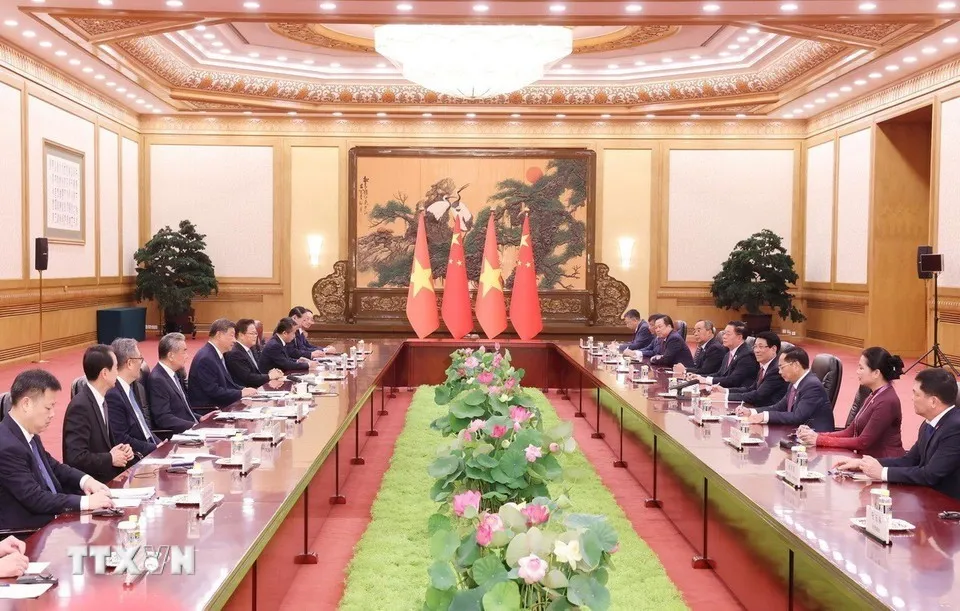
The two delegations at the meeting on September 4.
At the meeting with President Luong Cuong, the Chinese president also called for effective implementation of people-to-people exchange activities in celebration of the 75th anniversary of diplomatic relations and the Year of People-to-People Exchange, as well as aid projects that benefit both peoples.
The two leaders expressed satisfaction with the recent positive progress in bilateral ties, particularly following reciprocal visits by Vietnamese Party General Secretary To Lam and Xi in 2024 and 2025.
Both sides discussed major directions to deepen the Comprehensive Strategic Cooperative Partnership and to build a Vietnam–China community with a shared future of strategic significance.
President Luong Cuong stressed the need to strengthen high-level exchanges across diplomacy, defense and security, enhance theoretical research exchanges and promote practical cooperation in science, technology, innovation and human resources training.
He emphasized accelerating strategic connectivity, prioritizing railway cooperation and advancing high-quality investment, balanced trade, education and tourism.
Cuong also urged efforts to foster public understanding, particularly among younger generations, through friendship promotion and people-to-people exchanges.
On maritime issues, he highlighted the importance of better managing differences with mutual respect and in line with international laws, including the 1982 UN Convention on the Law of the Sea (UNCLOS).
Xi welcomed these proposals, pledging to promote high-level exchanges, strengthen Party-building, harness the sharing of governance experiences, and put existing bilateral cooperation mechanisms into effective action.