Private sector as key driver of Hanoi’s economic growth: Mayor
By expanding its space for innovation and flexibility, Hanoi could pioneer and guide the testing of new models for private sector-driven development.
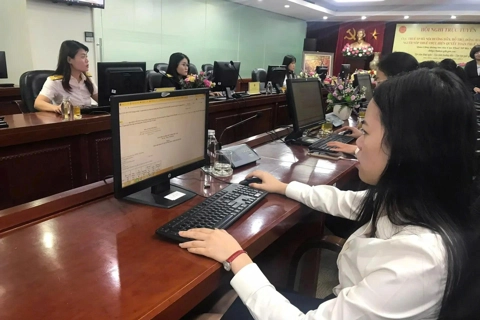
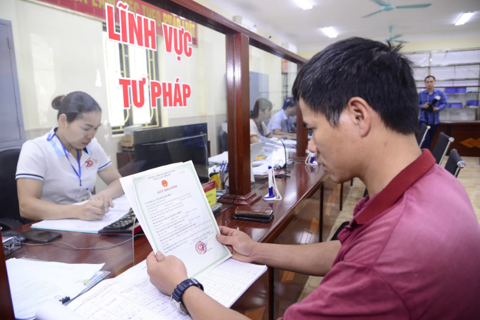
THE HANOI TIMES — The private sector is considered essential to accelerating Hanoi’s economic development, particularly in pursuit of the city’s double-digit growth targets in the near future.
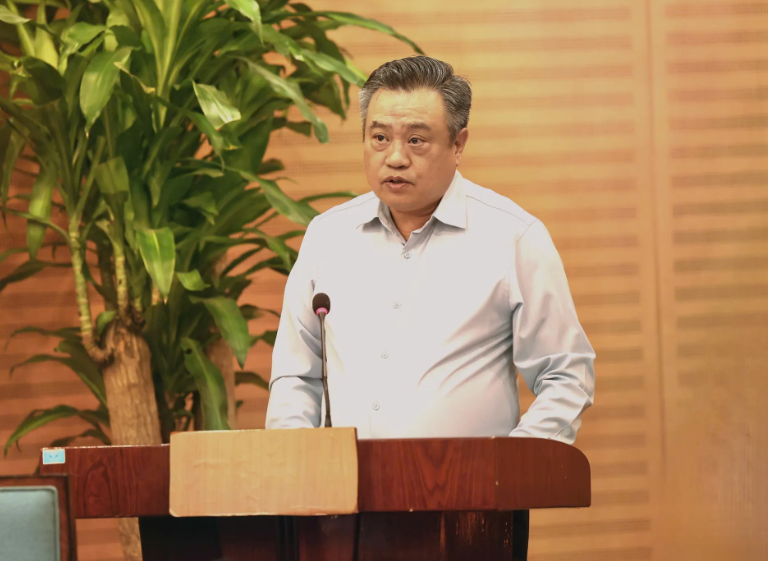
Chairman of the Hanoi People's Committee Tran Sy Thanh speaks at the conference on June 20. Photos: Pham Hung/The Hanoi Times
Chairman of the Hanoi People’s Committee Tran Sy Thanh shared the view during a conference held this week to discuss measures for the private sector's further engagement in the city's development.
Emphasizing the importance of the Private Sector Development Project, Thanh quoted General Secretary To Lam, who called on Hanoi to “build a science and technology ecosystem linked to innovation and promote private sector development, key drivers of growth in the coming period.”
Thanh stated that Hanoi, as the nation’s leading economic hub, has made significant efforts in recent years to create a favorable environment for private sector development. These efforts include fostering a supportive climate for private enterprises, encouraging innovation, supporting startups, and developing a resilient, globally minded business community.
“The relationship between the government and businesses will be one of partnership and facilitation,” said Thanh.

Overview of the conference.
Interaction between authorities and businesses
In the first five months of 2025, Hanoi granted business licenses to 11,600 newly established enterprises with a total registered capital of $4.2 billion.
However, experts note that of more than 151,000 non-state enterprises currently operating in Hanoi, 21,775 have capital under $39,000 each and 82,246 have capital between $39,000 and $390,000 each. Only around 1,800 enterprises have capital exceeding $19.5 million.
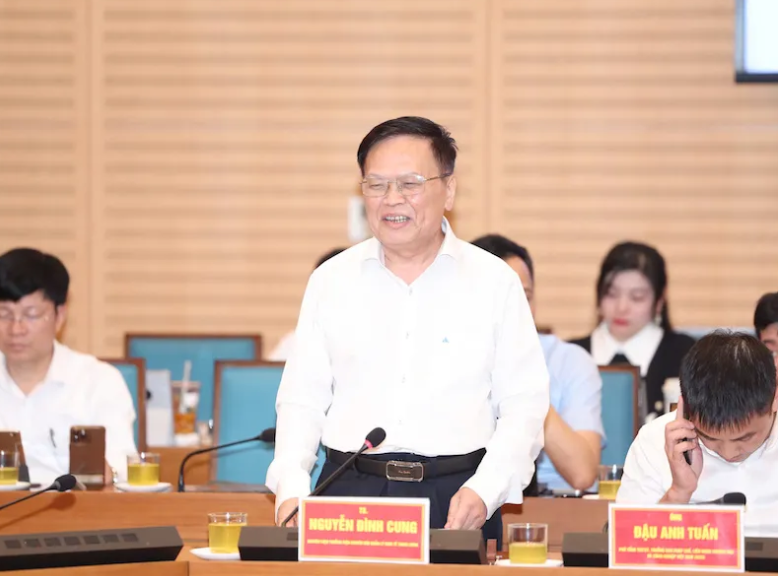
Dr. Nguyen Dinh Cung, former Director of the Central Institute for Economic Management.
Additionally, Hanoi has over 357,000 household businesses that have not been registered as formal enterprises and do not comply with regulations regarding taxation, insurance, and environmental standards. Large private enterprises remain few in the Fortune Southeast Asia 500 ranking. Of the 27 based in Hanoi, most are banks, state-linked enterprises, or lack international brand recognition.
According to Dr. Nguyen Dinh Cung, former Director of the Central Institute for Economic Management, the Politburo’s Resolution No. 68-NQ/TW on private sector development led the National Assembly to approve several targeted support policies for private businesses.
Government Resolution No. 138/NQ-CP dated May 16, 2025, outlines an action plan to implement Resolution 68 and emphasizes fair and equal treatment for the private sector. The resolution also promotes a relationship between the government and businesses based on openness, integrity, partnership, and facilitation.
"Enterprises should be regarded as 'entities to be served' rather than 'entities to be managed,' with a commitment to matching words with actions," said Cung.
He urged Hanoi to streamline administrative procedures by clearly defining roles, responsibilities, and authorities at each level and in each department, assigning accountability to agency heads for handling procedures.
He also called on the Hanoi People’s Committee to establish a standing body to gather feedback on administrative barriers limiting business freedom, review existing policies, support programs, and recommend revisions to align with market realities.
Participation from associations, research institutes, and universities should be encouraged in program implementation.
Cung also stressed that Hanoi must limit business inspections to once per year unless there is clear evidence of violations and must strictly deal with cases of abuse or harassment through unnecessary inspections.
Meanwhile, Dau Anh Tuan, Deputy Secretary General of the Vietnam Chamber of Commerce and Industry (VCCI), pointed out four key areas, namely land access, capital, the workforce, and technology.
Regarding land access, the city should publish information about available public land and lease it preferentially to small and medium-sized enterprises (SMEs) and startups. The city should also develop private industrial clusters with synchronized infrastructure and digital systems in districts like Dong Anh, Me Linh, Thuong Tin, and Phu Xuyen.
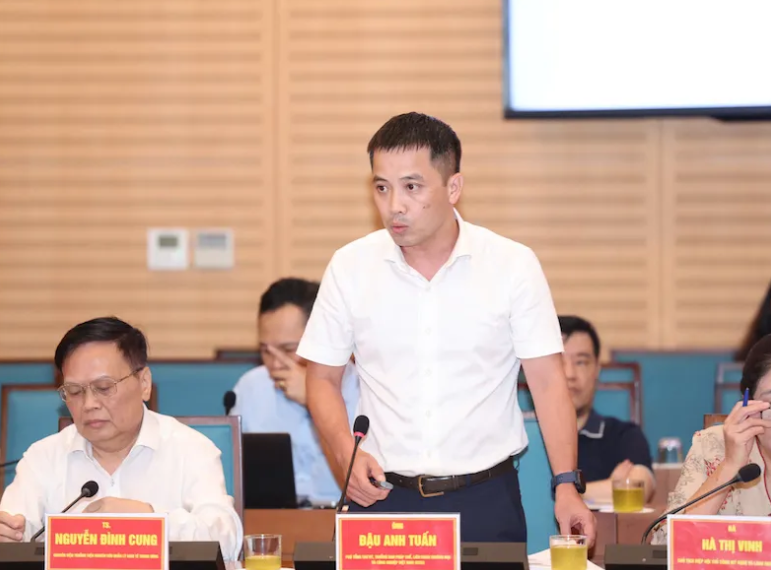
Dau Anh Tuan, Deputy Secretary General of the VCCI.
Hanoi could offer a 30% reduction in land and factory rent for the first five years to high-tech, supporting industries, and innovation-focused enterprises. Additionally, developing social housing and worker accommodations in high-tech zones like Hoa Lac would help businesses retain talent.
Regarding capital, Tuan proposed that Hanoi establish a Private Sector Development Fund to offer SMEs and startups preferential loans, credit guarantees, and matching funds. The city should collaborate with commercial banks to simplify access to financing and ease collateral requirements.
"The city could subsidize interest rates for businesses investing in priority sectors, such as high-tech, logistics, and digital transformation, for the first three years. It should also promote non-bank capital channels, such as corporate bonds and venture capital funds," Tuan noted.
Concerning human resources, the city could subsidize the reskilling and upskilling of SME workers using its budget and establish a high-tech training center directly linked to major corporations.
In terms of technology, Hanoi should cover 100% of consulting and training costs for SMEs adopting digital transformation in their first year. Free accounting, management, and e-invoicing software should be offered through the SME support center. The Hanoi Innovation Center could notably provide coworking spaces, expert mentorship, and investor connections for startups.
Dr. Tran Dinh Thien, former Director of the Vietnam Institute of Economics, emphasized a fundamental shift in development thinking, urged full support to private enterprises, and called on Hanoi to lead the way. "What is needed is a clear commitment that builds trust between the business community and the Hanoi government," he said.
Thien expected Hanoi to fully utilize the Capital Law and adopt mechanisms for decentralization, autonomy, and accountability. By expanding its space for innovation and flexibility, Hanoi could pioneer and guide the testing of new models for private sector–driven development.

Dr. Tran Dinh Thien, former Director of the Vietnam Institute of Economics.
Create opportunity spaces for businesses
Dr. Tran Dinh Thien added that Hanoi should urgently develop its Private Sector Development Master Plan with an "unconventional" spirit and a new approach to evaluate the current state and capacity of Hanoi's private sector with other provinces, global standards, and Hanoi's future strategic responsibilities.
The plan should prioritize increasing the number of registered enterprises by converting household businesses, fostering startups and innovative firms to fuel economic dynamism and transform Hanoi’s business ecosystem.
According to Thien, opening up new "spaces of opportunity" for enterprises is key to business development. For instance, promoting the nighttime and digital economies encourages private sector participation.
Talking about private sector involvement, Associate Professor Dr. Hoang Van Cuong, former Vice President of the National Economics University, noted that an attractive investment environment requires encouraging large private enterprises to invest in public projects.
Cuong also emphasized Hanoi's tremendous potential to attract private investors to public-private partnership (PPP) projects, particularly in culture, sports, and tourism.
He urged Hanoi to expand innovation-driven development. "Hanoi should establish more innovation hubs, not only in the Hoa Lac High-Tech Park but also in coordination with universities. Science and technology development and innovation funds can be channeled into supporting business incubators," he suggested.