Public transportation - Key for Hanoi to tackle traffic congestion
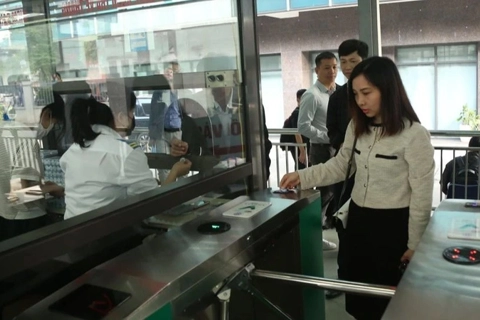
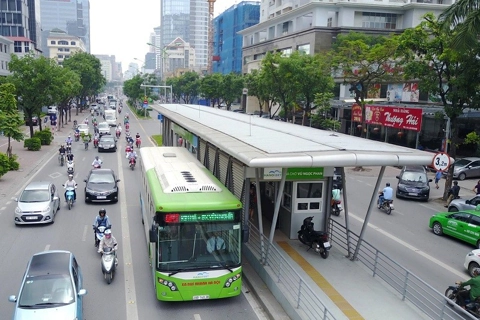
Hanoi boasts the most modern mass transit in Vietnam, with an extensive bus network of 154 routes and two active metro lines carrying hundreds of thousands of passengers daily.
Experts suggest that to effectively address traffic congestion and reduce accidents in Hanoi, it is essential to develop infrastructure, enhance public transportation, and gradually curb private vehicles.
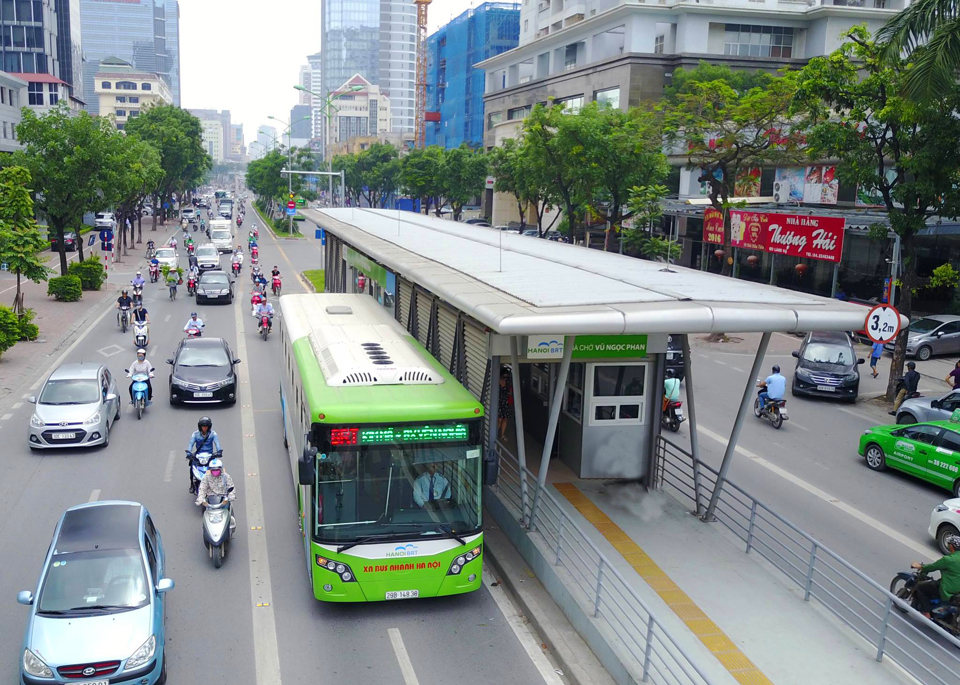
| BRT Bus on Lang Ha Street, Hanoi. Photo: Pham Hung/The Hanoi Times |
A representative from Hanoi’s Department of Transport stated that the city’s traffic infrastructure is currently handling approximately 7.9 million vehicles in addition to 12 million vehicles from various provinces.
The high volume of vehicles has exacerbated the challenges on Hanoi's roads, most of which remain underdeveloped and incomplete according to planned infrastructure projects, while urban technical systems are inconsistent. Meanwhile, the adoption of technology for managing and maintaining traffic infrastructure has been slow and lacks proper coordination.
Additionally, there is little awareness among people and businesses about adhering to the law and safeguarding transportation infrastructure.
Transport expert Vu Hoang Chung said that the most critical solution to address traffic congestion and reduce accidents is to promote public transportation and gradually reduce private vehicle use, apart from developing infrastructure where feasible.
According to calculations by Hanoi’s Department of Transport, private vehicles take up significantly more road space than public transport. On average, buses take up 1.5 to 2 square meters per person, motorcycles 8 to 12 square meters per person, and cars 24 to 26 square meters per person.
He added that Hanoi couldn't build a big 8-10 lane avenue in the inner city. “Therefore, developing public transport is essential,” he noted.
Chung emphasized Hanoi's commitment to developing public transportation and reducing the use of private vehicles, stressing that this approach is essential.
“Within the next 7 to 10 years, the city's infrastructure will be unable to withstand the traffic of 10 to 12 million vehicles,” Chung said.
While restricting motorcycle use is a sensitive issue, Chung asserted that it remains one of the most effective measures to safeguard residents' well-being.
“Authorities must actively raise awareness and encourage public understanding. More importantly, before implementing measures to reduce motorcycle use, a sufficiently capable public passenger transport system must be in place,” he continued.
Chung highlighted that reducing motorcycle use requires a well-developed, widely accessible, and efficient public transport network, with urban rail systems serving as the backbone.
These initiatives reflect the city's determination to reduce private vehicle use, particularly motorcycles, thereby helping to ease traffic congestion and reduce pollution.
Traffic expert Nguyen Manh Thang noted that Hanoi has been conducting research and applying technology in public passenger transport. These efforts aim to gradually digitize transportation management and make public transport a convenient primary travel option for residents.
Thang said that public transport and traffic systems will increasingly adopt advanced technologies to build a smart, modern, and civilized capital.
| “Hanoi's central urban area follows a grid layout, with urban roads consisting of radial and ring roads. As such, the urban rail system must serve as the backbone of public transportation, covering over 50% of residents' movements. This approach forms the foundation for organizing the city's traffic flow. Additionally, a multi-nodal urban development model is necessary to avoid concentrating large traffic volumes in one direction. Developing the urban rail system along high-traffic corridors is essential for this strategy,” says Do Xuan Truong, Deputy Director of Center 3 at the Hanoi Institute of Urban Planning. |