Seventy years of knowledge and cultural bridges in Chinese and Russian studies
ULIS–VNU celebrates seven decades of advancing foreign language education and strengthening cultural understanding through its long-standing Chinese and Russian studies departments.
THE HANOI TIMES — The University of Languages and International Studies under the Vietnam National University – Hanoi (ULIS–VNU) on November 15 celebrated the 70th anniversary of its two founding departments: the Faculty of Chinese Language and Culture and the Faculty of Russian Language and Culture.
These two units have built a strong record of achievements and played a vital role in shaping the ULIS brand today.

The Faculty of Chinese Language and Culture receives Certificate of Merit from the prime minister at its 70 years celebration. Photos by ULIS–VNU
The 70-year development reflects more than language education, but a journey of creating cultural bridges between Vietnam and countries with rich historical traditions.
The values built over decades continue to spread through generations of students, research projects and the dedication of faculty members.
Dr. Nguyen Xuan Long, Rector of ULIS–VNU, affirmed that the Faculty of Chinese Language and Culture and the Faculty of Russian Language and Culture lay the foundation for the school’s formation and development.
Many generations of graduates from the two faculties have worked in diplomacy, trade, education, research and other fields, making practical contributions to national development, he said.
The ULIS Rector said the growth of these traditional faculties has always been part of the school’s long-term strategy, aiming to supply high-quality human resources for comprehensive international integration.
He noted that ULIS is implementing three major directions, including developing training programs that meet international standards, expanding academic cooperation with universities worldwide and promoting digital transformation and technological applications, especially AI, to strengthen foreign language teaching.
Speaking at the ceremony, Associate Professor Dr. Nguyen Dinh Hien, Head of the Faculty of Chinese Language and Culture, emphasized the faculty’s proactive approach to renewing its curriculum.
He said the faculty is strengthening interdisciplinary methods by integrating economics, commerce, media, education and technology to equip students with the ability to work in diverse fields.
“Students need an open mindset, adaptability and professional skills so they can meet the demands of a rapidly changing job market,” said Hien
The faculty will develop applied modules, integrated learning models and more real-world experiences with businesses.”
He said that the faculty plans to expand academic cooperation with universities in China, Taiwan (China), Japan and across the region through student exchanges, internships and joint research programs.
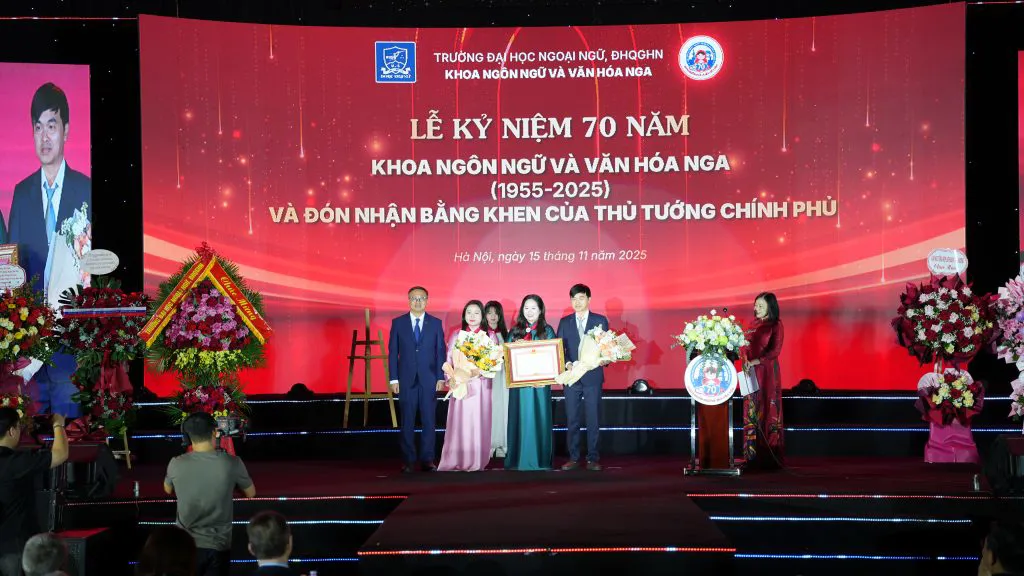
The ceremony commemorating the 70-year foundation of the Faculty of Russian Language and Culture.
Dr. Pham Duong Hong Ngoc, Head of the Faculty of Russian Language and Culture, said the faculty is undergoing a strong transformation by implementing modern training programs, increasing interactive modules, applying technology, developing blended learning models and creating more space for communication practice and cultural engagement.
She said research in linguistics, translation, intercultural communication and Russian language teaching methods is becoming increasingly important.
These areas are the foundation that helps the faculty maintain strong training quality and reinforce its position in Vietnam’s foreign language education system, Ngoc said.
On the occasion of the 70th anniversary, both faculties received the certificates of merit from the prime minister in recognition of their seven decades of contribution to language and cultural education.
For the two faculties, receiving the prime minister’s Certificates of Merit marks an important milestone and acknowledges their long-standing dedication to training, research and cultural exchange.
The recognition provides new motivation for both faculties to continue renewing programs, strengthening research, expanding cooperation, enhancing human resource quality and consolidating their role in Vietnam’s foreign language education network.