Single textbook system set for all schools in Vietnam by 2026
This will be a major leap forward in the country's education and training.
THE HANOI TIMES — The Vietnamese Government has decided to introduce a unified set of textbooks nationwide starting from the 2026-2027 academic year.
This decision is expected to bring significant changes across the education system, with a focus on enhancing overall educational quality.
It also aims to ensure free textbooks for all students nationwide by 2030, reducing the financial burden on families.
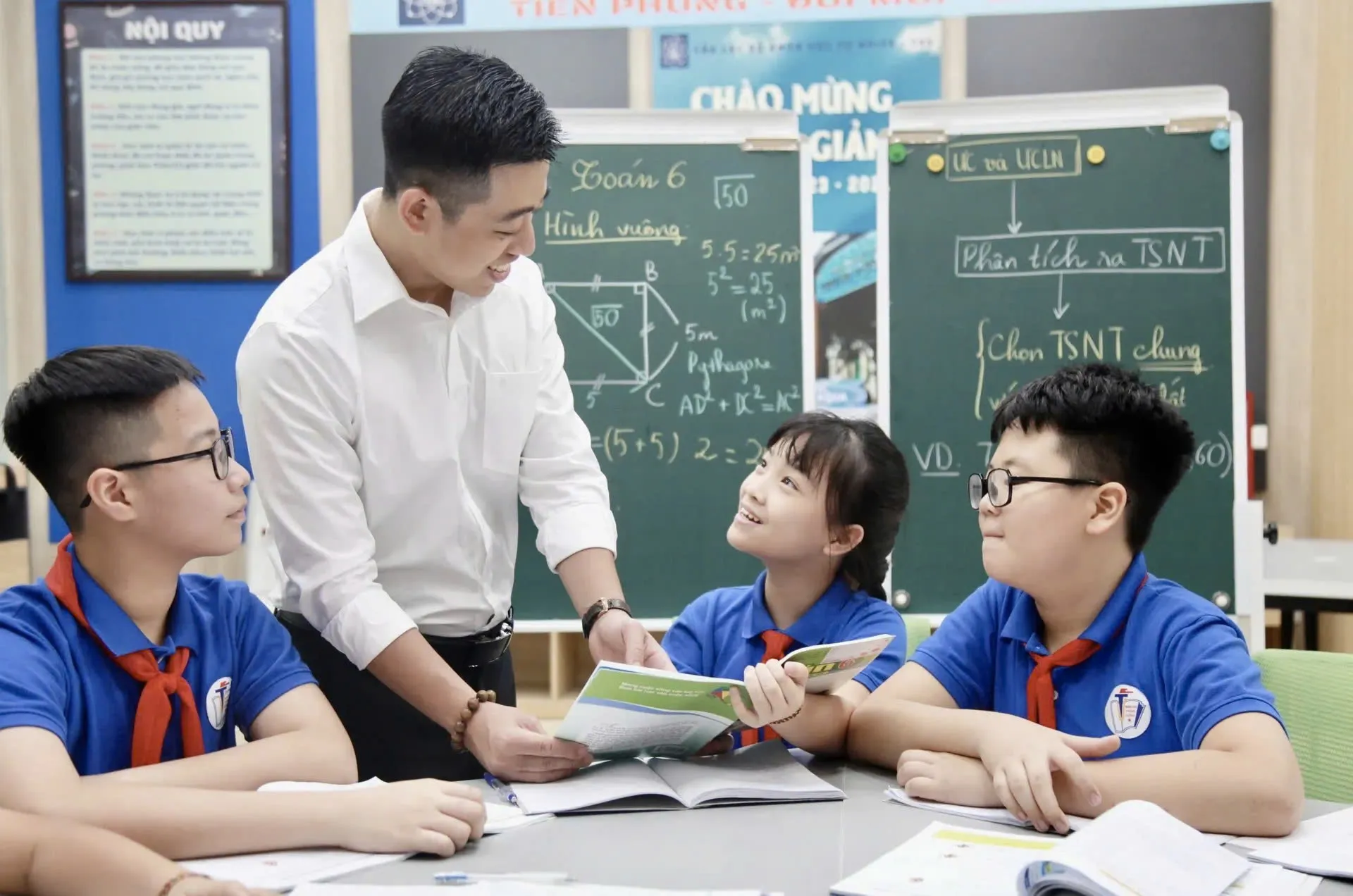
A teacher and his students of a secondary school in Cau Giay Ward, Hanoi. Photo: Kinh te & Do thi Newspaper
The move highlights the need for the education sector to adopt modern, learner-centered approaches, fostering self-study, creativity, independent thinking and problem-solving skills.
It also calls for continual reform of testing and assessment to ensure accurate evaluation of learning and teaching outcomes, while implementing comprehensive measures to curb the widespread practice of extra classes.
The government resolution emphasizes the enhancement of foreign language teaching and learning, with a roadmap to make English the country’s second language in schools, promoting its use as the medium of instruction for certain subjects where conditions permit.
It is part of a broader strategy to create a modern, equitable and high-quality education system. Ambitious targets include placing Vietnam among the top 20 education systems globally, modernizing curricula and teaching methods to meet the demands of the new era.
At present, Vietnam uses three different sets of textbooks for the new general education curriculum. They are "Connecting knowledge to life", "Creative horizon" and "Kite". The choice of textbooks has been decided by schools and teachers based on their own research and assessment.
Using different sets of textbooks since 2014 aimed to encourage privatized textbook development and eliminate publishing monopolies. However, it has caused confusion along with extra costs in selection and adoption.
As a result, the multi-textbook education policy has faced public anxiety and calls for a single-book system.