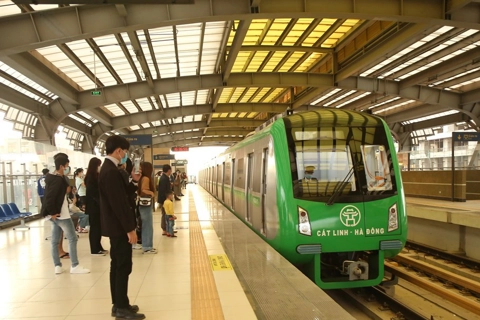
Special mechanisms to help Hanoi speed up construction of urban railway
The Capital Law 2024 allows Hanoi to decide on mechanisms and tools for planning and investment without seeking approval from multiple levels.
Special provisions in the Capital Law, together with the resolution on the pilot implementation of a series of special mechanisms and policies recently passed by the National Assembly, are helping Hanoi to accelerate urban railway construction, according to the Hanoi Metropolitan Railway Management Board (MRB).
The Capital Law 2024, which officially took effect on January 1, 2025, has created many groundbreaking mechanisms for the development of Hanoi's urban railway network.
Article 31 of Capital Law 2024, which regulates urban development under the Transit-Oriented Development (TOD) strategy, provides for the planning of the urban rail network, investment in urban rail development, and mechanisms for collecting surplus value from land in TOD areas.
It specifically regulates the mechanism and tools for developing TOD projects in Hanoi, including the definition of the TOD area; planning of the urban railway system and TOD area; investment in urban railway development under the TOD model; management, operation, and exploitation of the urban railway and TOD area.
The article defines TOD urban development as a solution for the planning, renovation, beautification, and development of urban areas.
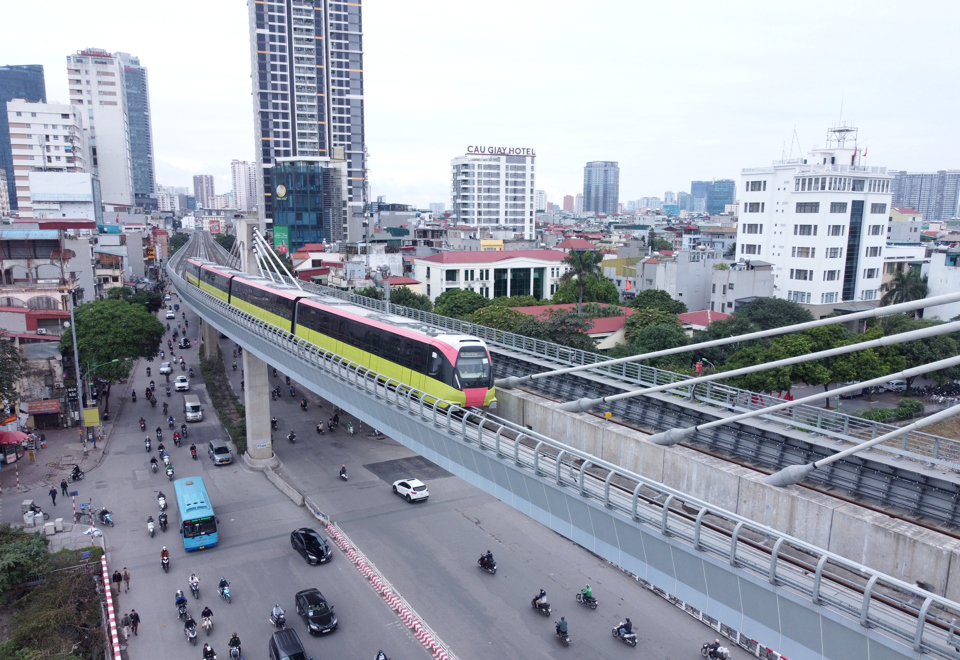
The elevated section of the metro line Nhon - Hanoi Station. Photo: Pham Hung/The Hanoi Times |
The Capital Law 2024 allows the Hanoi People's Committee to decide on mechanisms and tools for planning and investment without having to submit them to multiple levels for approval, helping to shorten time and be active in the implementation of projects.
"The law has a number of important breakthroughs, such as allowing the capital to decide on local adjustments to general urban planning and specialized planning of the city's technical infrastructure, which have been approved by the Prime Minister," the MRB said.
The Board emphasized the mechanisms and policies related to the transportation sector mentioned in Capital Law 2024, which strongly decentralizes power to the capital and promptly removes difficulties and obstacles for the transportation sector.
Thanks to Capital Law 2024, the National Assembly was able to pass pilot-specific mechanisms for urban railway projects in Hanoi and Ho Chi Minh City at the recent session. The resolution sets out specific policy groups, including capital mobilization, investment procedures, technology transfer, and human resources training, among others.
The resolution of the National Assembly, which allows the trial of the extraordinary regime, helps to remove barriers in procedures, capital, and mechanisms, which is expected to speed up the development of the urban railway network.
"This can be seen as an important step in overcoming long-standing obstacles in urban rail projects," the MRB said.
Nguyen Ba Son, the MRB's Deputy Head, told the Vietnam Government Portal that there will be significant economic and social losses if the development of urban rail systems is not prioritized.
He cited Forbes calculations that estimated the annual cost of traffic congestion at $11 billion for New York, $8.2 billion for Los Angeles, and $7.6 billion for Chicago. "For Hanoi, the loss is estimated to be at least $2-3 billion, considering the size of the population and the existing transportation infrastructure," Son said.
He emphasized that Capital Law 2024, with groundbreaking provisions, will create a favorable legal corridor and help Hanoi take the lead in developing urban TOD projects.
“These changes will help better connect districts in the city; optimize the use of land resources; build a green, smart, and sustainable city so that Hanoi can become a prosperous, integrated city with its own identity,” Son added.
The official commented that Capital Law 2024 will facilitate the formulation of policies, create specific mechanisms, and bring value for the capital to realize its ambition of having 600 km of urban rail in the future.
According to the revised Capital Transport Master Plan to 2065, the urban railway network will have 15 urban railway lines with a total length of 617 kilometers.
The 10 urban railway lines according to the Capital Transport Master Plan include Ngoc Hoi - Yen Vien section, Nam Thang Long section, Cat Linh - Ha Dong section, Nhon - Hanoi Railway Station section, Me Linh - Sai Dong - Lien Ha section, Van Cao - Hoa Lac section, Noi Bai - Ngoc Hoi section, Ha Dong - Me Linh section, Son Dong - Mai Dich section, and Son Tay - Hoa Lac - Xuan Mai section.
Five additional routes according to the adjustment of the master plan include Ngoc Hoi - the second airport in southern Hanoi, Me Linh - Co Loa - Duong Xa section, Cat Linh - Lang Ha - Le Van Luong - Yen Nghia section, Ring Road 2 - Southern Axis - the second airport in southern Hanoi, and Xuan Mai - Phu Xuyen section.
"At present, Hanoi's metro is showing its superiority in public transportation. Typically, more than 35,000 passengers commute on the Cat Linh - Ha Dong metro line every day," MRB said.
It added that the 8.5-kilometer elevated section of the Nhon - Hanoi Station metro line has served a large ridership of more than 500,000 people per day since its commissioning.
"The high ridership of the Cat Linh-Ha Dong and Nhon-Hanoi Railway Station metro lines shows that people value and are satisfied with public transport by metro," MRB stressed.