Tran Phu Street – an ancient feature in the heart of Hanoi
Tran Phu Street in Ba Dinh District, Hanoi, is a street of nostalgia for people who love an old and peaceful Hanoi.
Running from Phung Hung Street through Kim Ma, Dien Bien Phu, Hoang Dieu, Chu Van An, and Le Truc streets, Tran Phu Street stretches along the capital's history in space and time.
A beautiful thoroughfare of Hanoi
| The peaceful Tran Phu Street during the fall. Photo: Giang Trinh |
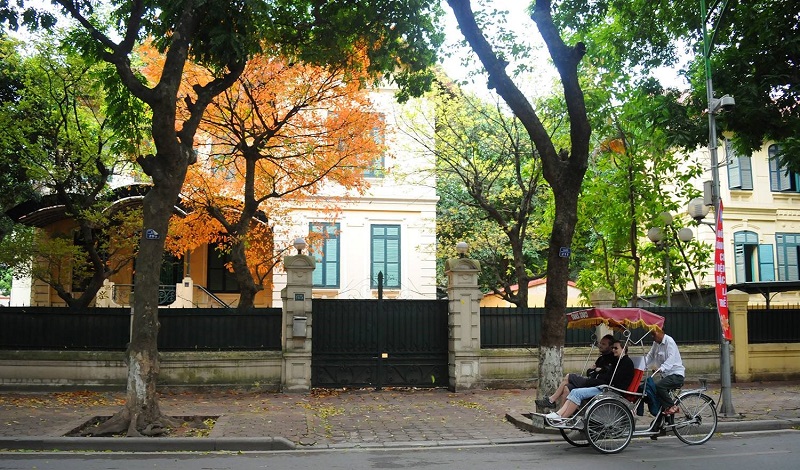
The road is home to the quintessence of French architecture with mansions and villas built in the early twentieth century, including the office of the French Development Agency in Vietnam, the Consular Department at Vietnam Ministry of Foreign Affairs, as well as the embassies of Germany, Iran, and Sri Lanka.
Located at No 60 Tran Phu Street, Saint Paul Hospital is one of the capital's leading medical examination and treatment facilities. It is also the first medical facility in the Indochina region that the French colonial administration established in the late 19th century. There is a flower garden with a statue of St. Paul right on the hospital’s premises.
The two sides of Tran Phu Street are airy without the hustle and bustle of makeshift cafes like on many streets in Hanoi.
Perhaps amid the busy and noisy city, Hanoians still find peacefulness on this street, so they can boast that Tran Phu Street is among the most beautiful ones in the capital.
The street is most charming in the early morning, with gentle sunshine and a calm and refreshed feeling.
On scorching hot days in the city, walking between the two rows of perennial trees on the road, one feels lost in another world. Gentle breezes drift while sunbeams freely stream down the road, creating a pleasant sensation. At times like those, it is so clear and peaceful here that one could feel a new breath of life flowing in the body to welcome a bright new day. Everyone looks calm with their daily tasks on a wide, empty street full of sunlight.
| Tran Phu is one among important streets of Hanoi. Photo: Duy Khanh |
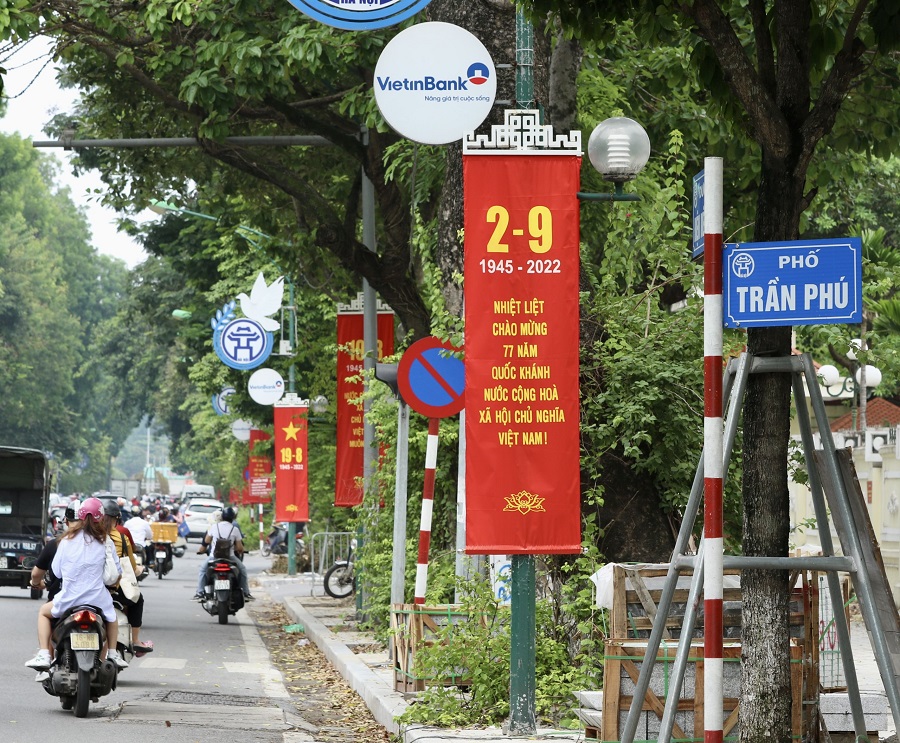
Leaving behind the disquiet modern life, going through all the ups and downs of times, Tran Phu Street still lies calmly, keeping an ancient feature of Hanoians every sunrise.
Thanh Thuy, 23, a resident of Ba Dinh District, told The Hanoi Times that Tran Phu is her favorite street in Hanoi. “The beautiful yellow houses that dot the tree-lined streets always intrigue me about their owners,” she said.
“In addition, different from other streets in Hanoi’s old quarter, the street's sidewalk is also very spacious that walkers can take their strolls leisurely,” she added.
Thuy often roams around and takes time to “listen to the breath” of Hanoi streets. She can also see a picture of modern Hanoi with various contrasting colors.
“It can be a quiet corner with deep shades, next to a vibrant spot with warm shades, and also intersections that provoke reflection. You may not like some certain points in the panorama of Hanoi, but surely there will be many fascinating things for you to discover, to love the city you live in even more,” she stated.
Passing through Tran Phu Street when seasons change in late April or early May, passengers occasionally come across showers of Indochina Dragonplum leaves. The light-yellow leaves fall fluttering, covering the roofs of the yellow villas on these two sides of the street. The scenery is just like in a fairy tale.
| The street is carpeted with yellow Indochina Dragonplum leaves in Hanoi's autumn. Photo: Giang Trinh |
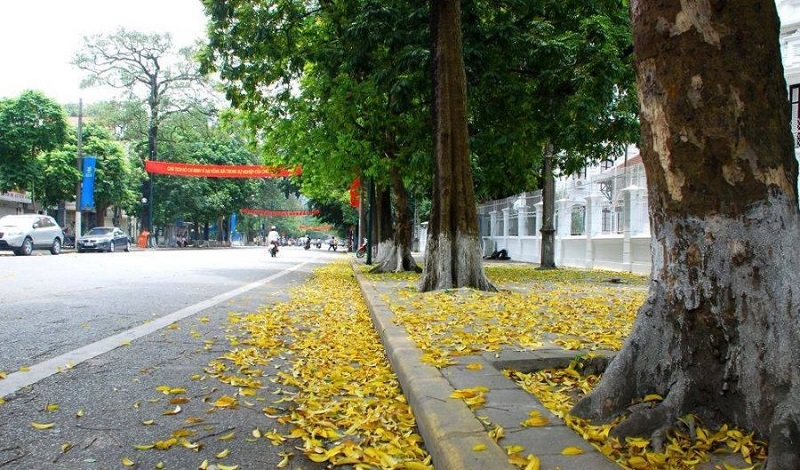
The beautiful street in Hanoi’s downtown was named after Tran Phu (1904 - 1931) - a Vietnamese revolutionary and the first general secretary of the Indochinese Communist Party, later the Communist Party of Vietnam.
Born on May 1, 1904, in the southern province of Phu Yen, the former communist leader was a teacher by profession since 1922. In 1926, Tran Phu, on behalf of the Vietnamese Revolutionary Party, went to Guangzhou (China) to discuss merging with Vietnam's Youth Revolution.
In December of the same year, he helped create the Hoi Phuc Viet, or Society for the Restoration of Vietnam later renamed the Tan Viet Cach Menh Dang or Revolutionary Party of New Vietnam.
| The romantic street in Hanoi is named after the first general secretary of Vietnam: Tran Phu. Photo: Giang Trinh |
.jpg)
In July 1927, Tran Phu conducted negotiations for the establishment of the first nucleus of the Communist Party of Vietnam (CPV), which was founded in February 1930 and renamed the Communist Party of Indochina (CPI) in October of that year.
Later, as a member of the Fellowship of Revolutionary Youth of Vietnam, he studied at the Communist University in Moscow.
Beginning in July 1930, Tran Phu, as a member of the Provisional Central Committee of the CPV, did many important works toward convening a plenum of the committee.
He was the author of the political theses for the first and second plenums of the Party, held in October 1930 and March 1931. These theses became the first program of the communists of Vietnam.
In October 1930, he became secretary general of the CPI. Tran Phu was arrested in Saigon in 1931. After five months of suffering brutal torture by the French colonial, on September 6, 1931, he died at Cho Quan Hospital at 27. He left the message of “Keep your fighting spirit” to his comrades.
Nowadays, his name has been given to many schools and streets throughout Vietnam.