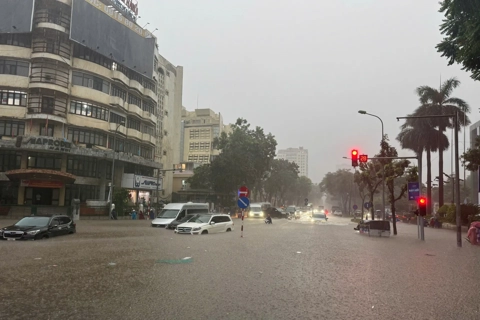
Typhoon Matmo forecast to hit northern Vietnam with winds up to 149 km/h
Vietnam's northern and north-central provinces must deploy measures to floods and flash floods, inundation, landslides and erosion.
THE HANOI TIMES — Typhoon Matmo, the 11th storm to hit the East Sea this year, is forecast to be over the waters of Vietnam's northern provinces on the night of October 5, with wind forces up to 149km per hour.
According to the National Center for Hydro-meteorological Forecasting (NCHMF), from October 5 to October 7, heavy to very heavy rainfall is forecast across Vietnam's six northern provinces in mountainous and midland regions, with average rainfall of 150–250 mm and isolated areas exceeding 400 mm.
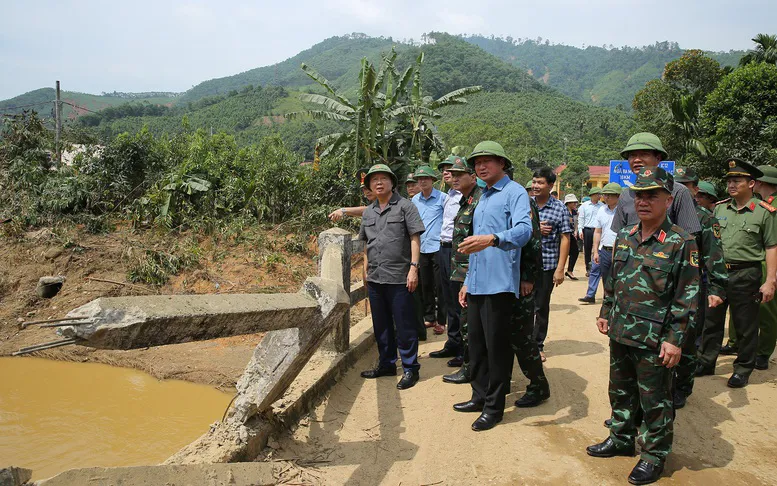
Deputy Prime Minister Tran Hong Ha inspects the work of overcoming the consequences of Typhoon Bualoi and preparing for Typhoon Matmo in the northern province of Lao Cai. Photo: VGP
The center said that over the next 24-60 hours, the storm is forecast to intensify further before making landfall . It is projected to reach mainland Vietnam in the early morning of October 6.
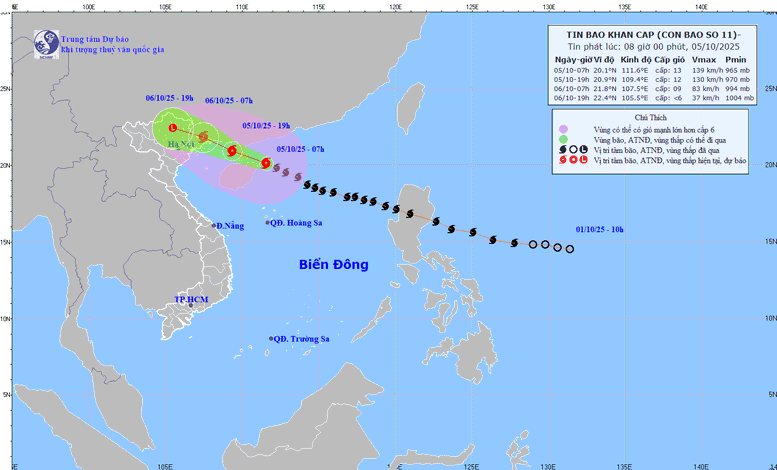
The projected path of Typhoon Matmo. Photo: NCHMF
In response to the typhoon, the northern province of Quang Ninh temporarily banned vessels from going offshore before 12 PM. on October 4 and stopped issuing permits for sightseeing and overnight stays at sea from 8 AM the same day.
The northern city of Haiphong and provinces of Hung Yen and Ninh Binh have banned maritime activities starting at 5 PM on October 3.
Hanoi is unlikely to be affected directly by the typhoon but will have rainfall between 70mm-120mm until the end of October 7, with some areas exceeding 150mm. The city has encouraged agencies to arrange for officials, public employees, and workers to work from home on October 6 in the event of severe weather conditions.
Prime Minister's directions
Prime Minister Pham Minh Chinh has requested ministries and localities to implement decisive, timely and effective response measures to ensure the safety of the people.
Northern and north central provinces, especially mountain and midland areas, must deploy response measures to floods and flash floods, inundation, landslides and erosion. They must allocate personnel, materials, machinery and equipment in key areas to be ready to immediately handle incidents.
The prime minister assigned the Ministry of Agriculture and Environment to direct the meteorological and hydrological forecasting agencies to closely and continuously monitor and update international forecasts, drawing on experience from recent typhoons, to provide the most accurate information on the typhoon’s evolution.
The ministry is also tasked with guiding provinces and cities to review, update and complete specific plans to respond to each level of disaster risk, and each possible situation for their localities.
Chinh has required the Ministry of Construction and Ministry of Industry and Trade to keep close watch on transportation activities, hydropower reservoirs and dams, electricity transmission systems and industrial production.
He has also assigned the Ministry of Foreign Affairs to coordinate with China regarding information from upstream reservoirs.
The ministries of National Defense and Public Security have been asked to allocate forces, prepare equipment at key locations to be ready to support people in responding to floods, flash floods, landslides and inundation.
On September 28, Typhoon Bualoi, the 10th typhoon, devastated Vietnam’s northern and central regions, leaving 51 people dead, 21 missing, 164 injured and more than 170,000 houses damaged or unroofed as of the night of October 2. It caused losses estimated at VND16 trillion (US$606 million).

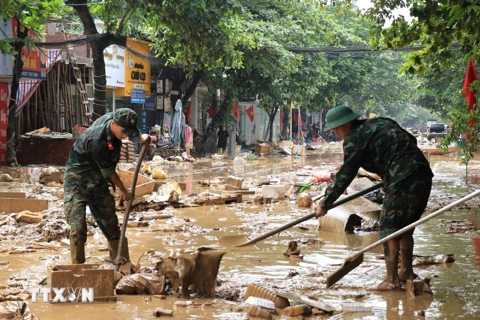
Army officers and soldiers support people in overcoming the consequences of Typhoon Bualoi. Photo: VGP