US launches $11 million environment protection project for Vietnam
The five-year project will enable a series of local entities to serve as the “backbone” for each collective impact initiative.
The US Agency for International Development (USAID) has launched a new project against environmental pollution worth US$11.3 million for Vietnam in the next five years.
| Representatives of the US Agency for International Development (USAID) and the Ministry of Natural Resources and Environment at the project launch on Nov 15. Photo: USAID |
.jpg)
The Reducing Pollution project will be implemented by USAID partner Winrock International in close cooperation with the Ministry of Natural Resources and Environment (MONRE), addressing address multiple sources of environmental pollution.
The project will bring together different people to collaborate, identify ways to solve a shared problem, and take action. In addition, it will demonstrate clear connections between environmental benefits and other social benefits, including public health, employment, and sustainable economic growth.
To foster Vietnamese leadership in addressing environmental pollution, the project will provide grants to a series of local entities to serve as the “backbone” for each collective impact initiative. These backbone organizations will serve as the local leaders for each initiative, including gaining public support, advancing policy, and leveraging additional funding.
Through a broad consultative process with authorized government agencies, local communities, and environmental experts, the Reducing Pollution project, which reflects community leadership and the private sector’s engagement, has identified six priority collective impact initiatives.
The key components will be pioneering companies, community, and consumer responsibility in plastic waste reduction in Vietnam (P3CR); developing a circular economy model in medical plastic waste management; reducing air pollution from road transportation; reducing air pollution from open burning; mitigating pollution in craft villages; and developing a transparent environmental data disclosure platform.
Commenting on the project, Aler Grubbs, USAID/Vietnam Mission Director, called it “a great first milestone”, saying the joint efforts will raise awareness and promote actions led by Vietnamese to reduce environmental pollution and support Vietnam in achieving its climate change goals.
Vietnam faces environmental pollution challenges spurred mainly by agriculture, transportation, and industrial production. Public interest in environmental quality has steadily increased, along with calls for action to improve the environment.
The Government of Vietnam released National Action Plans related to air quality, water conservation, and plastic waste pollution, demonstrating the country’s commitment to ensuring broad cooperation to address environmental pollution challenges.
Therefore, the USAID Reducing Pollution project is yet another example of how the US and Vietnam work strategically together to address the world’s most pressing issues, like climate.
Over the past five years, USAID has been working closely with Vietnam to foster collective action by local actors—including the Government of Vietnam, the private sector, local organizations, and citizens—to raise awareness of the causes and effects of environmental pollution, and to increase knowledge of effective strategies for reducing the environmental pollution.
Regarding efforts against environmental pollution, Dr. Duong Nguyen, Office of Climate Change, Energy, and Environment, USAID, highlighted the role of behavior change in resulting in collective action to help Vietnam cope with the issues.
Sharing with The Hanoi Times, he said it has become critical to have the participation of everyone, from grassroots communities to higher levels, including youth, women's unions, and state agencies like urban hygiene companies. He noted that the joint efforts from all players would result in combined strengths that are much more powerful than expected.
The expert emphasized that participation of all stakeholders would create collective action, which matters a lot to public attitude towards treating waste, bringing about helpful environmental campaigns.
| Soldiers of the Hanoi Capital High Command prepare for dredging Hoan Kiem Lake. Photo: The Hanoi Times |
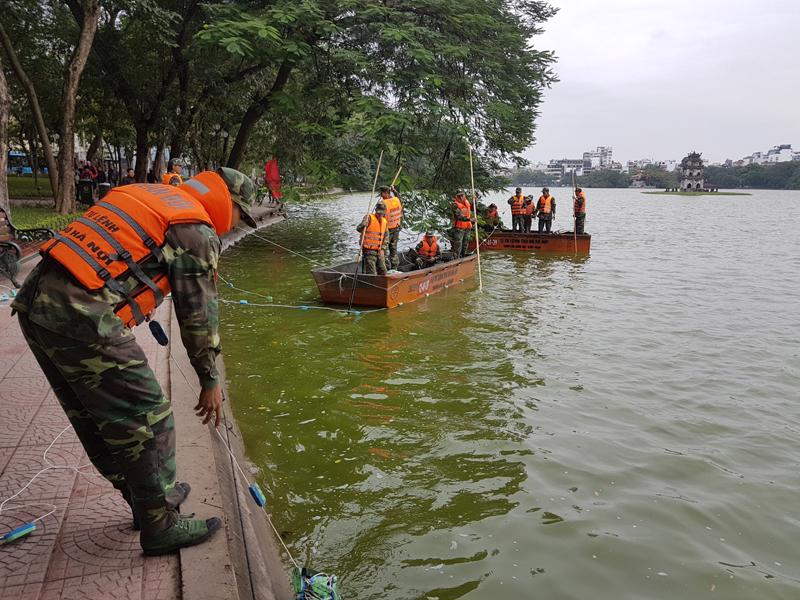
Joining the common efforts, Hanoi has taken drastic measures to curb environmental pollution. Specifically, the city has dredged canals and maintained aquatic rafts on the rivers to minimize pollution and improve water quality. The local authorities are also running 34 air monitoring stations and one automatic mobile air monitoring vehicle at Nam Son Waste Treatment Complex. At the same time, the city is investing in an automatic environmental monitoring system, including the installation of 15 fixed air monitoring stations in the 2022-2024 period. Furthermore, Hanoi has stopped the use of charcoal stoves and the burning of straw in the rice fields, enhanced hygiene work in the community, and planted more trees. In addition, Hanoi follows Vietnam to implement issues guided by the Nationally Determined Contributions (NDCs) while working with surrounding localities to have proper policies to reduce pollution and improve air quality. Environmental specialists suggest the city manage unorganized waste burning and minimize road dust while controlling vehicle gas emissions and increasing public means of transport. |