Vietnam approves electronic ID card issuance project
The ministry expects to issue 50 million chip-based identity cards by July 2021.
Vietnamese Prime Minister Nguyen Xuan Phuc has green-lighted a project to issue chip-based identity cards proposed by the Ministry of Public Security (MPS).
| Identity card with barcode is currently the most modern form in Vietnam |
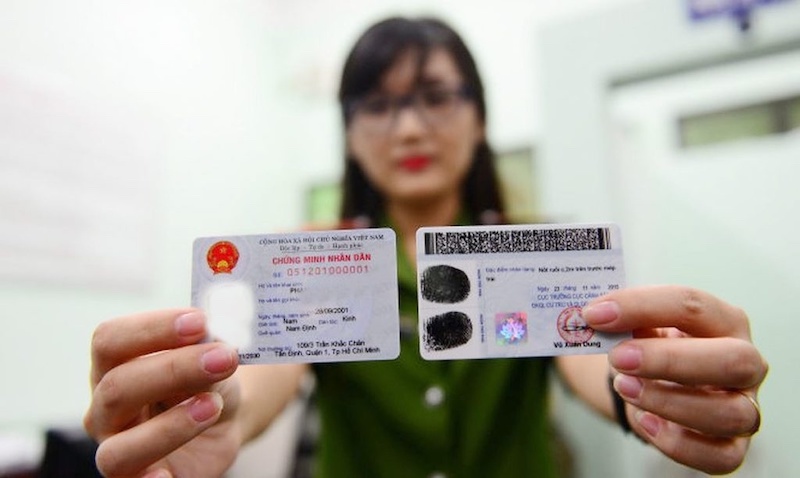
The plan, which would be proceeded together with a national population database project, is slated for operation by early 2021, Minister of Public Security To Lam said at a meeting earlier this week.
According to Major General To Van Hue, head of the ministry’s Department for Administrative Management of Social Order, chip-based identity (ID) cards are part of a citizen ID card project worth VND2.8 trillion (US$121.7 million).
He said the parallel execution of the two projects will save a large amount of money thanks to the use of joint technical infrastructure, servers, transmission lines, among others.
To serve the ID project, the MPS needs to collect information related to household registration, and database of image and biometrics.
The ministry sets up a roadmap for issuing 50 million cards nationwide by July 2021.
Expectations
Chip-based ID cards are believed to contain information of 20 different fields like insurance, driving license, tax, health insurance, among others.
The card, which is designed to be encrypted, would store facial recognition features, fingerprints, and anthropometry, Major General Hue said.
Notably, the card would be highly secure without counterfeiting and unauthorized installation. It can store much more information than identity (ID) card with barcode that has been issued since 2016.
Current situation
Currently, Vietnamese citizens are using either nine-digit ID cards, 12-digit ID cards or the ID cards with barcode.
The latest kind which was introduced in 2016 is now available in 16 cities and provinces namely Hanoi, Vinh Phuc, Hung Yen, Hai Duong, Ha Nam, Nam Dinh, Ninh Binh, Thai Binh, Haiphong, Quang Ninh, Thanh Hoa, Ho Chi Minh City, Can Tho, Tay Ninh, Ba Ria-Vung Tau, and Quang Binh.
The Law on Citizen Identification in 2014 stipulates that people from 14 years old are eligible to get an ID card and it will be renewed when they turn to 25, 40, and 60.
Pointing out both pros and cons of this kind of card, Major General Nguyen Thanh Hong, member of the National Assembly’s Commission for Defense and Security, said that it will be in line with the international trend thanks to the abolishment of procedures and papers but the project will cost a huge amount of money.
Over the past 63 years, the ID card in Vietnam has undergone five times of changes. The first nine-digit ID card made debut in 1957. It was renewed in 1964 and 1999. The 12-digit ID card was introduced in 2012 and ID with barcode was churned out in 2016.
Chip-based or electronic identity cards promise to supply a universal, nation-wide mechanism for user authentication.
Most European countries have started to deploy electronic ID cards for government and private sector applications.