Vietnam, China sign agreements in PM meeting in Beijing
Seeking solutions to boost border trade is part of the agreements, which also cover the management of the maritime environment in the Gulf of Tonkin.
Vietnam and China signed four agreements during the visit paid by Vietnamese Prime Minister Pham Minh Chinh on June 25-28.
| Vietnam and China sign an agreement on maritime environment management in the Gulf of Tonkin. Photos: VGP |
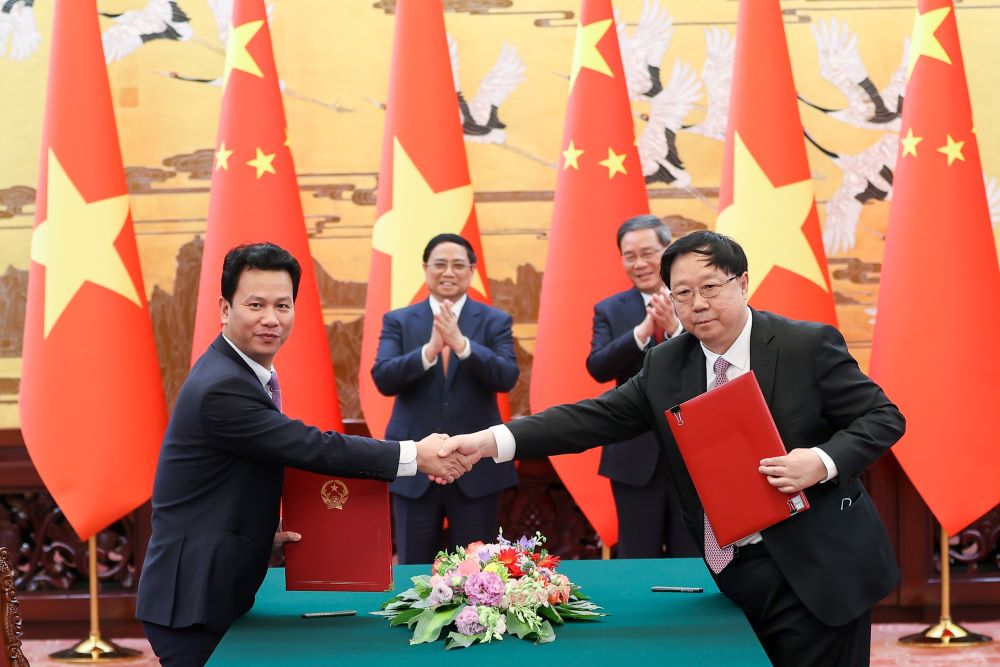
The agreements, signed today at the meeting between Prime Minister Chinh and Chinese counterpart Li Qiang in Beijing, cover immigration management, market supervision, smart border gate, and research and management of the marine environment in the Gulf of Tonkin.
The two prime ministers discussed some fields covering political trust, trade and investment, and people-to-people ties at the meeting during PM Chinh’s visit, which is the first by a Vietnamese PM to China in 7 years.
Accordingly, the leaders agreed to promote the joint statement on strengthening the Vietnam-China comprehensive strategic partnership with the exchange of visits of high-ranking officials and tightened collaboration between Parties, Governments, and National Assemblies.
PM Chinh reaffirmed that the relations with China are Vietnam’s priority in its foreign policy, while Li Qiang said Vietnam is among China’s priorities for neighborhood diplomacy.
They stressed the importance of cooperation in foreign affairs, defense security, border and maritime security maintenance and development, inter-local cooperation, and support in regional and international forums.
| Vietnam's Prime Minister Pham Minh Chinh (L) and China's Premier Li Qiang in China on June 26. |
.jpg)
On trade, PM Chinh said the two countries need to take advantage of geographical proximity to boost cooperation. He requested China to provide better access to Vietnamese farm produce and seafood; support Vietnam soon opening its trade promotion office in Chengdu of Sichuan and Haikou of Hainan; boost customs clearance at border gates; remove obstacles in some big projects in Vietnam; and speed up disbursement of China’s non-refundable aid.
In 2022, the two-way trade reached US$175 billion, accounting for one-fourth of China-ASEAN’s total trade. Vietnam is China’s 4th largest trade partner globally and the biggest in Southeast Asia.
Other possible cooperation fields would be finance, agriculture, transport, environment, healthcare, science-technology, digital transformation, green growth, circular economy, and climate response.
The two prime ministers envisaged connection via road, railway, and waterways, focusing on joint railway projects, resumption of commercial flights, water management in the Mekong River, and cooperation in education and tourism.
Regarding investment, Li Qiang said the Government of China would encourage leading companies to invest in Vietnam to make cooperation substantive and commensurate with the comprehensive strategic partnership.
Concerning maritime and regional issues, the two sides talked straightforwardly to stress the importance of curbing conflicts and maintaining peace and security in the East Sea (referring to the South China Sea).
Meanwhile, they vowed to cooperate with regional and international organizations, including the World Trade Organization (WTO), Asia-Pacific Economic Cooperation (APEC), Asia-Europe Meeting (ASEM), and ASEAN.