Vietnam committed to promoting sustainable Mekong – Lancang region
Vietnam will work with partners to build a green, sustainable, and inclusive Mekong-Lancang region, ensuring harmony between the present and the future, economic growth, and environmental protection.
The Vietnamese Government always values and will continue collaborating with China and the Mekong countries to promote the increasingly strong, effective, and sustainable development of Mekong-Lancang cooperation.
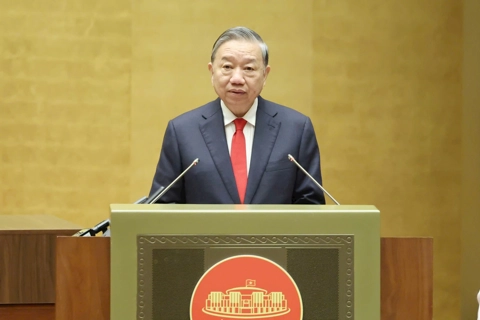
| Prime Minister Pham Minh Chinh during the conference. Photos: Nhat Bac |
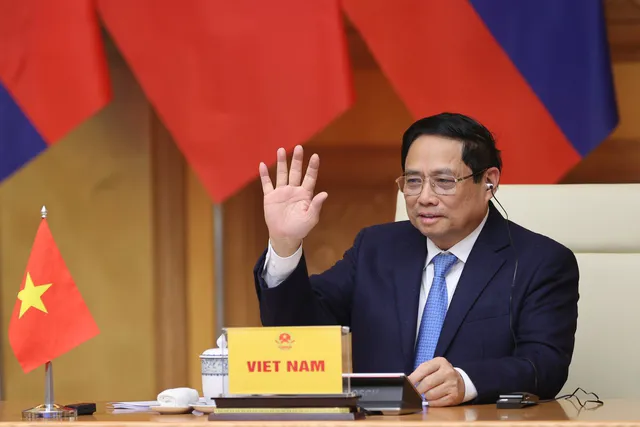
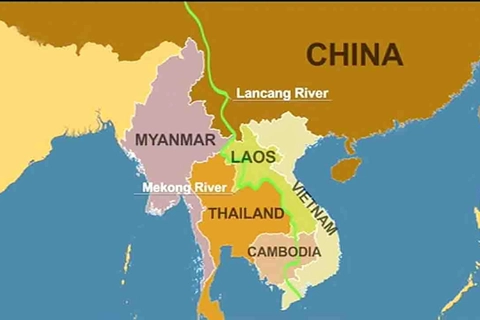
Prime Minister Pham Minh Chinh made the statement at the Fourth Mekong – Lancang Cooperation (MLC) Leaders’ Meeting (including Cambodia, Laos, Myanmar, Thailand, China, and Vietnam) via video conference on December 25.
The Vietnamese Government leader underscored the pivotal role of the Mekong-Lancang cooperation as a crucial mechanism uniting the Mekong countries and China, serving as a paradigm for common development and mutual prosperity. In the seven years of its establishment and growth, the MLC has achieved remarkable milestones characterized by enhanced cooperation mechanisms, more substantive content, and a deepening of friendship and mutual understanding among the people of the six nations, he noted.
Recognizing the swift and profound changes in the global economy, Chinh advocated for a comprehensive and innovative mindset to facilitate the robust development of the Mekong-Lancang countries. This approach entails involving the entire population and adopting committed, innovative, and breakthrough solutions.
Going forward, Chinh called for a focus on building a modern and developed Mekong-Lancang region, emphasizing the principles of resource development, mobilization, and efficient utilization.
This involves harnessing the potential and strengths of each country and the entire six-nation group, considering internal strength as fundamental and strategic and external strength as essential and pioneering.
“The central objective is to propel industrialization, modernization, and the development of independent, autonomous Mekong-Lancang economies that actively engage in extensive international integration and demonstrate substantial and effective progress,” Chinh said.
He also expected the region to build a green, sustainable, and inclusive Mekong-Lancang region, ensuring harmony between the present and the future, economic growth, and environmental protection, with humans at the center as the subject, driving force, resource, and goal of development, leaving no one behind.
Immediate priorities include supporting countries in achieving the United Nations' Sustainable Development Goals for 2030, adhering to the Paris Agreement on climate change, and commitments to reduce carbon emissions, thus fostering a green, circular economy. Furthermore, there is a need to strengthen basin-wide cooperation on ecological conservation, disaster prevention, and the efficient, sustainable, fair, and reasonable management and use of the shared Mekong-Lancang River, especially to avoid altering the river's natural flow, Chinh said.
“To build a better future for their people, the six countries must prioritize investment in human development, establish a comprehensive education and healthcare system, support the younger workforce in accessing modern science and technology, and create conditions for all citizens to benefit from the development process,” he continued.
Another focus, Chinh said, is to build a peaceful and cooperative Mekong-Lancang region. The six nations must continuously strengthen trust, sincerity, unity, and joint promotion of shared interests with an emphasis on multilateralism. There is a need to enhance complementarity between Mekong-Lancang cooperation and ASEAN and other regional cooperation mechanisms, make the most effective use of resources, create synergy, and spread benefits, he said.
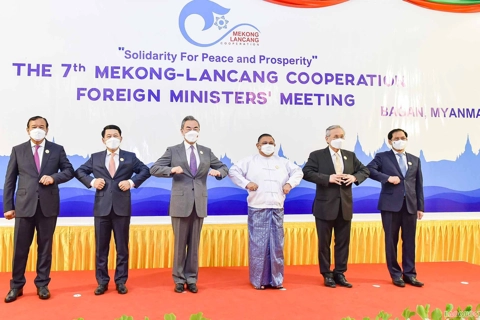
At the conference, the leaders highlighted the significant contributions of the MLC to peace, cooperation, and development in the Mekong subregion and beyond. They reiterated their commitment to close coordination in building a community for a shared future, peace, and prosperity among the Mekong-Lancang countries.
| Overview of the video conference. |
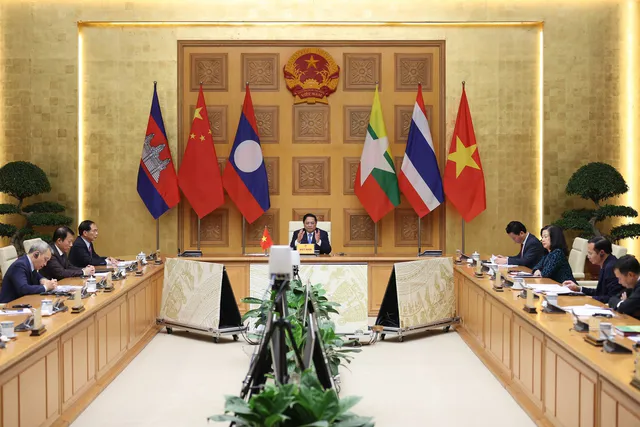
They welcomed the progress in water and environmental cooperation, especially the year-round sharing of hydrological information for the Mekong-Lancang River. Joint efforts in flood forecasting, disaster prevention, various programs, people-to-people exchanges, and educational activities were acknowledged for fortifying friendship and mutual understanding among the people of the six countries.
Concerning future cooperation, the leaders underscored a development-oriented approach, putting people first and maintaining harmony between man and nature. Innovation was highlighted as a driving force for development. In addition to strengthening existing cooperation programs, the leaders agreed to explore expansion into new areas, promoting high-quality, modernized cooperation to give new impetus to the sub-regional collaboration and assist countries in economic recovery and sustainable development.
The conference endorsed strengthening cooperation in building the Mekong-Lancang Economic Development Belt. Discussions also centered on the potential establishment of policy coordination and project implementation mechanisms to advance the Mekong-Lancang Innovation and Creativity Corridor and to seize development opportunities arising from scientific and technological progress.
Emphasis was placed on cooperation in digital transformation, smart customs, smart borders, smart connectivity, clean energy transition, green agriculture, climate change adaptation, and biodiversity.
Leaders also stressed the priority of sustainable management and use of natural resources, especially Mekong River water resources. This involves cooperation in sharing hydrological information, minimizing risks from natural disasters, and enhancing the capacity for water resource management.
Support was expressed for efforts to enhance coordination and harmony between the MLC and ASEAN, the United Nations' 2030 Agenda for Sustainable Development, and other regional cooperation mechanisms and initiatives.
The conference concluded with the leaders adopting the Nay Pyi Taw Declaration, the Mekong-Lancang Cooperation Action Plan for 2023-2027, and the Mekong-Lancang Innovation and Creativity Corridor Initiative.