Vietnam hopes for more JBIC support: Prime Minister
Prime Minister Pham Minh Chinh lauded the strategic partnership between Vietnam and Japan and hoped Japanese investors would contribute more to the country’s socio-economic growth.
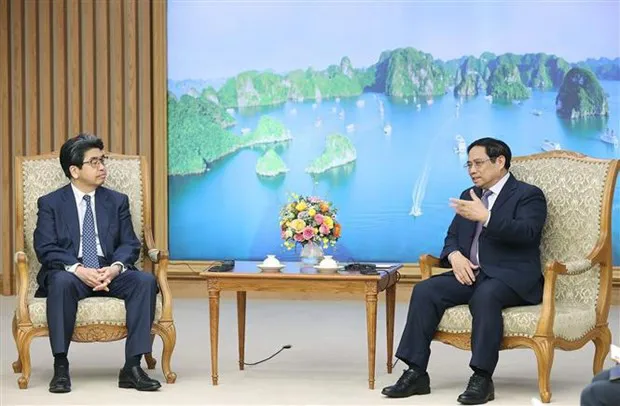
Prime Minister Pham Minh Chinh on September 14 suggested Hayashi Nobumitsu, Governor of Japan Bank for International Cooperation (JBIC), extend support for Vietnam’s post-pandemic socio-economic recoveries.
| Prime Minister Pham Minh Chinh (right) receives Hayashi Nobumitsu, Governor of Japan Bank for International Cooperation (JBIC) on September 14. Source: VNA |
The Prime Minister also hoped the Japanese bank would assist Vietnam in developing an independent, integrated, practical and effective economy whilst enhancing the consultancy in policy-making and human resources development.
Additionally, PM Chinh recommended JBIC foster private-public partnership (PPP) activities and make further investments in renewable energy transition and infrastructure development projects.
Chinh also wanted the bank to support Vietnam in innovation, digital transformation, and development of digital Government, digital economy and digital society, as well as the development of the auxiliary industry, to produce equipment for the renewable energy sector.
PM Chinh wished JBIC would expand preferential loans for both Japanese and Vietnamese companies so that they are able to partake in new-generation ODA projects.
He also encouraged Japanese firms to establish their factories in Vietnam, thus strengthening Vietnam’s position in Japan’s global supply chain and making Japan the largest investor in Vietnam.
JBIC should provide Vietnam with more assistance to help the country fulfill its commitments and reduce greenhouse emissions to zero by 2050, he said, adding that he wanted the bank to support Vietnam to approach the US$10 billion aid package that the Japanese PM Kishida Fumio pledged at the 26th United Nations Climate Change Conference of the Parties (COP26).
PM Chinh proposed that JBIC and the Japanese Government work with relevant parties to resolve the issues at the Nghi Son oil refinery plant in a win-win spirit and “harmonized interests, shared risks”.
On the occasion, PM Chinh appreciated the partnership JBIC has had with Vietnam through the provision of loans and encouragement of Japanese investment for key local infrastructure projects, as well as through active discussions with ministries and sectors of Vietnam.
The head of the Vietnamese Government also spoke highly of the strong, comprehensive and trustful Vietnam-Japan strategic partnership.
Japan remains one of the most important partners to Vietnam as the former is the largest ODA lender, the second largest labor cooperation partner, the third largest investor and the fourth largest trade partner to Vietnam, he said.
The total value of Japanese ODA projects in Vietnam is estimated at $30 billion. Japan has received some 350,000 Vietnamese laborers while there are now nearly 4,900 active FDI projects in the Southeast Asian country with total investment capital of more than $65 billion. Japanese investors have poured capital into nearly 4,900 FDI projects in the country. Bilateral trade value in 2021 was up 7.8% on year to $42.7 billion, and the six-month figure for 2022 increased by 11.9% on year to $23.4 billion.
Amid the adversities brought by the Covid-19 pandemic, the two nations have strengthened their partnership in all fields. Last year, the prime ministers of the two governments had three successful meetings with practical outcomes, thus lifting the two nations’ partnership to higher levels. Vietnam and Japan are preparing activities to commemorate the 50th anniversary of the establishment of diplomatic relations in 2023.
Vietnam always sees Japan as one of its long-term major strategic partners, PM Chinh said, adding Vietnam pledges to ensure political and social stability, develop a clear, transparent investment environment for Japanese investors, and assist them to deal with any issues.
In response, JBIC Governor Hayashi agreed with the suggestions of PM Chinh. He highly appreciated the effort and management quality of the Vietnamese Government.
Vietnam has stabilized macro-economic conditions in the world of adversities, maintained good growth and developed a potential market, he said, adding Vietnam will remain one of the top priorities for JBIC as well as other Japanese investors.
The Japanese official also recognized Vietnam’s dual target to cut greenhouse emissions to zero by 2050 and become a developed economy in 2045. As Vietnam is a key partner that shares a lot of goals with Japan, JBIC and the Japanese Government will accompany the country in taking drastic measures in climate change responses, especially regarding energy transition and renewable energy development, he said.
JBIC will provide financial aid, technical and technological assistance, and manpower support for Vietnam to not only cut emissions in production but also in other activities such as distribution and use of electricity, Hayashi said.
He stressed that he would have further activities and ideas to foster the bilateral strategic relation between Vietnam and Japan out of his affection and understanding of Vietnam. In addition, the Governor said he would work with relevant parties to settle the issues in the Nghi Son oil refinery project as suggested by PM Chinh.