Vietnam leverages AI to boost healthcare standards
Artificial Intelligence (AI) is considered a powerful tool that can enhance diagnostic and treatment capabilities in Vietnam's healthcare system.
THE HANOI TIMES — The application of Artificial Intelligence (AI) is showing promising results in Vietnam's medical diagnostics and treatment, helping to provide better healthcare.
Major General Dr. Le Huu Song, Director of the Military Central Hospital 108, made this statement at the Vietnam Health Forum 2025 held earlier this week in Hanoi.
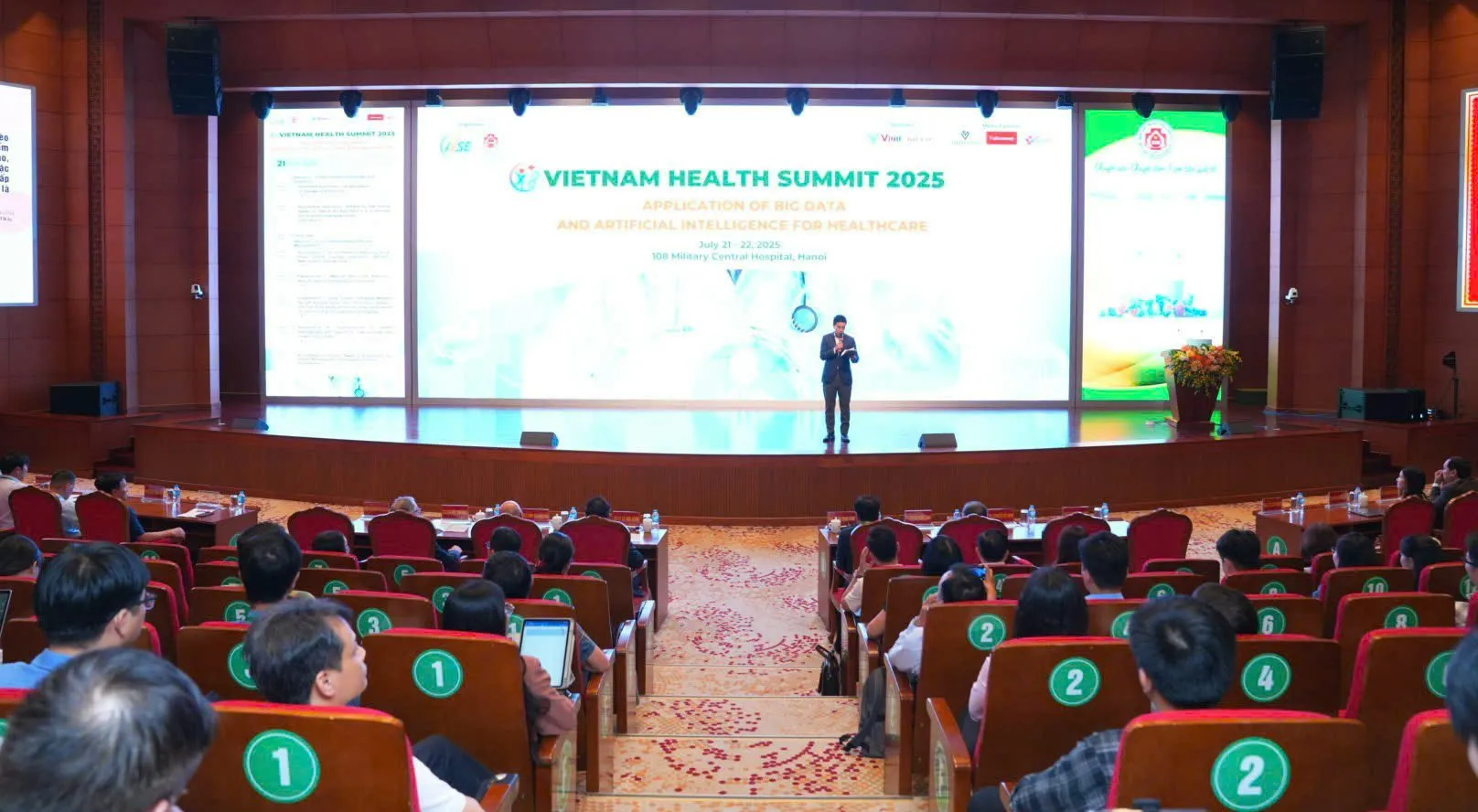
An overview of the Vietnam Health Forum 2025. Photo: Anh Kiet/The Hanoi Times
“Vietnam's Ministry of Health (MoH) has identified AI as a key solution in enhancing the healthcare system’s capabilities during the ongoing digital transformation,” said the director.
Song added that AI is increasingly being integrated into various medical fields, particularly diagnostic imaging, treatment optimization, and hospital management. Several major hospitals have piloted AI in clinical settings with encouraging results.

Major General Dr. Le Huu Song, Director of the Military Central Hospital 108, delivers a speech at the forum. Photo courtesy of the hospital.
AI-powered systems are utilized by central-level hospitals to interpret diagnostic imaging, such as X-rays, CT scans, and MRIs, facilitating the early detection of abnormalities and expedited clinical decision-making. AI-driven software for cancer treatment has been introduced, enabling the personalization of treatment plans based on individual clinical data.
"The adoption of advanced technologies has significantly improved organ transplantation, particularly lung and multi-organ transplants, in 2024. Since the country’s first organ transplant in 1992, Vietnam has performed over 9,200 such transplants," Song said.
He underscored that AI in healthcare is an inevitable trend because of its potential to elevate the quality and accessibility of healthcare nationwide.
However, the MoH understands that AI is a supporting tool that does not replace doctors and medical professionals. "The ministry plans to focus on completing legal regulations related to AI in healthcare to ensure that new technologies are applied safely and effectively in alignment with Vietnam’s healthcare system,” said the director.
Despite promising advances, integrating AI into Vietnam's healthcare sector faces several challenges. Talking about these issues, Prof. Dr. Guy Barrington Marks, President of the International Union Against Tuberculosis and Lung Diseases in Australia, said successful AI implementation requires technical expertise, financial sustainability, and socio-political commitment.
“Each of these factors is crucial to fostering an environment conducive to AI adoption,” Marks emphasized.

Prof. Dr. Guy Barrington Marks, President of the International Union Against Tuberculosis and Lung Diseases in Australia, speaks at the forum. Photo courtesy of the Military Central Hospital 108.
There is an urgent need for a comprehensive legal framework to support AI adoption. This framework is essential for addressing ethical concerns, data privacy, and the overall governance of AI technologies in healthcare, which are critical for building public trust and ensuring the safe deployment of AI systems.
"There is no referral system in the Vietnamese healthcare system. The public tertiary care centers in major cities are heavily oversubscribed, so record-keeping is typically manual. In this context, transitioning to electronic systems is a long-term aspiration rather than an urgent priority,” Dr. Nguyen Thi Thu Hien, Senior Clinical Expert of the Molecular Diagnostics Department at North Denmark Regional Hospital, shared with The Hanoi Times.

Dr. Nguyen Thi Thu Hien, Senior Clinical Expert of Molecular Diagnostics Department at North Denmark Regional Hospital.
"The Vietnamese government has announced the nationwide expansion of its electronic health record system. By applying AI, we can expect to witness groundbreaking innovations that will benefit not only its citizens, but also contribute to the progress of healthcare technology throughout the country," Hien said.
Speaking at the Vietnam Health Forum 2025, Nguyen Nhu Khoa, an AI consultant at FPT Digital, said that integrating AI into Vietnam's healthcare system presents several significant challenges.
The first is the issue of data limitations. AI systems require large, high-quality datasets to function effectively, and these are not yet consistently available in Vietnam's healthcare system.
The second is the shortage of highly qualified personnel. "There is a lack of professionals with expertise in both healthcare and AI, particularly those who can bridge the two fields and apply interdisciplinary knowledge effectively," said Khoa.
He added that infrastructure is another barrier. Many healthcare facilities, especially in remote and rural areas, still lack the necessary medical equipment and IT infrastructure to support AI deployment.
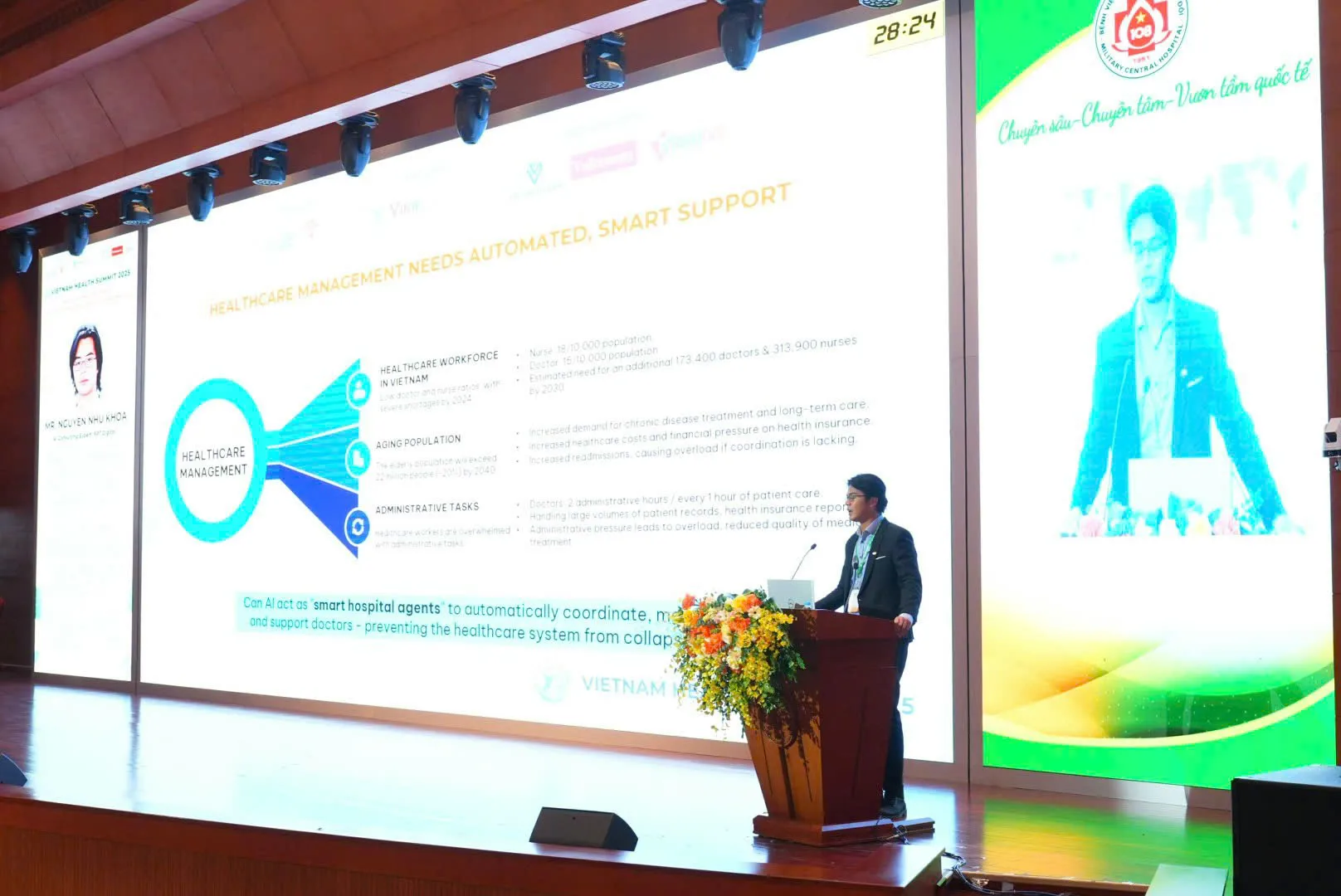
Nguyen Nhu Khoa, AI consultant at FPT Digital, makes speech at the event. Photo: Anh Kiet/The Hanoi Times
"Finally, the high cost of investment poses a major challenge. Developing, testing, and deploying AI solutions requires substantial financial resources, which is an obstacle for many healthcare institutions," said the consultant.
Addressing challenges
Themed “Big Data and Artificial Intelligence in Medical Diagnosis and Treatment,” the Vietnam Health Forum 2025 addresses global healthcare challenges.
The event brought together medical experts from Vietnam, Denmark, Australia, and France. It is expected to become a major biennial forum where healthcare professionals, researchers, and businesses can advance digital technology in Vietnam’s medical sector.
This year marks the forum's debut as an international event, with over 30 expert speakers and around 300 guests from more than 10 countries in attendance. The event's overarching goal is to improve healthcare quality and raise the profile of Vietnam's medical sector on the global stage.
The Association of Vietnamese Scientists and Experts Global (AVSE Global) and the Military Central Hospital 108 co-organized the event, which was sponsored by the Vingroup Innovation Foundation.

Time-lapse technology for embryo culture and selection combined using AI software are used in Hanoi's Vinmec Hospital to select good embryos, increasing the likelihood of IVF conception. Photo courtesy of the hospital