Log in
Hanoi

Vietnam parliament approves special finance-budget mechanism for Hanoi

Under the decision, the Hanoi People’s Council is now authorized to levy new fees and charges in the city, and adjust the existing fees and charges.

The National Assembly (NA) today [June 19] approved a special finance-budget mechanism with more autonomy for Hanoi.


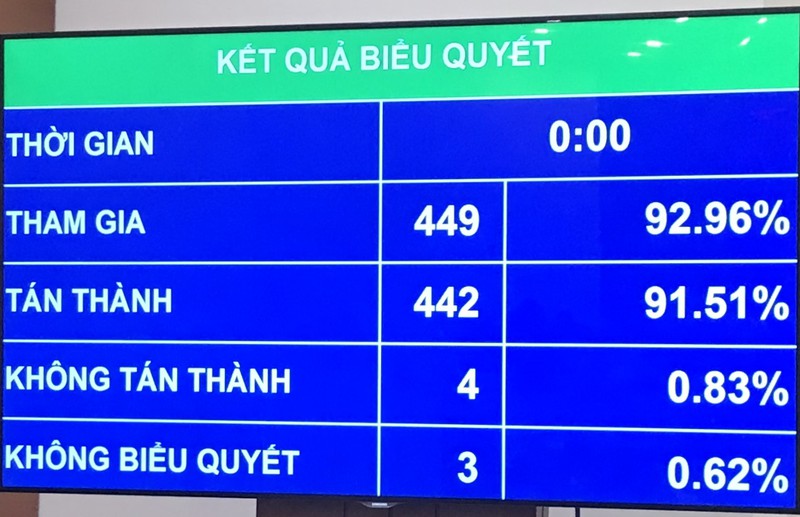
The National Assembly (NA) has approved the special finance-budget mechanism for Hanoi with the backing of 91.51% of its deputies present.

Under the decision, the Hanoi People’s Council is now authorized to levy new fees and charges in the city, as well as adjust the existing fees and charges.

Moreover, 100% of the revenue from the newly levied fees and charges will go to the city’s budget for future investment in socio-economic infrastructures, science and technological activities, education and healthcare, among others.

The new mechanism also allows Hanoi to retain 50% of the receipts from the sale of state-owned properties; 100% of proceeds from the divestment and privatization of state-owned enterprises.

Chairman of the NA Finance-Budget Committee Nguyen Duc Hai said while some deputies suggested the NA to reconsider the authorization for Hanoi to levy fees and charges, the NA Standing Committee opted to give Hanoi’s full authorization as it did recently to Ho Chi Minh City.

At that time, the Ho Chi Minh City People’s Council raised parking fees from VND5,000 (US$0.21) per car to VND30,000 (US$1.29) per hour; adjusted the environmental protection fees for industrial waste water and tuition fees, among others.

“The decision would ensure Hanoi’s leaders to have sufficient flexibility and decision making power in management,” Hai said.

Meanwhile, others expressed concern that allowing Hanoi to retain a 50% of revenue from sales of state-owned properties would erode the state budget.

Regarding this issue, Hai said government agencies subject to relocation are entitled to 70% of the revenue from the sale of their former offices to fund the new ones, which means only 30% are paid to the state budget.

Hai added the 50% amount received by Hanoi, therefore, would not have big impacts on the state budget revenue in the short term, while it encourages local governments and other agencies to improve efficiency in public asset management.

Additionally, Hanoi would have more resources to address issues related to urban planning and technical infrastructure development.


Reactions:
Share:
Trending
Most Viewed
Related news
Hanoi Metro launches automated ticket-control system to boost smart mobility

Hanoi Metro launches automated ticket-control system to boost smart mobility

Hanoi Metro has introduced a fully automated fare-collection system on the Cat Linh–Ha Dong line, marking a major milestone in the capital’s transition toward smart and green public transportation.

Hanoi to roll out time-based bans on polluting vehicles near pedestrian hotspots

Hanoi to roll out time-based bans on polluting vehicles near pedestrian hotspots

These locations already have the foundations for sustainable traffic and tourism management.

Hanoi, Seoul strengthen strategic cooperation in smart urban and river development

Hanoi, Seoul strengthen strategic cooperation in smart urban and river development

Both sides highlighted the strong foundation of their three-decade partnership and emphasized the need to deepen collaboration in innovation, urban planning and people-to-people exchanges.

Hanoi looks to Seoul’s Han River revival for Red River transformation

Hanoi looks to Seoul’s Han River revival for Red River transformation

The revival of the Han River transformed Seoul’s urban landscape, improved residents’ quality of life and supported South Korea’s broader growth, the possible transformation for the Red River.

Hanoi set for special measures to unlock mega projects

Hanoi set for special measures to unlock mega projects

Such a move would help Hanoi launch major infrastructure projects and advance the city’s long-term development.

Hong Van Commune rises as Hanoi’s emerging model for community-based tourism

Hong Van Commune rises as Hanoi’s emerging model for community-based tourism

Blessed with natural beauty, strengthened by deep cultural heritage and supported by its residents, Hong Van Village is emerging as one of Hanoi’s most distinctive tourism destinations. From ecology and agriculture to handicrafts and festivals, this Red River village is shaping a dynamic vision of sustainable community tourism for the capital.

Hanoi unveils digital heritage journeys to connect tradition with modern urban life

Hanoi unveils digital heritage journeys to connect tradition with modern urban life

Hanoi has launched a new digital heritage program that brings centuries-old cultural assets into a modern, interactive format. By mapping key monuments and creating themed journeys, the city aims to help residents and visitors explore its deep-rooted identity through fresh, engaging experiences.

Hanoi launches two-wheel electric vehicles to expand green urban mobility

Hanoi launches two-wheel electric vehicles to expand green urban mobility

Hanoi has introduced two-wheel electric vehicles for the first time in its transport network, offering residents a new green mobility option and marking a key step in the city’s smart-transport development.