Vietnam re-elected UNESCO General Conference vice president for 2025 term
Vietnam’s re-election as Vice President of the UNESCO General Conference proves the country’s growing stature, credibility and contribution to global multilateral institutions.
THE HANOI TIMES — Member states of the UNESCO General Conference have elected Vietnam as Vice President at the conference’s 43rd session in Samarkand, Uzbekistan, a move that will allow Vietnam to contribute more deeply to UNESCO’s activities.
The Vietnamese delegation, led by Deputy Minister of Foreign Affairs Ngo Le Van, is attending the UNESCO General Conference’s 43rd session from October 30 to November 13.
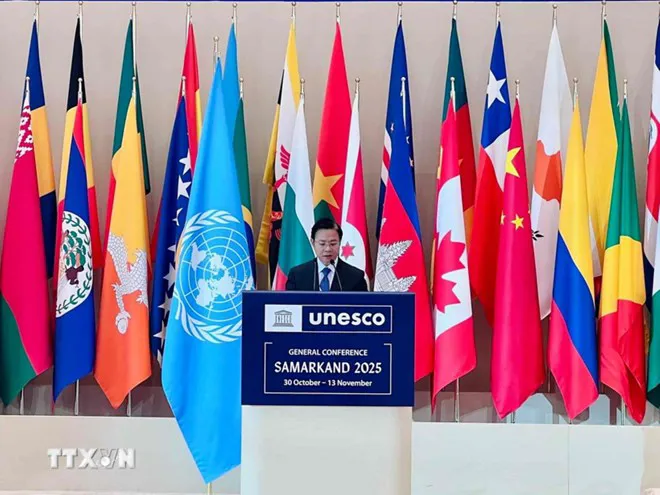
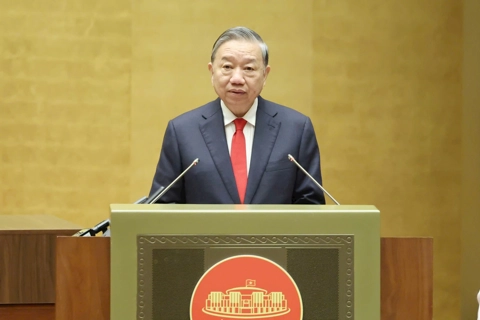
Deputy Minister of Foreign Affairs Ngo Le Van speaks at the UNESCO General Conference 2025. Photo: VNA
The election enables Vietnam to play a stronger role in shaping policies, coordinating initiatives and implementing UNESCO programs in education, culture, natural sciences, social sciences and information and communication.
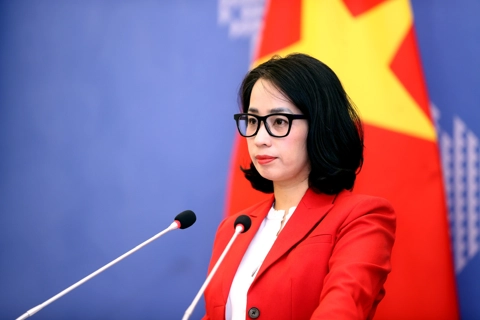
“This election reflects Vietnam’s growing reputation and capacity to contribute actively and responsibly to global multilateral efforts,” Hang said at a press briefing on November 6.
She said the result shows the international community’s trust in Vietnam’s leadership within UNESCO.
The General Conference is UNESCO’s highest decision-making body with 194 member states. It sets the organization’s strategies, policies, cooperation programs and budget and elects its governing bodies.
At the conference’s high-level session on November 4, Deputy Minister Ngo Le Van called for stronger multilateralism and global solidarity as one of UNESCO’s top priorities in a changing world.
He praised UNESCO’s 80-year legacy since 1945 for advancing peace, mutual understanding and sustainable development, calling the organization a true “House of Wisdom”.
Van also shared Vietnam’s national policies and initiatives across key fields.
In education, he said that the government will waive tuition fees for all public school students starting from the 2025–2026 academic year. The reform aims to build an inclusive, equitable and high-quality education system.
In culture, he emphasized that Vietnam considers culture a foundation of peace, progress and sustainable development.
Vietnam proposed that UNESCO recommend the United Nations launch an “International Decade of Culture for Sustainable Development”. The Vietnamese government is drafting a new resolution to promote and develop Vietnamese culture in the modern era, he said.
In science and technology, the deputy minister noted that Vietnam is implementing a national strategy on innovation and digital transformation to drive growth.
He cited the United Nations Convention against Cybercrime signing ceremony in October, hosted by Vietnam with the participation of 72 countries - one of the largest treaty-signing events in the past decade.
Vietnam also celebrated the 50th anniversary of UNESCO’s International Hydrological Program and the 60th anniversary of its Water Science Program, reaffirming its commitment to global digital and water security.
Deputy Minister Van highlighted Vietnam’s recent achievements in UNESCO designations, including the recognition of the Yen Tu – Vinh Nghiem – Con Son, Kiep Bac Complex as a World Heritage Site, Ho Chi Minh City’s inclusion as a UNESCO Creative City of Film and UNESCO’s commemoration of the 300th birth anniversary of scholar Le Quy Don.
“These recognitions bring pride to Vietnam and honor the universal values of cultural diversity and innovation,” he said.