Vietnam reaffirms commitment to gender equality after 30 years of Beijing Declaration
Thirty years after joining the Beijing Declaration, Vietnam has turned its commitment into tangible progress in gender equality, earning global recognition for advancing women’s empowerment nationwide.
THE HANOI TIMES — Vietnam’s implementation of the Beijing Declaration and Platform for Action over the past three decades has played a crucial role in advancing gender equality and empowering women across all sectors, according to the National Report on 30 Years of Implementation.
The report was released in Hanoi by the Ministry of Home Affairs in collaboration with UN Women Vietnam on October 31.
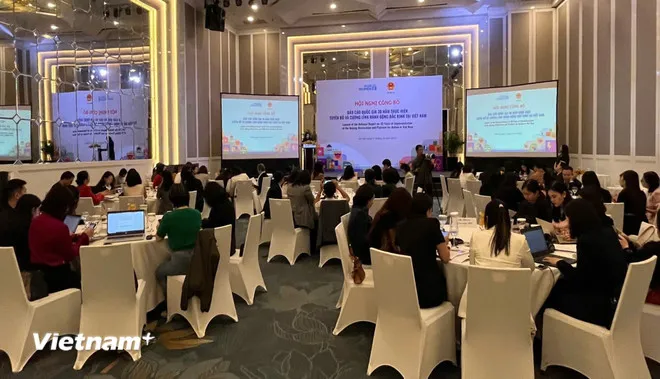
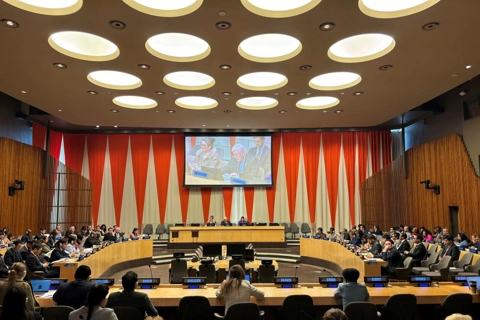
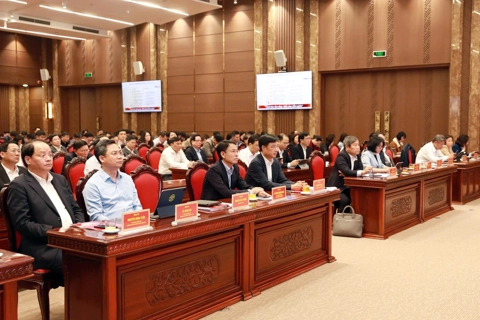
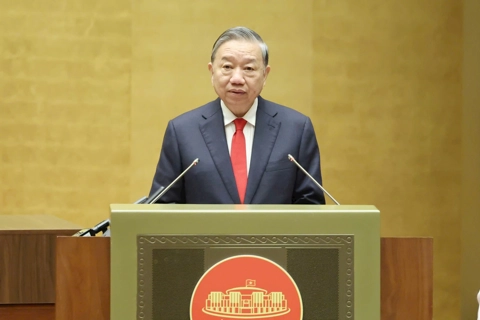
Overview of the event. Photos: Vietnamplus
The report reveals that the most significant achievement in recent years is the adoption and wide rollout of the National Strategy on Gender Equality for 2021–2030, a key framework driving progress in women’s empowerment nationwide.
Adopted at the Fourth World Conference on Women in Beijing in 1995, the Beijing Declaration was a landmark global commitment by 189 countries to promote women’s rights and gender equality into the 21st century.
Over the past 30 years, especially between 2019 and 2023, the Vietnamese Government has shown strong determination to advance gender equality by improving the legal framework and integrating gender perspectives into all national strategies, policies and programs.
Gender equality has been consistently recognized as a foundation for social progress and sustainable development, aligned with the principle of “leaving no one behind.”
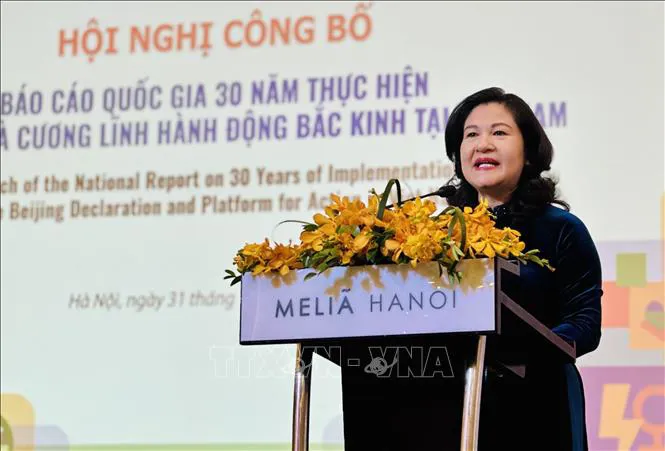
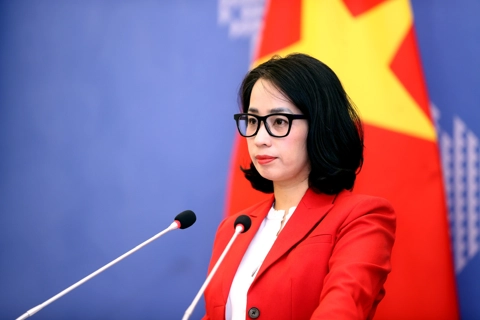
Deputy Minister of Home Affairs Nguyen Thi Ha.
According to Deputy Minister of Home Affairs Nguyen Thi Ha, the report highlights Vietnam’s core lesson that economic development must go hand in hand with social progress and equity, placing women and children at the center of all development policies while strengthening state management and gender mainstreaming across all sectors and levels.
“This 30-year national report is not only a reflection of Vietnam’s achievements but also a reaffirmation of its strong commitment to gender equality and women’s empowerment in the years ahead,” said Ha.
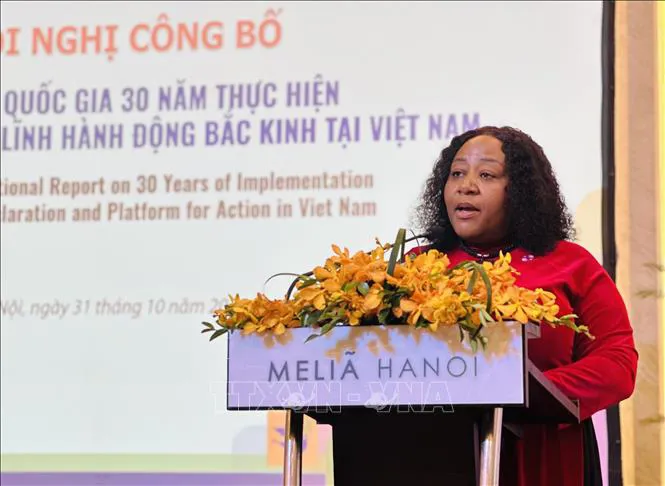
Caroline Nyamayemombe, UN Women’s Country Representative in Vietnam, commended Vietnam’s leadership, saying the nation stands out globally for its proactive approach and forward-looking vision on gender equality.
According to Nyamayemombe, UN Women remains committed to working with the Ministry of Home Affairs, relevant ministries, social organizations and development partners to turn Vietnam’s strong political commitments into tangible results for women and girls, in every province, community and household.
Health care for ethnic minority and migrant women has been strengthened, and services for survivors of gender-based violence have expanded significantly in both quality and coverage.
In April 2024, Vietnam was elected to the Executive Board of UN Women for the 2025–2027 term, affirming its growing international role in promoting gender equality.
Despite progress, challenges remain including persistent gender stereotypes, limited gender-disaggregated data, rapid population aging and the disproportionate impact of climate change and pandemics on women and children. These issues call for continued political commitment, innovative solutions, and stronger international cooperation.
Delegates at the launch discussed women’s employment, welfare and livelihoods in the new context, sharing ideas and policy recommendations to promote substantive gender equality.
The outcomes will help strengthen policies and mobilize resources for the effective implementation of the 2021–2030 National Gender Equality Strategy and the 2030 Sustainable Development Agenda, ensuring that no one is left behind.
|
Thanks to consistent policy efforts, Vietnam has achieved remarkable results: Over the past 20 years, it has been among the fastest countries in narrowing the gender gap and was one of the earliest to meet Millennium Development Goal 3 on gender equality. In 2024, Vietnam ranked 72nd out of 146 countries in the Global Gender Gap Index, up 11 places from 2022. Women make up 30.26% of the National Assembly, one of the highest rates in the Asia-Pacific region. Women account for 46.8% of the national workforce, with 62.4% labor force participation. Female-owned businesses represent 28.2% of total enterprises, while gender gaps in basic education continue to narrow. |