Vietnam, Russia promote negotiations on nuclear power cooperation
Rosatom’s ongoing cooperation with Vietnam, together with renewed talks on a bilateral agreement, highlights both countries’ intent to reintroduce nuclear energy and expand their strategic energy partnership.
THE HANOI TIMES — Vietnam and Russia have agreed to accelerate talks on agreements concerning nuclear power cooperation, along with boosting oil and gas ties.
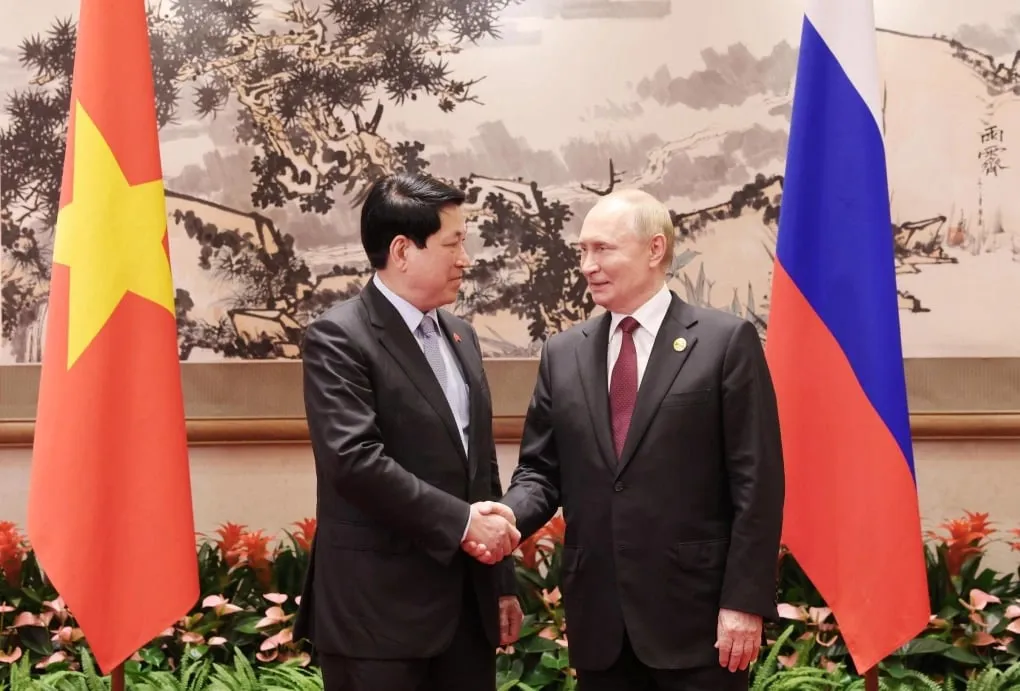
Vietnamese President Luong Cuong and Russian President Vladimir Putin in Beijing on September 3. Photos: VNA
The news was reported from a meeting between Vietnamese President Luong Cuong and Russian President Vladimir Putin on the sidelines of the 80th anniversary of the victory over fascism in Beijing on September 3.
The two leaders shared their determination to intensify negotiations, reflecting Vietnam’s continued interest in diversifying its energy sources, ensuring long-term energy security and pursuing a low-carbon future.
Russia, with its extensive expertise in nuclear technology and international projects, has been one of Vietnam’s most significant partners in this field.
Cooperation between Russia and Vietnam in nuclear energy development began in the 1980s when the Soviet Union supported the construction of a research institute in Da Lat, the central coast province of Lam Dong.
In 2012, the two sides signed a memorandum of understanding to build the Ninh Thuan nuclear power plant, but the project was suspended in 2016 over financial and safety concerns.
Vietnam has resumed its nuclear ambitions in 2022 when the government approved the National Power Development Plan VIII, which highlights nuclear power as a potential energy source in its power mix by 2050. Under the plan, nuclear power is projected to contribute 8,000 MW by the year.
Russia’s state-owned nuclear corporation Rosatom has remained engaged with Vietnam, offering training programs for Vietnamese engineers, supporting research at the Da Lat Nuclear Research Institute, and exploring small modular reactor technologies suited for Vietnam’s conditions.
The renewed push for a bilateral cooperation agreement signals that both sides are considering practical pathways to reintroduce nuclear energy into Vietnam’s future power mix.
The acceleration of negotiations on nuclear cooperation demonstrates both nations’ intent to build on their long-standing partnership and explore new strategic areas, reinforcing the importance of energy in bilateral relations.
Trade and investment in spotlight
Apart from nuclear cooperation, both leaders reaffirmed commitments to deepen oil and gas collaboration, supporting joint ventures such as Vietsovpetro and Rusvietpetro, which have long been pillars of Vietnam–Russia economic ties.
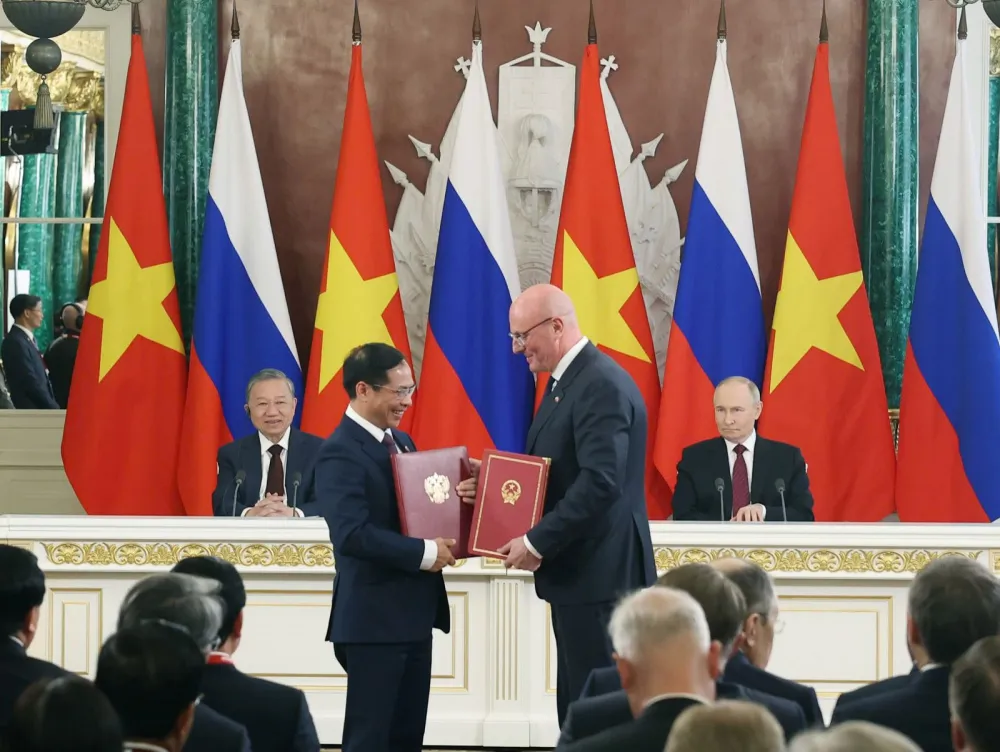
Vietnam and Russia ink an agreement on oil and gas cooperation during the visit by General Secretary To Lam in mid-May 2025.
They also agreed to expand cooperation in defense, cybersecurity, maritime scientific research, healthcare, education, transportation and tourism, while strengthening coordination in multilateral forums such as the United Nations and ASEAN.
The two countries have made trade and investment a key pillar in the relations. Statistics from Vietnam’s customs show that two-way trade gained 26% year-on-year to reach US$4.5 billion in 2024, but it was much lower than the $5.5-billion figure in 2021 due to transportation, logistics and payment issues.
Vietnam is now Russia’s biggest ASEAN trading partner. The potential remains large and the two countries have vowed to boost trade by making full use of the Vietnam–Eurasian Economic Union free trade agreement (EAEU includes Russia, Armenia, Belarus, Kazakhstan and Kyrgyzstan).
Since the establishment of diplomatic relations in 1950, Vietnam and Russia have maintained close and multifaceted ties, upgrading to a Comprehensive Strategic Partnership in 2012.
At the meeting, President Luong Cuong reaffirmed that Vietnam treasures its traditional partnership with Russia, supporting Russia’s stable development and constructive role in global affairs.
He noted that Vietnam is ready to promote cooperation between Russia and ASEAN, while welcoming Russian enterprises to expand investment in Vietnam’s industrial parks, pharmaceuticals, information technology and digital economy.
President Putin emphasized Russia’s appreciation for its friendship and multifaceted cooperation with Vietnam, expressing confidence that Vietnam will continue to achieve major successes and contribute more to the world’s peace, cooperation and development.
Both leaders showed their determination on boosting trade and investment ties, open door to each other’s more products along with tightening traditional fields like energy while implementing the Vietnam-Russia comprehensive cooperation plan by 2030.