14TH NATIONAL CONGRESS OF THE COMMUNIST PARTY OF VIETNAM
Log in
Vietnam

Vietnam says ASEAN doesn’t want to get trapped between competition of major powers

Vietnam’s top diplomat said ASEAN wants all countries around the world and those in the region to make constructive contributions, supporting and promoting peace and stability of Southeast Asia.

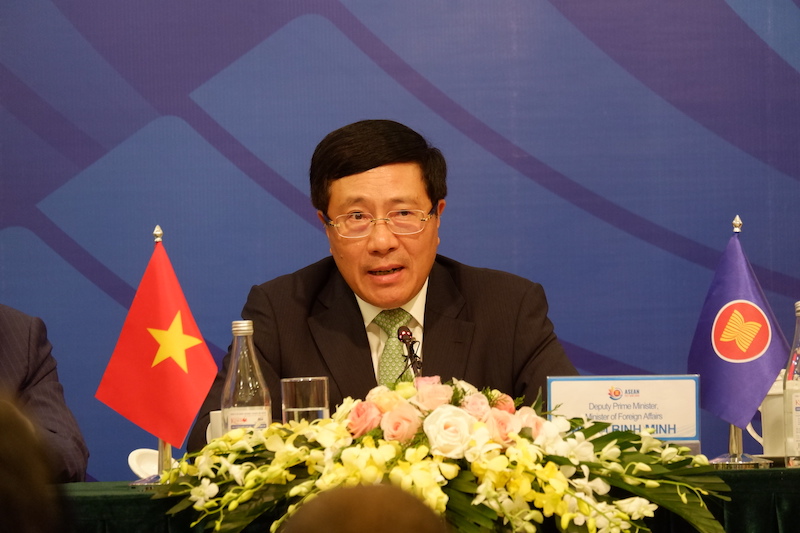
Southeast Asian country don’t want to be stuck in competition of major countries, Vietnam’s Deputy Prime Minister and Foreign Minister Pham Binh Minh said last weekend after the conclusion of ASEAN foreign ministers’ meetings.

 Vietnam’s Deputy Prime Minister and Foreign Minister Pham Binh Minh speaks at an international press meeting on September 12. Photo: Minh Tuan

Mr. Minh acknowledged that competition of major powers is present and is discussed in many fora across the world. “It’s obvious that this is seen in Southeast Asia – a strategic geographic area.”

The issue was mentioned at the recently-concluded East Asia Summit (EAS) and ASEAN Regional Forum where topics of strategic nature are discussed.

In a statement on the 53rd anniversary of the establishment of ASEAN, ASEAN foreign ministers noted growing uncertainties resulting from the changing geo-political dynamics in the regional and global landscape, and reiterate their commitment to maintaining Southeast Asia as a region of peace, security, neutrality and stability, and strengthening peace-oriented values in the region in line with international law.

They also committed to strengthening ASEAN Centrality and encourage the constructive engagement of ASEAN’s external partners, through ASEAN-led mechanisms such as the EAS, ARF and ASEAN Defense Ministers’ Meeting Plus (ADMM-Plus), in building mutual trust and confidence as well.

“ASEAN countries want all countries around the world and those in the region to make constructive contributions, supporting and promoting peace and stability of Southeast Asia,” Vietnam’s top diplomat noted.

The tensions overshadowed the ARF, a political and security forum between ASEAN foreign ministers and 27 partners, on Wednesday.

China’s Foreign Minister Wang Yi told the ASEAN ministers that the United States was interfering in the South China Sea and was driving its militarization.

Meanwhile, in a separate virtual meeting a day later, US Secretary of State Mike Pompeo called on Southeast Asian countries to review ties with Chinese state-owned enterprises amid territorial disputes in the sea.

Washington recently announced sanctions on 24 Chinese entities involved in building artificial islands in disputed waters and installing missile systems on them.

A joint statement released late on Thursday said “Concerns were expressed by some Ministers on the land reclamations, activities, and serious incidents in the area, which have eroded trust and confidence, increased tensions, and may undermine peace, security, and stability in the region.”
Reactions:
Share:
Trending
Most Viewed
Related news
COC talks to resume by December: Filipino FM

COC talks to resume by December: Filipino FM

09 Sep, 20:59

ASEAN and China have negotiated on such a COC since 2002 with a view to reaching law-abiding rules on the South China Sea, but the coronavirus outbreak has delayed the talks.

Hanoi’s Party chief outlines agenda at voter meeting

Hanoi’s Party chief outlines agenda at voter meeting

The candidates pledge institutional reform, infrastructure upgrades and a stronger focus on science, technology and public services as the capital prepares for the 16th National Assembly term.

Young generation steps up to power climate action

Young generation steps up to power climate action

As climate risks intensify across Southeast Asia, young people are being called upon to move from awareness to action, harnessing technology, creativity and policy engagement to accelerate environmental solutions.

Hanoi positions itself at forefront of implementing key Party resolutions

Hanoi positions itself at forefront of implementing key Party resolutions

The three resolutions on education, healthcare reform and cultural development are closely interconnected and mutually reinforcing, all directed toward building a capital that is cultured, civilized, modern and happy.

Party Chief urges stronger state economy and cultural drive

Party Chief urges stronger state economy and cultural drive

Developing the state economy and Vietnamese culture forms the twin pillars of a unified development strategy, one strengthening material capacity, the other reinforcing cultural and social resilience.

Putting people first: Making happiness Hanoi’s measure of success

Putting people first: Making happiness Hanoi’s measure of success

A central message of the 14th National Party Congress and the 18th Congress of the Hanoi Party Organization (2025-2030) is that people’s happiness must be at the core of development. All policies be grounded in citizens’ legitimate rights and interests, with public satisfaction serving as the ultimate measure of success. 

The flavors of Vietnamese Tet linger around the world

The flavors of Vietnamese Tet linger around the world

From Osaka in Japan to Lorient in France, Vietnamese communities are spreading the spirit of Tet through vibrant cultural celebrations.

Vietnam pledges to enhance tax reforms after EU listing decision

Vietnam pledges to enhance tax reforms after EU listing decision

Vietnam has reaffirmed its strong commitment to meeting international standards on tax transparency and information exchange following the European Union's adding Vietnam to its list of non-cooperative tax jurisdictions.

Tet at the mission: Peach blossoms bloom in Africa

Tet at the mission: Peach blossoms bloom in Africa

Under the dry winds and red dust of Abyei and Bentiu, mission compounds glow with paper blossoms and steaming banh chung, as each square rice cake carries from Vietnam to Africa a message of solidarity, compassion and enduring cultural identity.