Vietnam welcomes foreigners but closely eyes Covid-19 infection risk
Reopening international flights is a matter of time, so it is crucial to control the foreign source of Covid-19 in Vietnam.
The Vietnamese Ministry of Health has issued a guide to facilitate the entry and stay of foreigners in the country while trying to minimize the risk of Covid-19 infection in the community, Kinh Te & Do Thi reported.
As of September 24, Vietnam has passed 23 straight days without transmission in the community while the capital city has gone 36 consecutive days without confirming local infection.
However, Vietnam is ready to respond to all situations, reinforcing the prevention of the pandemic, but still creates favorable conditions for foreigners to enter and do business in the country.
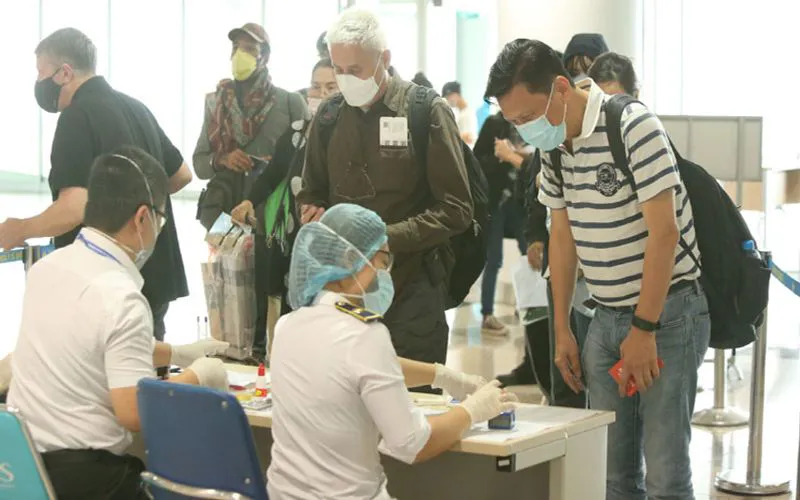
| Passengers make medical declarations at Noi Bai International Airport. Photo: Ngoc Tu |
The Southeast Asian country has so far reopened six international air routes, including flights to Taiwan, Guangzhou, Japan, South Korea, Cambodia and Laos, which are those with low risk of contracting Covid-19.
Vietnam's Ministry of Health will then ensure these arrivals undergo thorough health check sat the country's airports before being transported to local quarantine facilities. All will be tested for Covid-19.
New quarantine rules adapting to border reopening
Incoming foreigners who stay in Vietnam for more than 14 days will have to pay testing and quarantine expenses. The conditions will apply to holders of official and diplomatic passports, staff of international organizations, experts, managers, skilled workers, foreign investors, students and foreign relatives of Vietnamese.
The visitors, who are required to have coronavirus-free certificate issued three to five days before boarding, will be tested using real-time polymerase chain reaction (real-time PCR) for SARS-CoV-2 twice in Vietnam.
The fee for each real-time PCR test is VND734,000 (US$31.62). The fee for each quick test is VND238,000 (US$10.25). The test will be done upon entry and again six days later. If testing positive for SARS-CoV-2, the foreign person will be taken to a medical facility for treatment. If testing negative twice, they will still be put under quarantine for 14 days.
International arrivals who opt to stay at government-run quarantine facilities are required to pay at least VND120,000 (US$5.17) per day. They need to choose the tentative quarantine facility before entering Vietnam.
According to the new guidance of the Ministry of Health, incoming passengers will be allowed to be quarantined at the company’s factory, the company headquarters, or at a designated hotel/facility.
All incoming passengers to Vietnam will be tested for Covid-19.Photo: Dong Duong |

Deputy Director of the Hanoi Department of Tourism Ngo Minh Hoang said that the Hanoi city government has decided to select eight hotels for quarantining foreign experts, skilled workers and flight crews entering Vietnam. They include Hoa Binh Hotel, Sofitel Metropol, InterContinental Hanoi Westlake, Muong Thanh Grand Xa La, Binh An 1, Binh An 2, Wyndham and Crowne Plaza West Hanoi.
These hotels have a total of 915 rooms, equivalent to 1,354 beds. All the hotels are experienced in hosting guests for quarantine. They have prepared adequate staff, tools and food for guests in accordance with the regulations issued by the Ministry of Health, Mr. Hoang added.
The cost for 14-day quarantine period at three- to five-star hotels in Hanoi city ranges from VND16.8 million - VND56 million (US$728 - 2,427) per person.
Tightly controlling the source of Covid-19 infection
According to medical experts, reopening international flights is inevitable, so it is crucial to control the foreign source of Covid-19 disease by coordinating with related countries to conduct test and early detect virus carriers.
Dr. Tran Dac Phu, advisor to the Vietnam Center for Emergency Response to Public Health Events, said that ensuring accurate test is the health sector’s responsibility.
The guide of the Ministry of Health shows the cautiousness of the government in supporting foreigners in the country but at the same time ensures pandemic prevention measures, Dr. Tran Dac Phu added.
According to Dr. Nguyen Huy Nga, former director of the Preventive Medicine Department under the Ministry of Health, Vietnam’s testing capacity has been significantly improved.
Vietnam has 137 laboratories capable of detecting SARS-CoV-2 by using RT-PCR technique. This helps Vietnam respond to the increasing number of tests when more international flights are relaunched.
When safety screening measures are enforced from the airport in a methodical and scientific way, reopening more international routes is not a concern, Dr. Tran Huy Nga said.
Talking to Kinh Te & Do Thi, Deputy Director of the Hanoi Center for Diseases Control and Prevention (CDC) Khong Minh Tuan said that the medical team at Noi Bai International Airport is still working at full capacity and complies with all steps for the pandemic protocols.