Vietnamese Gov’t pushes plan to unlock public gold reserves
Vietnam ranked among the region’s largest gold consumers with an average annual demand of about 55 tons in 2025.
THE HANOI TIMES — Prime Minister Pham Minh Chinh has asked the State Bank of Vietnam (SBV) to swiftly complete a study on solutions to mobilize foreign currency and gold bullion held by the public.
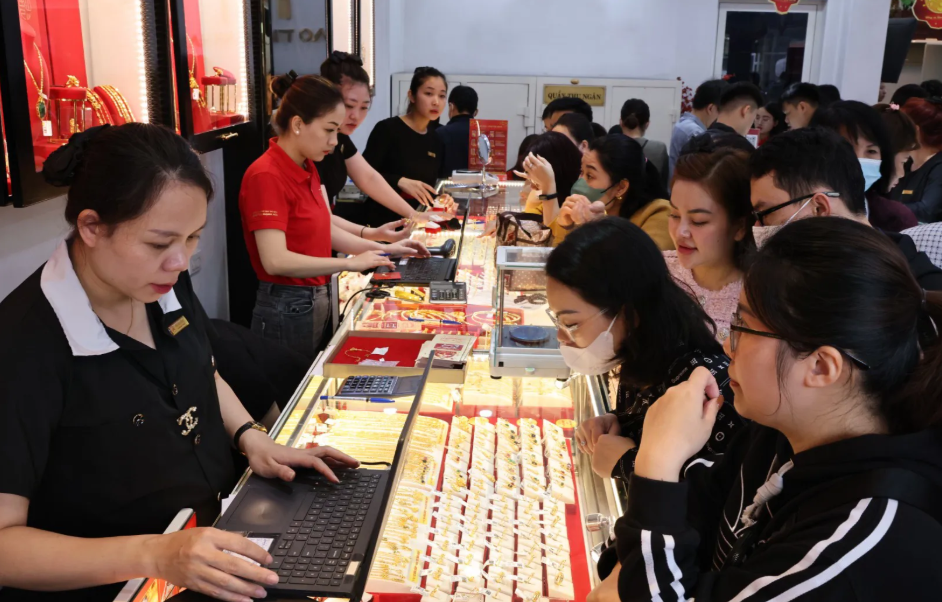
Customers buy gold at a jewelry shop on Nguyen Trai Street in Hanoi. Photo: Hai Linh/The Hanoi Times
The request, made on February 8, also urged the central bank to finalize its research and submit proposals for establishing a national gold exchange or trading platform without further delay.
He stressed that the banking regulator should report concrete solutions to attract idle foreign currency and gold bullion among households into the formal financial system.
Mobilizing dormant resources such as foreign currency and especially gold has been raised repeatedly in recent years.
According to data released by the World Gold Council, last year, Vietnam ranked among the region’s largest gold consumers with an average annual demand of about 55 tons. This level exceeds Thailand, which ranks second in Southeast Asia with consumption of 48.8 tons, followed by Indonesia at 47.3 tons.
In 2022, the organization also identified Vietnam as the regional leader in gold demand growth.
However, experts note that most of this gold remains stored privately in household safes, representing a vast pool of resources that has yet to be converted into capital for the economy.
Many specialists agree that tapping this gold resource requires a gradual and cautious approach rather than abrupt administrative measures.
In the near term, regulators should prioritize improving the legal framework and regulatory mechanisms, as well as standardizing gold-linked financial instruments. They should also develop trading, custody and supervision infrastructure and strengthen transparent communication to build public trust.
To change the long-standing habit of holding physical gold, the state needs to develop attractive, transparent and easily tradable gold-backed financial products. These could include gold bonds modeled on India’s experience or digitized gold certificates that are fully convertible into physical gold at any time.
This year, Vietnam is targeting double-digit economic growth while maintaining macroeconomic stability and safeguarding major economic balances.
In the same dispatch, the prime minister also outlined key orientations for monetary and fiscal policy management.
He instructed the Ministry of Finance (MoF) to pursue a reasonably expansionary fiscal policy in close coordination with monetary policy.
The ministry was also tasked with effectively mobilizing domestic and external resources, developing capital markets, attracting foreign direct investment and creating medium- and long-term funding channels for the economy.
In addition, the MoF was assigned to pilot a digital asset trading platform, bring the international financial center into official operation in February and advance the development of the carbon market. It is also required to support small and medium-sized enterprises in accessing finance and further improve the National Investment One-Stop Portal.
The SBV was directed to manage monetary policy proactively, with close attention to inflation, exchange rates and interest rates, while avoiding market shocks.
The banking sector is also expected to control credit growth in a suitable and transparent manner, channel capital into production and priority sectors and manage risks.
Meanwhile, the Ministry of Industry and Trade was asked to step up trade promotion, diversify export markets and implement measures to ensure energy security.
The ministry must prevent shortages of electricity and petroleum products under all circumstances.
.