Vietnamese intellectuals in France aspire to contribute to nation's "rising era"
Each speaker addressed a different topic, but all shared a common goal: to contribute to the development of Vietnam in its "rising era," as called for by General Secretary To Lam.
In response to General Secretary To Lam's call to lead Vietnam into a "rising era," a seminar entitled "The Role of Vietnamese Intellectuals in France in Advancing Science and Technology Development in the New Era" was held on November 30 in Paris.
| Vietnamese Ambassador to France Dinh Toan Thang at the event. Photos: VNA |
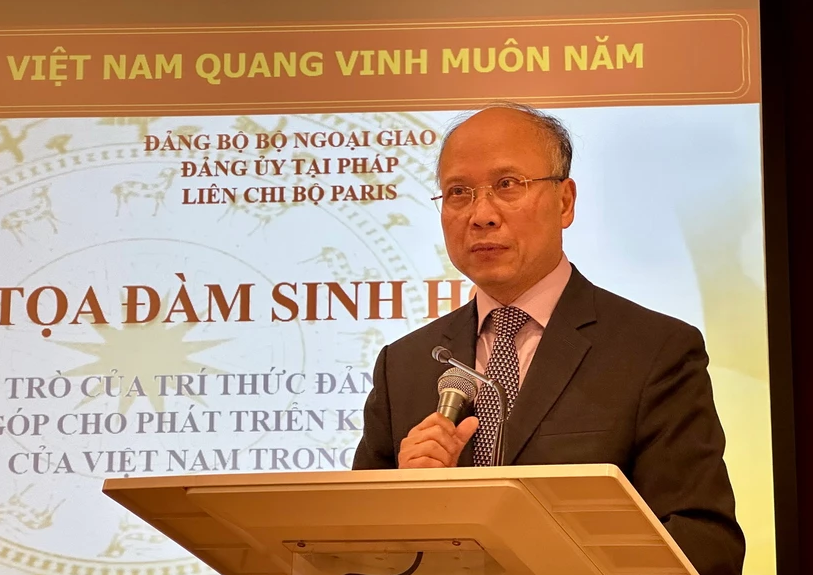
Vietnamese expatriate intellectuals gathered in Paris to discuss their contributions to Vietnam's scientific and technological development in the new era. At the seminar, nearly 80 Vietnamese expatriates listened to passionate insights from distinguished speakers, including professors, doctors, and experts working in critical fields in France such as economics, healthcare, energy, construction, and higher education. These are key areas of focus for the Vietnamese Party and State as the country looks to future growth.
Prof.-Dr. Nguyen Duc Khuong expressed his concerns about the challenges Vietnam faces in becoming an economically developed nation by 2045, while Dr. Vo Toan Trung emphasized the importance of developing the country's medical and biotechnology sectors as a pillar of Vietnam's economy.
Meanwhile, Dr. Tran Duy Chau advocated the involvement of Vietnamese expatriates in building Vietnam's energy infrastructure, particularly in nuclear and green energy, while Prof. Dr. Ha Minh Cuong proposed solutions for developing an education and training strategy to build a skilled workforce of scientists and technicians.
Each speaker addressed a different topic, but all shared a common goal: to contribute to the development of Vietnam during its "rising era," as called for by General Secretary To Lam. The delegates expressed their desire to contribute their expertise and efforts to the progress of the homeland and hoped that the Vietnamese government would recognize these potentials and make the most effective use of this potential.
In an interview with Vietnam News Agency in France, Dr. Vo Toan Trung noted that the overseas intellectual community is large and influential across many countries. He emphasized that to help Vietnam become a modern, developed, and prosperous nation, the government should develop a strategic approach that focuses on key sectors like biotechnology, semiconductors, information technology, digital transformation, and green energy.
| Prof. Dr. Ha Minh Cuong at the event. |
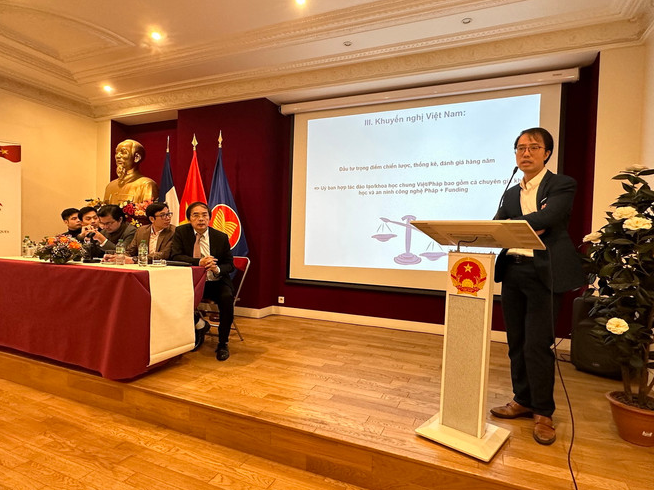
In addition to harnessing internal resources, Vietnam should make the most of external support, particularly from the Vietnamese intellectuals abroad. "The expertise of the overseas intellectual community is a valuable resource that can assist the country in many areas, from strategic development consulting to training a high-quality workforce to participating in or leading technology projects that will help achieve national goals," he stressed.
Impressed by the passion and commitment of the Vietnamese expatriates, Vietnam’s Ambassador to France, Dinh Toan Thang, praised the seminar as "practical, beneficial, and meaningful," especially as the country prepares for its new era of development.
"The presentations and contributions were closely aligned with domestic goals and should be compiled into a document for policymakers to study and refer to. It is important to work with the overseas Vietnamese intellectuals to implement these ideas," the Ambassador noted.
Ambassador Thang also emphasized the importance of the Vietnamese intellectual community in France in contributing to the country's development strategy and hoped that the initiative would continue, attracting more Vietnamese expatriates and French friends to support Vietnam's development. This would not only elevate the Vietnam-France strategic partnership but also turn ideas into actions for the betterment of Vietnam, he noted.
Speaking at the Ho Chi Minh Academy on November 25, General Secretary To Lam outlined his vision for the "new era" and the "era of national growth," emphasizing that it is a period of development, prosperity, and wealth under the leadership of the Communist Party of Vietnam. This era aims to successfully build a socialist Vietnam, where the people are prosperous, the nation is strong, and the society is democratic, just, and civilized. Every citizen will enjoy a life of comfort and happiness, receive support for their development and wealth creation, and contribute more to peace, stability, and development in the region and the world. The ultimate goal of the "era of rising strength" is for a wealthy, strong, democratic, just, and civilized society, to develop under socialism and stand shoulder to shoulder with the world's leading powers. The top priority in this new era is to achieve the strategic goals for 2030 when Vietnam will be a developing country with a modern industry and high average income. By 2045, Vietnam aims to be a developed socialist nation with a high income. The era will ignite a strong national spirit, self-reliance, confidence, and pride, fostering a desire for national development. It will also align the power of the people with the forces of the times, combining national strength with global progress. |