Vietnam’s National Assembly: a journey of 75 years
The NA has so far ratified five constitutions, including those of 1946, 1959, 1980, 1992 and 2013.
Over the past 75 years since the first legislature, the National Assembly has made great contribution to the smooth operations of State apparatus.
Chairwoman of the National Assembly (NA) Nguyen Thi Kim Ngan. Photo: Baodantoc |
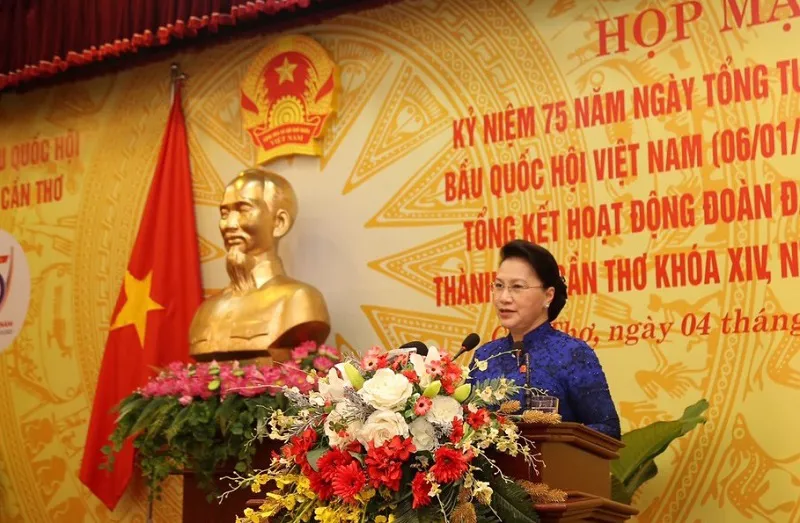
The legislative body, whose first legislature was elected in 1946, has ratified hundreds of laws and codes, institutionalized the party’s policies, forming a firm, consistent, and transparent legal framework for the development, stable defense and security, and international integration, according to Chairwoman of the National Assembly (NA) Nguyen Thi Kim Ngan.
On January 4, the chairwoman said at a meeting in Can Tho where she met her constituents to celebrate the 75th anniversary of the first NA general election (January 6, 1946).
Ms. Ngan said over the last 14 terms, legislative activities have increasingly corresponded to the reality with improved quality, contributing to resolving many problems facing society and the country’s development.
The NA deputies have upheld their role sand responsibilities, actively serving as a bridge between the Party and the State and voters, she noted.
The NA has also made reforms in Q&A sessions, ensuring quality and efficiency and meeting the requirements of national development.
Notably, the NA has been applying advanced technologies to its operations
So far, the NA has ratified five Constitutions, including those of 1946, 1959, 1980, 1992, and 2013.
Each Constitution has marked a country’s stage of development and served as the foundation for improving the legal system and building a socialist rule-of-law state of Vietnam.
The 1946 Constitution was the first constitution in the constitutional history of the Vietnamese State.
It comprises the Preamble, seven chapters with 70 articles, clearly defining the nation’s tasks to defend the territorial integrity, gain complete independence and build the country on the democratic foundation. It confirms three basic principles, namely the unity of all people regardless of race, gender, social class and religion; protection of the people’s democratic freedoms; and building of a strong and clear-sighted administration of people.
The 1959 Constitution was adopted during the socialist construction process in the North and struggle for liberation of the South and national reunification.
It is composed of the Preamble, 10 chapters with 112 articles, affirming “Vietnam is an inseparable unified North-South bloc”.
The constitution provides the political, socio-economic regimes; the relationship of equality and mutual assistance among nationalities; the responsibilities and powers of state agencies; the rights and obligations of citizens, aiming to bring into full play the people’s great creativity.
The 1980 Constitution marked the national reunification and transition to socialism throughout the country.
It provides the political, economic, cultural and social regimes, the fundamental rights and obligations of citizens, the organizational structure and principles for operation of state agencies.
The 1992 Constitution was born in the initial period of national renewal. It defines the political, economic, cultural and social regimes, defense, security, the fundamental rights and obligations of citizens, structure, and principles for organization and operation of state agencies, institutionalizing the relationship between the Party, people and State.
The 2013 Constitution came at a time of accelerated comprehensive national renewal, national construction and defense, and international integration. It inherited the core and fundamental values of the 1946, 1959, 1980 and 1992 Constitutions.
The constitution has demonstrated the “Party’s will and the people’s heart”, reaffirming the Communist Party of Vietnam’s role of leading the State and society while expressing the confidence, will and aspirations of the vast majority of the people.
The constitution values the human rights, the fundamental rights and obligations of citizens, promoting the role of the people as masters in building the state apparatus, and exercising the political, civil, economic, cultural, social, defense, security and diplomatic rights.
It affirms the legislative, executive and judiciary powers; defines the basic principles for renewal and perfection of the state apparatus; ensures the assignment of responsibility, coordination and control of powers among state agencies; and delegates full powers and responsibilities to the National Assembly, the President, the Government, People’s Courts, People’s Procuracies and local administrations in running the country.