Which kind of new era?
Now, they have created a trilateral framework for cooperation in all fields, especially on military and security issues and in defense.
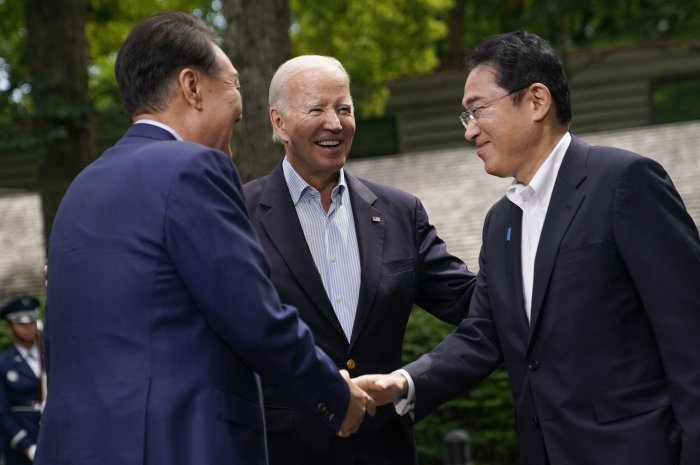
It was the power of words that US President Joe Biden, South Korea's President Yoon Suk Yeol, and Japanese Prime Minister Fumio Kishida had used to describe the significance and importance they attached to the trilateral summit they held at Camp David on the outskirts of the US capital Washington last week. They called it "historic". They wrote down in their joint statement: "We, the leaders of Japan, the Republic of Korea (ROK), and the United States, convened at Camp David to inaugurate a new era of trilateral partnership".
President Joe Biden (C) smiles as South Korean President Yoon Suk-yeol (L) and Japanese Prime Minister Fumio Kishida shake hands at the trilateral summit at Camp David in Maryland on August 18, 2023. Photo by Nathan Howard/UPI |
"Historic event" and "a new era of trilateral partnership" - both characterizations weren't exaggerated for them and exactly that made China and North Korea become deeply concerned. From the tough reactions by China and North Korea could be lernt and expected that their ties with China and North Korea would further deteriorate in the coming times.
For the US, Japan, and South Korea, the recent Camp David summit was in fact historic because it was the first official trilateral one although both Japan and South Korea are militarily strategic and traditional allies of the US and Japan and South Korea have always been relying on the US for security and defense. Now, they have created a trilateral framework for cooperation in all fields, especially on military and security issues and in defense. Furthermore, they agreed to institutionalize this framework. They turned their Camp David summit and their joint military exercises into annual events. They have agreed to a new security pledge, committing them to consult with each other in the event of a security crisis or threat in the Pacific and to share information via an emergency hotline between their Capitals. They pointed out in their statement that they will set up an "early warning system" to share information and coordinate on "possible disruptions to global supply chains as well as to confront and overcome economic coercion."
With these summit results, they are still a little bit far from becoming allies like Nato members and they didn't form some kind of "Asian Nato". But they have already built a new power block in East Asia and in Indopacific as well. They ushered in a new era of their partnerships.
A new era of partnerships for them implicates at the same time a new political, military, and security constellation in East Asia and in the Indopacific. It will change these Three's strategic standing, military powers, and coordinating capabilities in Northeast Asia, in the Taiwan Strait zone, and in Southeast Asia as well as in the entire Indopacific. Now, the US and Japan, South Korea will have another bulwark in their network of military and security bilateral and multilateral agreements and links in the Indopacific. For the US, Japan, and South Korea, cards will be re-shuffled and new trumps have been created for all present and future power and interest games in this region. Therefore, a new era of partnership for the US, Japan, and South Korea also means a new situation for many others in many aspects of this region.
Disclaimer: The views expressed by Ambassador Tran Duc Mau are his own and do not necessarily reflect the opinions of The Hanoi Times.