World Bank economist suggests how to turn Vietnam into digital powerhouse
To become a digital powerhouse, Vietnam will need to offer the conditions that will enable its local operators to adopt and adapt to new global digital technologies.
The domestic private sector should ensure to remain dynamic over time as the innovation cycle is very short in the digital economy.
This is one of the measures that World Bank (WB) Lead Economist and Program Leader for Vietnam Jacques Morisset wrote a post on the organization's blogs recently to turn Vietnam into a digital powerhouse.
Morisset noted that to keep the private sector agile and motivated to adopt new technologies, the government should act to preserve competition when some markets are almost naturally dominated by digital champions because of their know-how, network externalities, and economies of scale.
Vietnamese are using cell phones but have limited digital skills. Source: World Bank’s Taking Stock, August 2021. Chart: Nguyen Ngan |
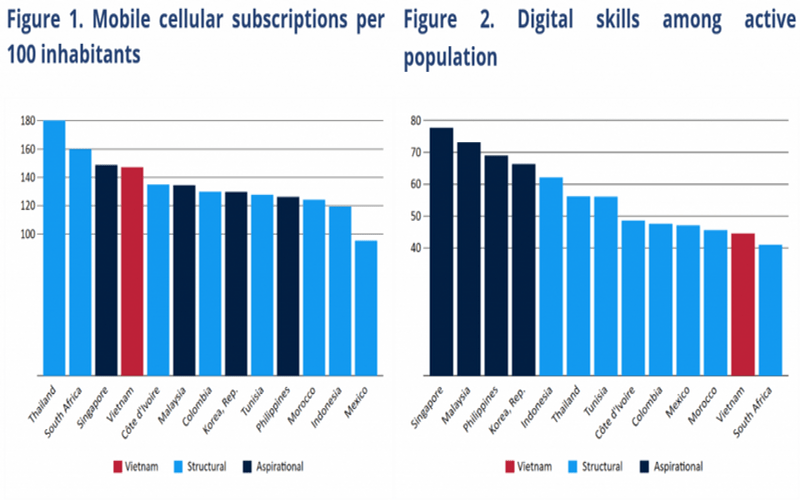
“Today, Vietnam compares to peer and aspirational comparators in penetration of mobile phones, its citizens and enterprises are well connected to the Internet. Its digital infrastructure is quite modern, covering all provinces, and funded by forward looking national telecommunication companies,” Morisset wrote.
The WB expert cited the latest edition of the WB’s Taking Stock report which argues that the country will need to do more if it wants to become a digital powerhouse as envisioned in the socio-economic development strategy adopted by the Vietnamese Communist Party in February 2021.
“The social task then becomes to correct the failure which means Vietnam needs to ensure the development of a digitally skilled labor force, the emergence of a dynamic and agile local private sector, and good but secure access to information," the economist said.
The second measure is to ensure the availability of a labor force with digital skills. This is central because up to one third of existing jobs in Vietnam are at risk to be lost in a five-year span due to digitalization.
In successful countries, the government has acted to address the market failure by removing legal obstacles to labor mobility; providing information to workers on labor market trends and demands to inform their decision making; improving the quality of technical/vocational education programs; and supporting financially firms and workers in their efforts to acquire sets of new skills.
Jacques Morisset, World Bank Lead Economist and Program Leader for Vietnam. Photo: WB |

The third and last measure by the government is to facilitate access to data and information. This is a public good by definition as the benefits of sharing information largely exceed the cost of collecting it.
Morisset advised that the Vietnamese Government can improve access to information by developing inter-operability across its databases and through open data initiatives, which consist of sharing online public data in a user-friendly manner.
Vietnam would need to correct these three market failures urgently to set the country on the path to achieve its ambitious digital economy goals, the WB expert concluded.
However, he stressed that it will also be important to be careful not to create new government failures as well-intended but misguided government interventions could exacerbate rather than address initial market distortions.
As a principle, the Government’s interventions must be designed and implemented in close collaboration with the private sector and with maximum transparency to avoid their capture by either vested public or private interests, Morisset said.
He stated that digital revolution has never been just about discovering breakthrough technologies. To become a digital powerhouse, Vietnam will need to offer the conditions that will enable its local operators to adopt and adapt new global digital technologies.