Xi Jinping’s visit to Vietnam: Deciding new path for relationship
A common political ideology is believed to bind the relationship between the two communist parties and the countries, which have extensive relations, especially economic ties.
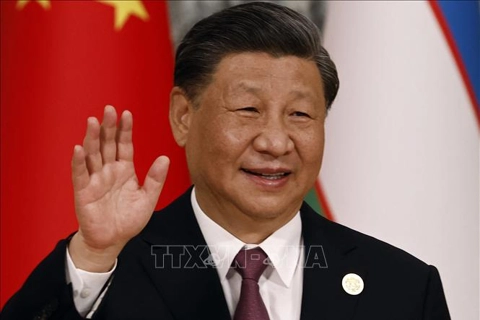
The official visit to Vietnam by Chinese President Xi Jinping is expected to determine the direction of the relations between the two countries.
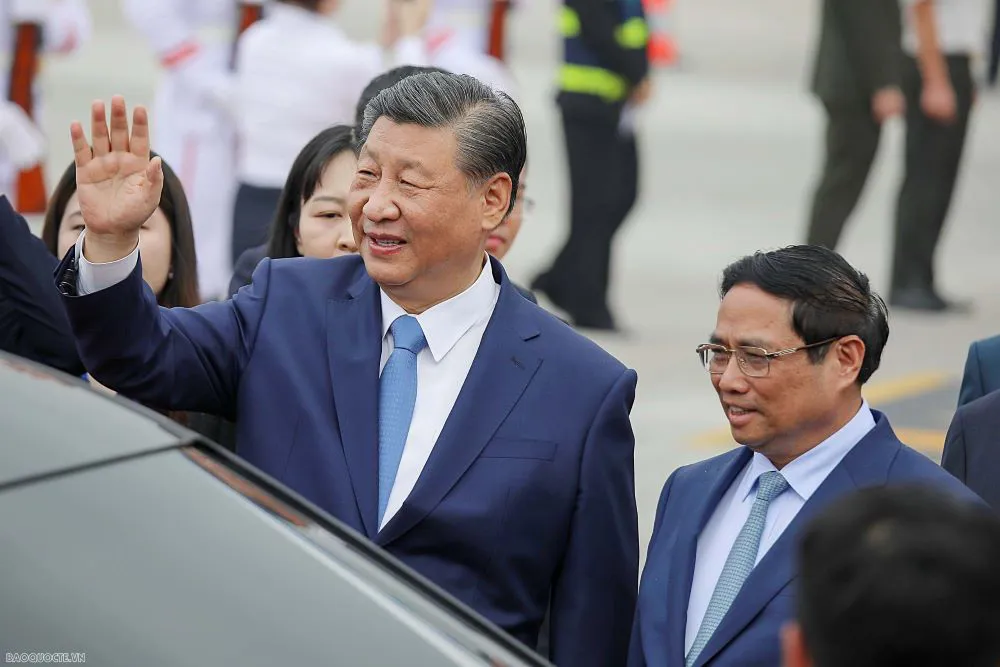
| Chinese President Xi Jinping arrives in Hanoi on Dec 12. Photo: Baoquocte |
Chinese Ambassador to Vietnam Xiong Bo told local media ahead of Xi’s two-day visit starting December 12.
Two sides will ascertain with clarity what course the two countries’ relationship will take in the new circumstances, state media quoted the ambassador as saying.
Discussions will prioritize the exchange of visits by top leaders of the Communist Parties and States as both countries pursue communism, Ambassador Xiong Bo said, noting that Vietnam-China relations are unique for their shared political doctrine.
The direction would motivate the development of the relations which have been upgraded to a comprehensive strategic partnership for 15 years. The top leaders are also expected to discuss the regional and global situations in which maintaining peace and development in East Asia is valued.
Meanwhile, the Vietnamese Ambassador to China Pham Sao Mai believed that the two sides would discuss issues relevant to the better development of the comprehensive strategic partnership by promoting high-ranking exchanges. At the same time, the two sides should work closely in different fields, especially trade, to make the cooperation more substantial.
The Vietnamese ambassador stressed the importance of reinforcing political trust.
As the two countries share about 1,500 km of land border, maintaining the border of peace and stability becomes critical. The two sides have worked to implement three legal agreements on the land border and have always said to make full enforcement.
On maritime issues, the two sides reached a consensus on restraint and dispute settlement to maintain peace and stability under international law, including the United Nations Convention on the Law of the Sea 1982 (UNCLOS). They have also promoted negotiations on maritime issues while implementing the Declaration on the Conduct of Parties (DOC) in the South China Sea and substantively building the Code of Conduct (COC) in the South China Sea. In 2000, Vietnam and China inked an agreement on maritime delimitation and fisheries cooperation in the Gulf of Tonkin.
According to Chinese Ambassador Xiong Bo, the two countries are likely to sign dozens of agreements between party organs, government agencies, and decentralized cooperation, in the areas of defense and security, justice, communications, development connectivity, economic ties, trade and investment, digital economy, green growth, farm produce trading, irrigation, and maritime cooperation.
In the meantime, journalist Wei Wei, Head of the Vietnamese Department of China Central Television, said it’s necessary to diversify people-to-people ties for further understanding and better relationships, especially among young people.
Comprehensive relations
The two neighboring countries of Vietnam and China share the same political doctrine which is believed to bind the relationship between the two communist parties and the countries.
Both ambassadors highlighted the political relations as China was the first country to establish diplomatic relations with Vietnam, dated January 18, 1950.
The ambassadors listed some exchange visits over the past time. The most typical one is the visit paid by CPV’s General Secretary Nguyen Phu Trong on October 30-November 1, 2022 shortly after the conclusion of the 20th CPC Congress.
This year marked a series of trips, including that paid by Vietnamese State President Vo Van Thuong to Beijing for the Belt and Road Forum (BRF) in October; Prime Minister Pham Minh Chinh attended the World Economic Forum (WEF) in Tianjin in June and the China-ASEAN Expo (CAEXPO) and the China-ASEAN Business and Investment Summit (CABIS) in September; Truong Thi Mai, Permanent Member of the CPV’s Secretariat to Beijing in April.
In early December, Chinese Foreign Minister Wang Yi visited Vietnam for the 15th meeting of the Steering Committee for Vietnam-China Bilateral Cooperation, while throughout 2023, the secretaries of Guangxi, Yunnan, and Hainan – three provincial-level localities bordering Vietnam, came to the neighboring country.
The exchange between the parties, governments, parliaments, and fatherland fronts is held frequently while decentralized cooperation has been strengthened, according to Ambassador Xiong Bo.
Both ambassadors stressed the role of trade between the two countries. Since 2004, China has become Vietnam’s biggest trading partner. Between January and October, two-way trade hit US$139.2 billion, according to Vietnamese customs, and $185 billion according to Chinese customs.
With this figure, China remains Vietnam's largest trading partner and the second-largest export market. Meanwhile, Vietnam remains China’s leading trading partner in ASEAN and the fourth globally.
Ambassador Xiong Bo said Vietnam is among the few countries that maintain stable trade with China and is the only country that keeps its export growth with this neighboring country.
He said that China seeks to open its market to Vietnam’s farm produce, especially fruits to balance the trade. One of the fruits with export growth is durian. In the first 10 months of this year, the exports hit $1.95 billion. The two countries are working to make fresh coconut the next staple of trade.
Regarding investment, China’s investment in Vietnam hit $3.06 billion between January and November, accounting for 18.7% of Vietnam’s total foreign investment, making it the fourth largest investor, after Singapore, South Korea, and Hong Kong (China).
Other fields of cooperation include tourism, culture, and education. Following the resumption of commercial flights, the frequency between the two countries has increased to 200 flights per week. In the first 11 months of this year, Vietnam welcomed 1.5 million Chinese arrivals. At the same time, China has resumed granting visas to Vietnamese students and workers.