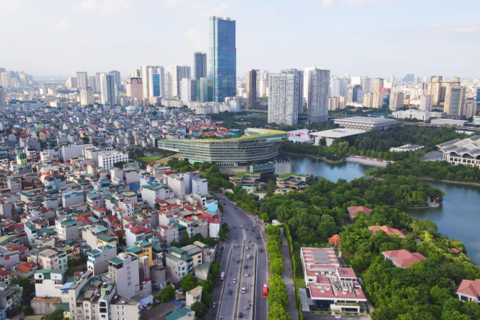
Amended capital law should make Red River a top priority: lawmakers
For thousands of years, the Red River has been the main engine of Hanoi's growth.
New riverfront designs are key to the future cityscape that could thrive on Hanoi's sustainable, green growth, National Assembly deputies said on November 27.
Lawmakers said the amended Capital Law should include measures to make riverfront development a highlight of modern, sustainable urban design.
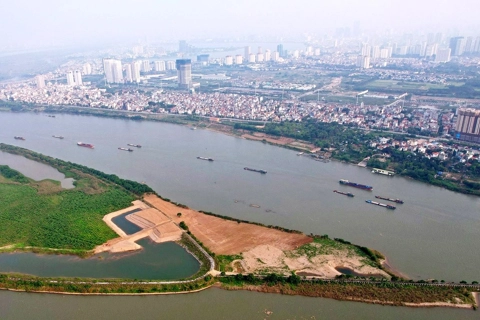
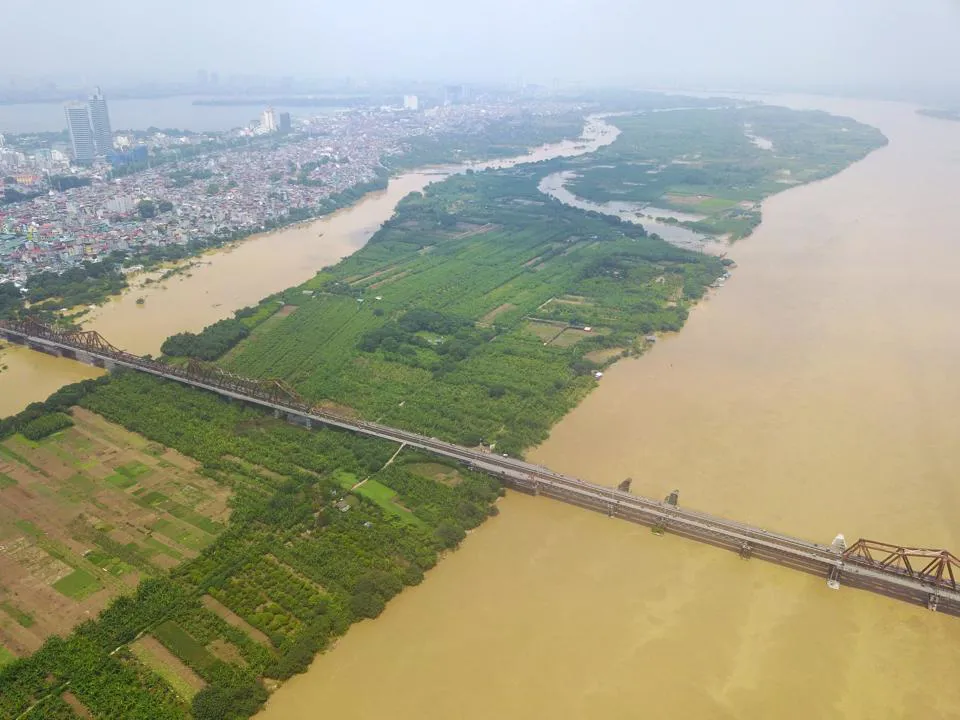
| The Red River Islet from a bird's eye view. Photo: Hai Linh/The Hanoi Times |
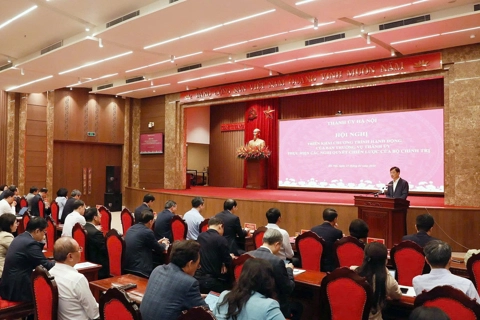
Representative Ta Thi Yen from the northern province of Dien Bien said that Hanoi is one of the most important socio-economic drivers of Vietnam, as the city is endowed with potential for technological advancement and human resources development.
The lawmaker appreciated the policy of power decentralization, which will allow Hanoi to make its own decisions in socio-economic projects, especially in landscape planning.
"Under the amended Capital Law, Hanoi will be able to develop new residential areas along the banks of the Red River, creating a new growth momentum for the capital," she said.
Based on the experience of provinces and cities such as Nghe An, Ho Chi Minh City and Haiphong, which have benefited from such development plans, I strongly suggest that there should be solutions to turn riverbank development into a boost for the city."
Deputy Truong Thi Ngoc Anh from the southern city of Can Tho agreed that the amended Capital Law is needed to soon institutionalize the ideas and goals of Hanoi's development.
The new law must solve three major problems in Hanoi's development plan, which are related to making the capital a metropolis and the growth engine for the Red River Delta and the Northern Key Economic Zone, she said.
"Hanoi's design plan must be put under the strict scrutiny of the Party and the government," she said.
In recent years, the government and the Hanoi People's Committee have taken the Red River as the axis for the future urban design of the capital.
In 2022, the Hanoi People's Committee announced the special design plan for the Red River residential area. According to the plan, the region will stretch about 40 kilometers from the city's northern border with Vinh Phuc province to its southern border with Hung Yen province.
The region will cover 13 districts of Dan Phuong, Me Linh, Tay Ho, Ba Dinh, Hoan Kiem, Bac Tu Liem, Hai Ba Trung, Dong Anh, Long Bien, Gia Lam, Hoang Mai, Thanh Tri and Thuong Tin with 55 of their communes.
The region will be developed in three parts: a natural and ecological reserve, a public and commercial area, and a historical, agricultural, and aquatic center. It will be home to about 300,000 people by 2030.
A city surrounded by rivers
Waterways, especially the Red River, have been an essential part of Hanoi's history. Due to its location, the name of Hanoi means "the city surrounded by rivers".
Because of these characteristics, Hanoi was chosen as the capital of ancient Vietnam in the early 1000s. Since then, the Red River has been the source of life for the townspeople of Hanoi for thousands of years.
City planners have selected several projects to develop the areas along the Red River, including those that will form the riverfront residences and a cultural and natural park on the islet.
According to Hoang Van Cuong, Vice Rector of the National University of Economics, the Red River projects will create new cultural spaces, tap the full potential of cultural values, and transform cultural heritage for tourism development.
"The Red River will become one of the main economic drivers for Hanoi, providing water transport and connecting residential areas on both banks," he said. "There will be modern commercial and service centers with unique, attractive designs in the riverfront areas."
Architect Le Hoang Phuong, director of the Hanoi Center for Architecture and Planning under the Ministry of Construction, said the Red River will be the spatial axis for cultural creativity, so the transformation of the Red River will be a highlight that epitomizes Hanoi's development.
The river will become a green corridor, cultural space and creative art for business, trade, modern technology and transit-oriented development (TOD), Phuong said.
According to Do Dinh Hong, director of Hanoi's Department of Culture and Sports, the project on creative space and cultural industry center on both sides of the Red River in the period 2024-2026 will be jointly developed by the Ministry of Culture, Sports and Tourism and the Hanoi People's Committee.
"It is expected to consolidate the said orientation, which focuses on making culture a new resource for the city's growth," he said.