Balancing ambition and reality in Hanoi’s green push
To make the gasoline motorbike ban effective, Hanoi is urged to implement a wide range of support measures.
THE HANOI TIMES — Hanoi’s plan to prohibit gasoline-powered motorbikes inside Ring Road 1 starting July 2026 is set to be a defining test of the capital’s capacity to manage urban reforms and address deep-rooted transport challenges.
Hanoi encourages residents to switch to green vehicles for environmental protection. Photo: Pham Hung/The Hanoi Times
In Hanoi, air quality at times ranks among the worst globally, while water quality in urban rivers has remained far below safe standards for years.
To address these issues, the prime minister has instructed Hanoi to accelerate the transition away from fossil-fueled vehicles. Beginning on July 1, 2026, gasoline-powered motorbikes will be banned from operating within Ring Road 1.
The ban is set to expand, restricting gasoline-powered private cars inside Rings 1 and 2 starting in 2028, with a full ban on all personal vehicles running on gasoline or diesel within Ring Road 3 by 2030.
During the city’s recent meeting, Vice Chairman of Hanoi People's Committee Nguyen Manh Quyen said the capital is developing support policies to help residents switch to electric motorbikes, with resolutions expected to be submitted to the People’s Council in September 2025.
He also noted that the city has asked the Ministry of Construction to issue a circular defining visual identifiers for clean-energy vehicles under the 2024 Road Traffic Safety Law.
According to Quyen, Hanoi is working with relevant ministries to establish standards for emissions and technical requirements for imported and domestically manufactured vehicles, including those already in circulation.
“The city is also promoting the adoption of electric and zero-emission public transport and encouraging the use of clean fuel and environmentally friendly alternatives. By 2030, Hanoi aims to convert all public buses to green vehicles,” he said.
Despite these ambitious goals, many experts have voiced concerns about the tight timeline.
Dr. Nguyen Xuan Thuy, former Director of the Transport Publishing House with over four decades of experience in urban transportation, warned that while the plan is sound in principle, a sudden ban without viable alternatives could disrupt traffic and deeply impact livelihoods.
This is particularly significant as motorbikes remain the primary means of transport for millions, including students, gig workers, and freelance laborers.
“Banning gasoline motorbikes without adequate charging infrastructure or clear financial support is like taking away the livelihood tools of thousands of low-income workers,” Dr. Thuy told the Vietnam News Agency (VNA).
While electric motorbike brands have expanded in recent years, prices ranging from VND15 million to VND20 million (US$570 – $763) per unit remain a major barrier for low-income groups. At the same time, charging infrastructure is still lacking, especially in residential areas like boarding houses and apartment complexes.
One ride-hailing driver shared that many landlords prohibit battery charging due to fire safety concerns, forcing tenants to move. Most apartment buildings also lack charging stations, adding hidden costs and difficulties for electric vehicle users.
Nguyen Hong Van, a courier at Viettel Post, echoed this concern. He said a sudden transition would be inconvenient, though gradual implementation would give workers time to adapt.
He hopes his company will provide electric vehicles for staff, as Vietnam Post has done, but worries about battery charging. “Electric bikes take hours to charge, which eats into delivery time, while gasoline bikes take just minutes to refuel and run all day,” he explained.
Others have questioned why the ban targets motorbikes first, arguing that cars pollute more, cause greater congestion, and take up more space. This public concern, experts say, must be addressed through transparent communication and inclusive policy design.
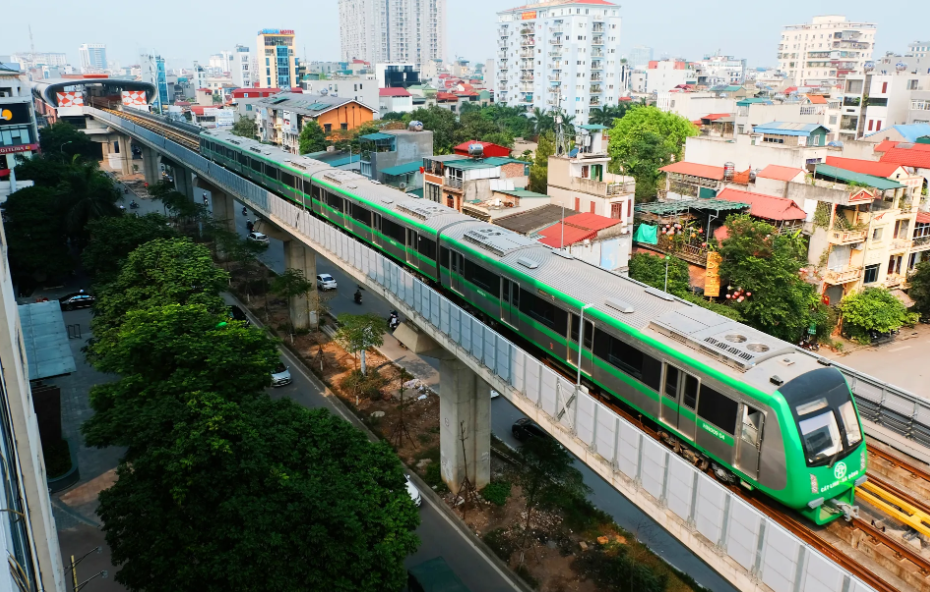
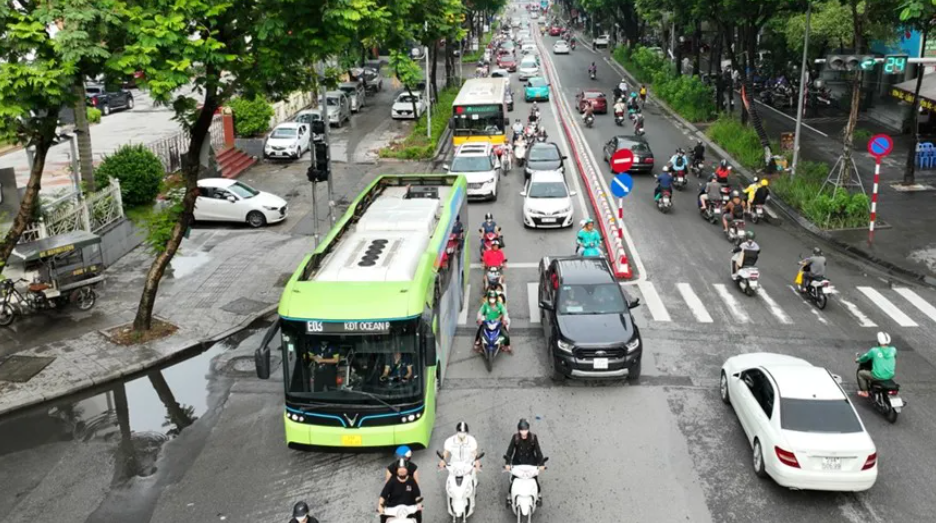
Public transportation is set to play a bigger role as the city accelerates its green transition. Photo: Cong Hung/The Hanoi Times
Associate Professor Doan Minh Tam, former Director of the Institute of Transport Science and Technology, highlighted the need for thorough surveys on vehicle usage, income levels, and transport needs before implementation.
“Without accurate data, the city risks uncoordinated and ineffective enforcement,” Tam told the VNA.
Professor Tran Thanh Hai, Rector of Hanoi University of Mining and Geology, also warned that electric vehicles, particularly those using lithium-based batteries, may pose future environmental risks due to battery waste and fire hazards. He stressed that green transition efforts must be viewed through a sustainability perspective.
Not leaving anyone behind
Vietnam has committed to achieving net-zero carbon emissions by 2050 as part of its sustainable development strategy, which combines environmental protection with economic growth. Controlling emissions from the transport sector is a key component of this goal.
To make the gasoline motorbike ban effective, experts and residents, especially vulnerable groups, have urged Hanoi to implement a wide range of support measures.
These include greater financial subsidies, preferential loans, and free vehicle registration for low-income workers.
There are also calls for the city to invest in a comprehensive charging infrastructure, particularly fast-charging stations in residential areas, bus terminals, industrial zones, and tourist sites.
Wider public awareness campaigns are needed to help people understand the long-term benefits of green transportation. Some have proposed that Hanoi apply flexible policies, such as phased timelines for low-income groups, allowing gasoline motorbikes during off-peak hours, or permitting use in areas lacking public transport alternatives.
Experts also recommend expanding public transportation networks by investing in electric buses, metro lines, and feeder bus routes to make it easier for suburban residents to reach the city center.