Changes in Vietnam’s government apparatus seen through legislative efforts
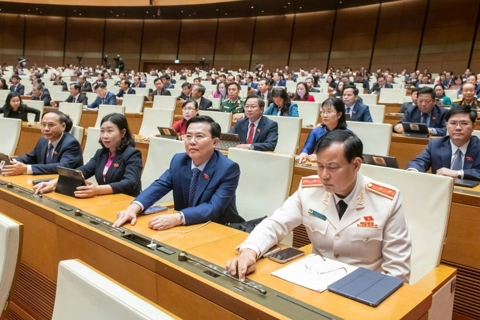
Vietnam has ramped up government restructuring to boost efficiency and advance its goal of becoming a developed nation by 2045, as highlighted in the recent National Assembly plenary.
Vietnam’s determination to streamline the governmental apparatus is aimed at it effective for the ambitious growth targets, including becoming a developed country by 2045.
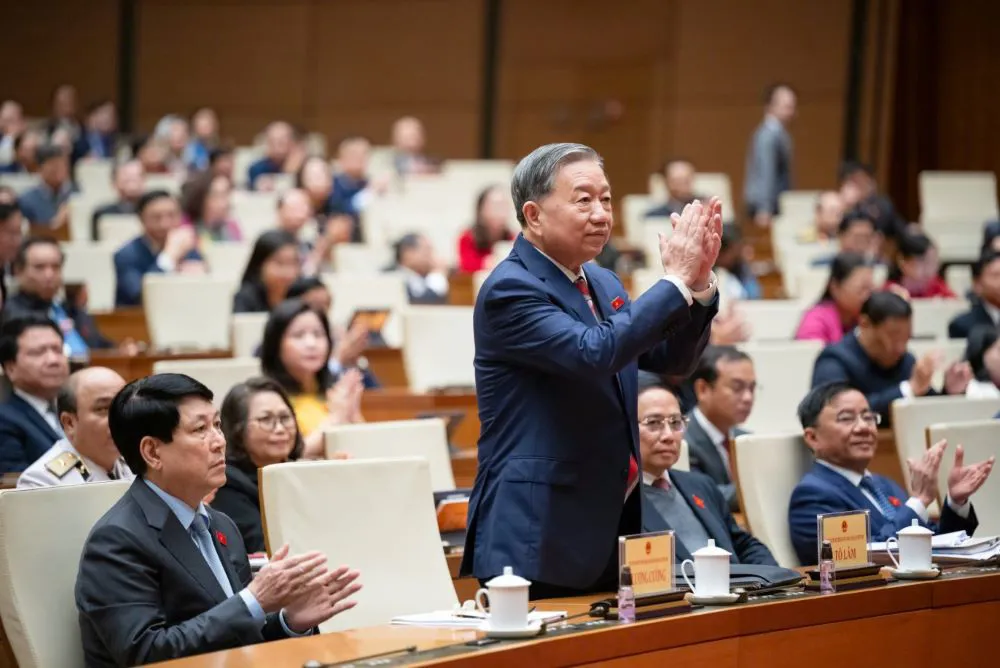
The efforts were institutionalized by the recently concluded National Assembly’s extraordinary session, which focused on streamlining the apparatus.
The week-long session, which concluded on February 19, passed resolutions on organizational restructuring, along with resolutions on scientific and technological development, a policy to promote nuclear power development, and a target of 8% economic growth this year.
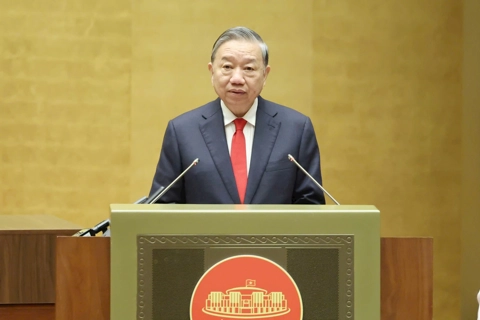
| General Secretary of the Communist Party of Vietnam To Lam at the 9th Extraordinary Session of the National Assembly concluded on February 19. Photo: Quochoi |
Government restructuring
At its February 18 session, the National Assembly approved a major reshuffle of the government proposals set to take effect on March 1. The reorganization reduces the number of government members from 27 to 25, now consisting of a prime minister, seven deputy prime ministers, 14 ministers, and three heads of ministerial-level agencies.
Two new deputy prime ministers Mai Van Chinh and Nguyen Chi Dung were appointed. Meanwhile, five new ministries were created by merging existing government bodies. The new Ministry of Finance is the result of merging the Ministry of Planning and Investment with the Ministry of Finance. This ministry is headed by Nguyen Van Thang.
The Ministry of Construction comes from the merger of the Ministry of Transport and the Ministry of Construction, led by Tran Hong Minh.
The Ministry of Agriculture and Environment is the result of the merger of the Ministry of Agriculture and Rural Development and the Ministry of Natural Resources and Environment, under the leadership of Do Duc Duy.
The Ministry of Sciences and Technology takes over some parts of the Ministry of Information and Communications, with Nguyen Manh Hung as Minister.
The Ministry of Home Affairs now assumes some responsibilities from the Ministry of Labor, Invalids, and Social Affairs, with Pham Thi Thanh Tra as its head.
The Ministry of Ethnic and Religious Affairs is a new ministry created by merging the Committee for Ethnic Minority Affairs with state religious functions previously administered by the Ministry of Home Affairs. Dao Ngoc Dung was appointed Minister.
Meanwhile, several ministers were reassigned as part of the reorganization, including Hau A Lenh, Head of the Committee for Ethnic Minority Affairs who is now Party Secretary of the northern province of Ha Giang; Nguyen Thanh Nghi, former minister of construction, was appointed Deputy Secretary of the Ho Chi Minh City Party Committee; Huynh Thanh Dat was named Deputy Head of the Central Commission for Propaganda and Mass Mobilization; and Le Minh Hoan was promoted to the position of Vice Chairman of the National Assembly.
The National Assembly also approved an increase in the number of deputy positions in some ministries and agencies, with one deputy minister of Foreign Affairs, four deputy ministers of Finance; four deputy ministers of Construction; two deputy ministers of Home Affairs; and one deputy Governor of the State Bank.
Following these mergers, ministries, such as the Ministry of Finance, may have as many as nine deputy ministers to accommodate the expanded responsibilities resulting from the consolidation.
This major reshuffle reflects the government’s goal of streamlining operations, boosting efficiency, and enhancing the overall effectiveness of administrative functions.
The changes are designed to better align with Vietnam’s broader socio-economic development strategies and respond to the growing demands of a rapidly growing economy.
Impressive economic targets
At its closing session on February 19, the National Assembly (NA) approved a resolution targeting economic growth of 8% or more for 2025. The General Secretary of the Communist Party of Vietnam, To Lam, urged double-digit growth in the coming years. Economic growth is expected to drive electricity demand up by 12-16% annually.
Vietnam is expanding its power supply and focusing on clean energy to support its fast-growing economy. In line with this, the NA approved a resolution to revive the Ninh Thuan nuclear power project after an eight-year hiatus. Operations are expected to begin by 2030-2031.
Additionally, the legislative body passed a resolution to ease barriers to scientific research, technology, and innovation.
Revising NA membership suspension rules
On February 17, the NA passed amendments to the Law on the Organization of the National Assembly.
The revised law empowers the Standing Committee to temporarily suspend deputies who are being prosecuted or those facing disciplinary action of a warning level or higher. Deputies who are public officials or civil servants can also be suspended upon formal requests from relevant authorities, such as inspection or investigative bodies.
Suspended legislators may only resume their duties if they are cleared of any violations, disciplinary action, or legal charges. Convicted deputies lose their seat as soon as the court’s verdict takes effect.