Hanoi approves 143-hectare urban development project
The project will offer a variety of housing options as well as commercial and public facilities.
THE HANOI TIMES — Hanoi’s People’s Committee has greenlit a detailed plan for a 143-hectare urban development project near the Red River, marking a significant step in the city’s expansion.
Spanning Thuong Cat and Tay Tuu wards and the O Dien commune, the new urban area is close to the Thuong Cat Bridge, one of ten major bridges planned across the Red River. It is part of Hanoi’s transport plan from 2015 to 2030, with an estimated investment of VND8.3 trillion (US$330 million).
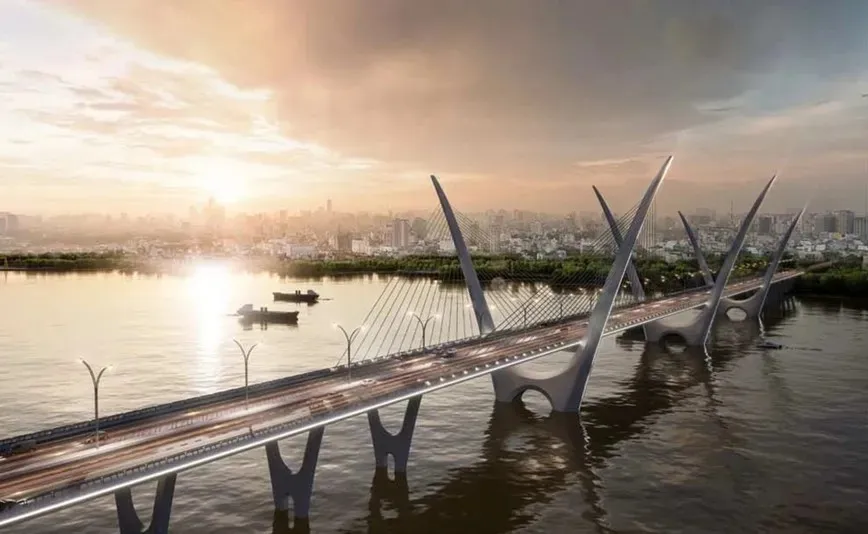
Rendered image of Thuong Cat bridge, one of Hanoi's key infrastructure projects. Photo: Vietnam Association of Architects
The newly approved plan divides the urban area into three functional zones. The first zone will consist of villas, townhouses, social housing, public facilities, commercial service complexes, schools, green spaces, and parking areas.
The second zone will focus on townhouses, villas, mixed-use land, and educational institutions. The third emphasizes commercial and service mixed-use areas, social housing, and land for training and research facilities.
Of the total area, 11 hectares are allocated for low-rise housing and 5.3 hectares for apartment complexes. The plan also reserves land for public infrastructure, green spaces, and utilities to balance urban growth with livability.
Extending along an east-west axis of Hanoi, the 143.2-hectare urban zone prioritizes a sustainable, eco-friendly urban model centered on green spaces and bodies of water. Residential areas are interwoven with parks, pedestrian pathways, and community spaces that promote the use of environmentally friendly construction materials.
Hanoi’s Department of Planning and Architecture will oversee the documentation and publication of the detailed plan to ensure it aligns with the city's goals of addressing housing demand and improving connectivity.
This development demonstrates Hanoi’s commitment to sustainable urbanization and enhances regional connectivity through strategic infrastructure.