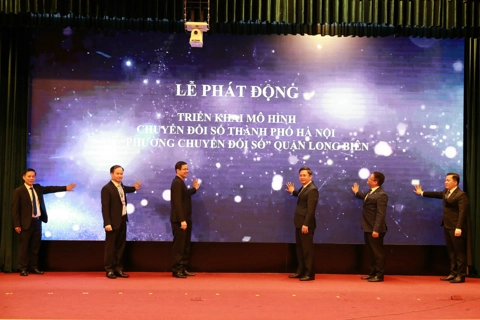
Hanoi builds new development model through digital transformation
The capital is ready to pilot new mechanisms and test innovation and digital transformation models to help shape national standards.
THE HANOI TIMES — Hanoi is piloting new development models anchored in science, technology, innovation and digital transformation to restructure development space, enhance governance and drive sustainable growth.
This approach reflects the capital’s vision of an enabling and proactive locality that moves early and takes responsibility in implementing major national strategies.
Hanoi moves first and takes responsibility
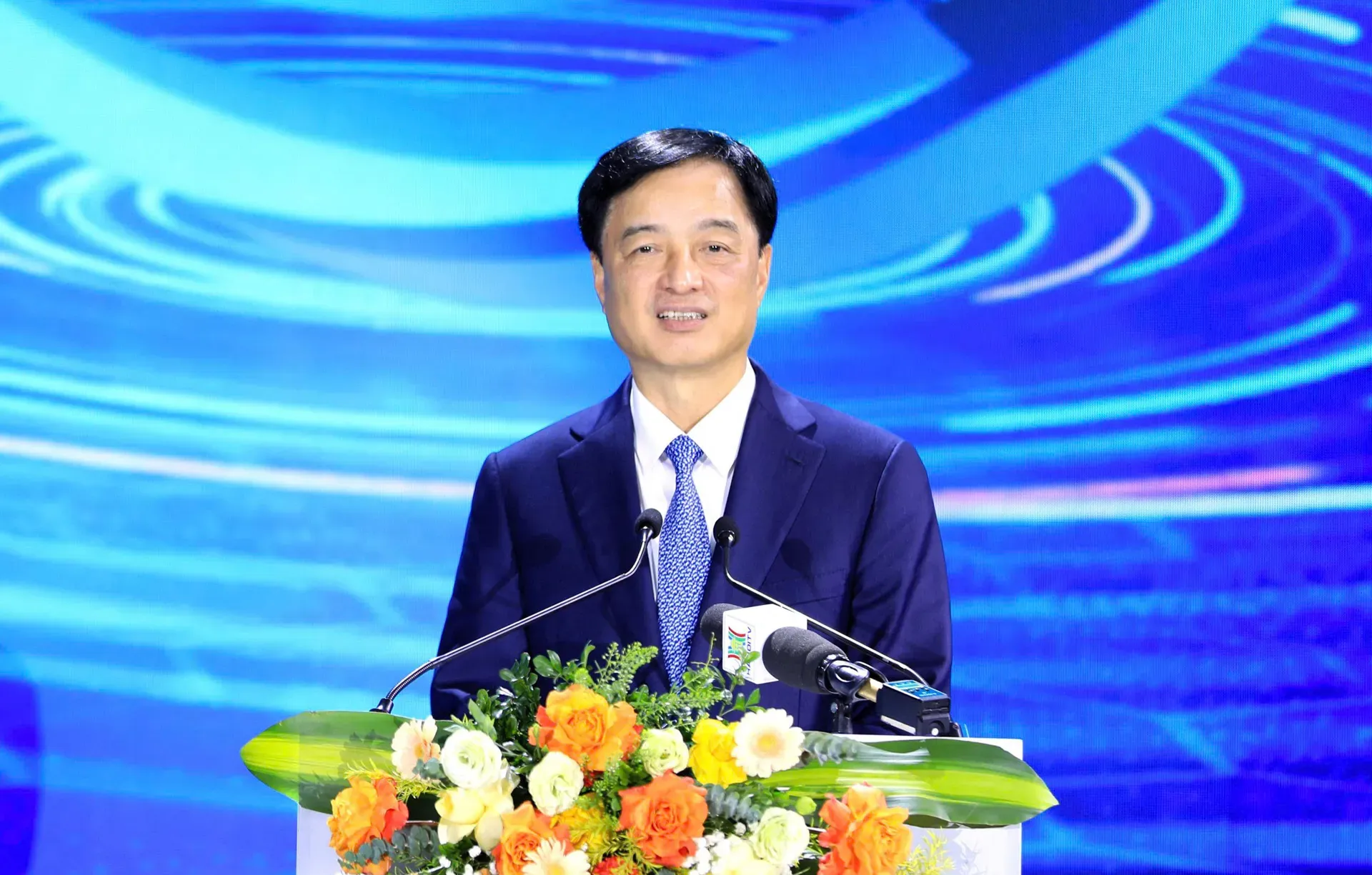
Hanoi Party Secretary Nguyen Duy Ngoc said at a conference on December 25. Photos: Thanh Hai/The Hanoi Times
Speaking at the Hanoi 2026 Action Conference implementing Resolution No. 57-NQ/TW, Hanoi Party Secretary Nguyen Duy Ngoc said the discussions reflected strong political determination from both central and local authorities.
The conference was held alongside a live relay of the national year-end meeting reviewing science, technology, innovation and digital transformation in 2025 and outlining key tasks for 2026.
The year-end meeting, held by the Central Steering Committee on December 25, was chaired by General Secretary To Lam and attended by Prime Minister Pham Minh Chinh, Standing Member of the Party Central Committee’s Secretariat Tran Cam Tu, Politburo members, and leaders of relevant agencies.
For Hanoi, nine key tasks have been identified covering the most critical issues the capital must address in the coming period. They are complex and demanding, requiring systematic breakthrough solutions and persistent and decisive implementation.
To make the goals attainable, the city’s Party chief called on all levels, sectors, local authorities and experts involved in the city’s Steering Committee 57, which is responsible for implementing Resolution No. 57-NQ/TW on science, technology, innovation and national digital transformation, to identify breakthrough areas in these fields.
"This is not the responsibility of a single sector or level but of the city’s entire political system," he said.
Hanoi’s decision to allocate 4% of its budget, equivalent to more than VND9 trillion (US$342 million), to priority areas reflects the state’s role in facilitating and leading development by creating momentum, opening pathways and mobilizing non-budget resources.
In addition, he urged a strong shift from a management mindset to a development facilitation mindset.
Accordingly, each agency, unit, locality and position is required to proactively design specific action plans with clearly defined breakthroughs, measurable outputs, timelines and accountability aligned with assigned functions.
The city’s Steering Committee 57 will directly guide, monitor and accompany implementation.
Additionally, issues within the city’s authority will be handled promptly while those beyond its mandate will be proactively reported to central authorities for solutions.
According to Ngoc, the ultimate goal of science, technology, innovation and digital transformation is to better serve people and businesses, improve urban governance and promote socio-economic development.
Hanoi is encouraged to form more innovation centers, accelerate research and application, and rapidly bring results into practice, with a focus on administrative reform and public service quality.
Foundation for a new phase
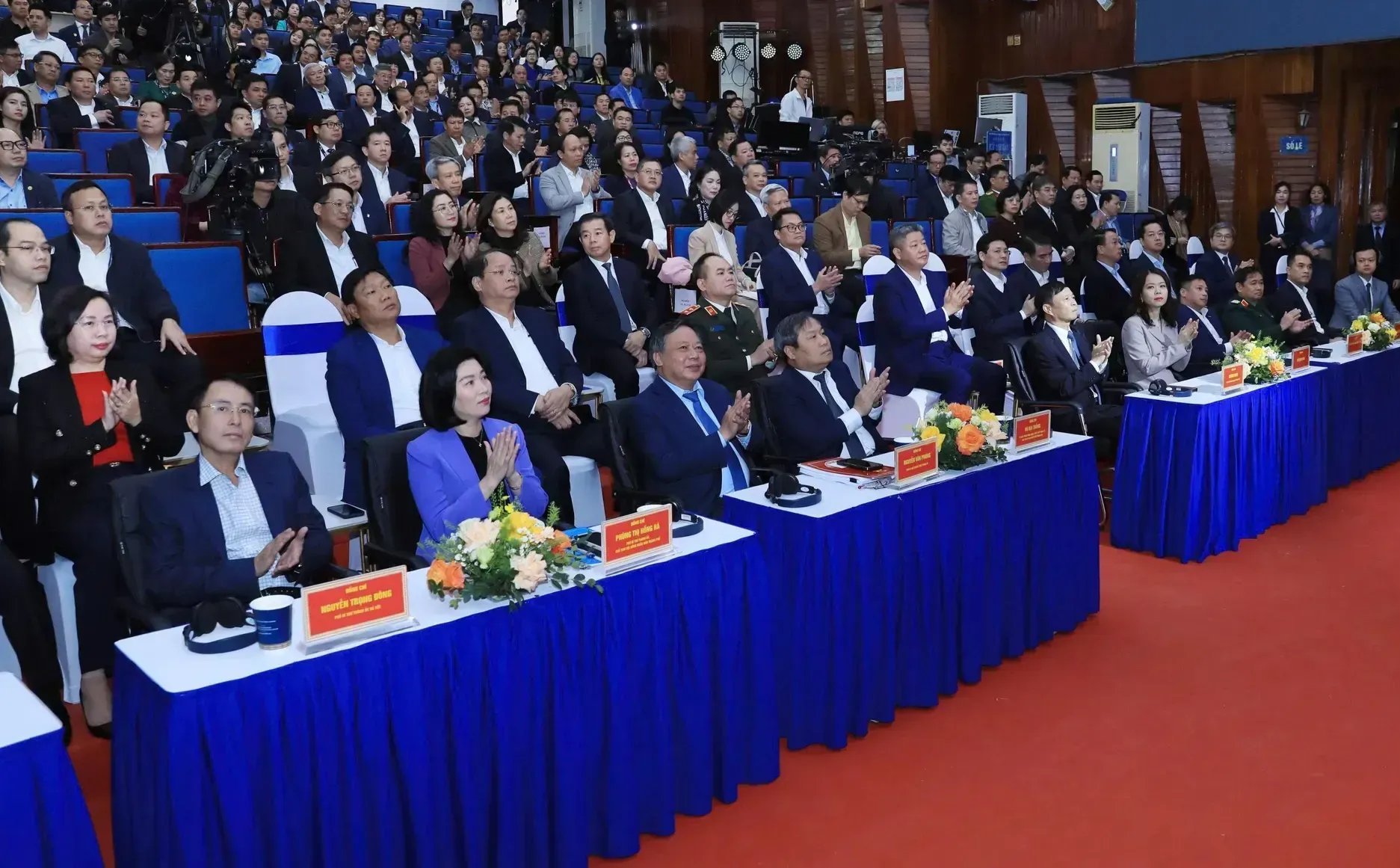
Hanoi leaders at the Hanoi site.
After one year of implementing Resolution No. 57-NQ/TW, Hanoi has recorded significant progress, marking a clear shift from awareness to action.
In 2025, the city maintained its national lead in the Provincial Innovation Index, ranking first in 18 out of 52 component indicators.
Meanwhile, the share of enterprises engaged in innovation reached 25.2%, while the innovation startup ecosystem expanded to 207 science and technology enterprises.
In digital transformation, Hanoi continued to top the Provincial Digital Transformation Index for several consecutive years.
The city digitized more than 24.1 million pages of records, deployed 25 fully online public services, migrated 409 IT systems to the central data center and expanded the open data portal to more than 125 datasets.
Remarkably, the iHanoi application has been widely rolled out, forming a foundation for digital government, digital economy and digital society.
Within Party agencies, Hanoi piloted four Party administrative procedures on the National Public Service Portal.
By December 7, 2025, as many as 99.98% of Party members had registered accounts and conducted nearly one million online Party fee transactions totaling more than VND132 billion ($5 million).
Building a new development model from practice

Hanoi's Party Secretary Nguyen Duy Ngoc, Hanoi People's Committee Chairman Vu Dai Thang and other delegates at the launch of the City Innovation Network.
At the Hanoi site, Vice Chairman of the Hanoi People’s Committee Truong Viet Dung said the Resolution No. 57-NQ/TW identifies science, technology, innovation and digital transformation as foundational drivers of national growth and competitiveness.
As the capital of Vietnam, Hanoi sees implementation not just as carrying out a major policy but as testing and building a new development model.
He said breakthroughs come from tackling key development challenges rather than rolling out scattered programs, especially the gaps between rapid growth and sustainability, concentrated resources and fragmented management, and innovation ambitions and institutional capacity.
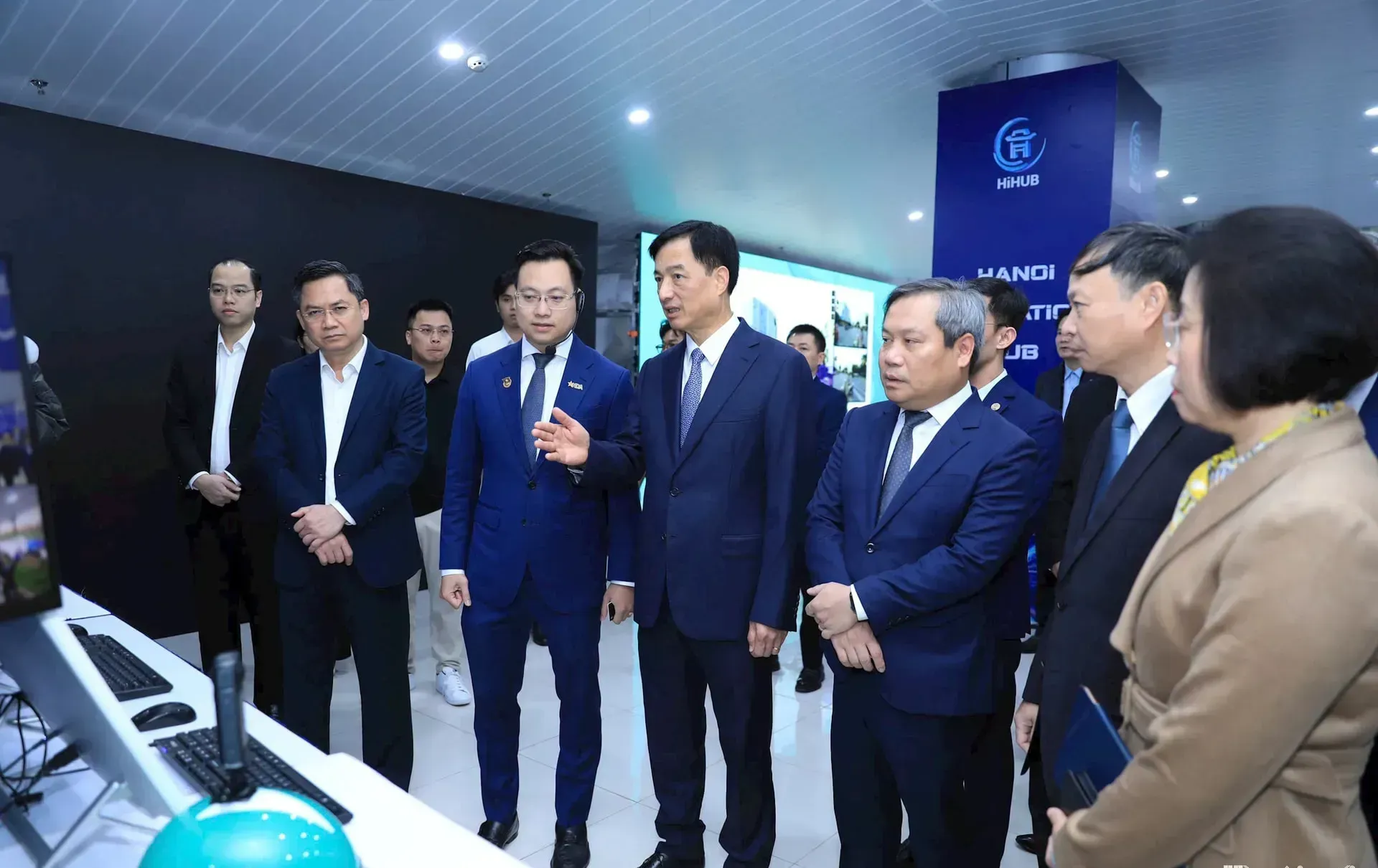
Hanoi's Party Secretary Nguyen Duy Ngoc (fourth from the right) and Hanoi People's Committee Chairman Vu Dai Thang (third from the right) visit the exhibition on innovation products.
After one year of implementation, Hanoi has recognized that the focus is on building an innovation ecosystem where institutions space data and people are fundamentally reorganized.
Hoa Lac Hi-Tech Park and the smart city model have been identified as two core pillars in terms of space infrastructure and governance. The park is defined as the spatial nucleus of Hanoi’s science and technology ecosystem.
At the same time, the city has shifted from periodic support to investment facilitation for innovation, accepting controlled experimentation and measuring success through outputs and real impacts.
Hanoi has issued a coordinated set of resolutions to develop the innovation ecosystem introduced flexible pilot mechanisms and refined institutions through practical experience.
The city has also accelerated decentralization moving from project management to development partnership and assessing effectiveness based on investors’ internal technological capacity and sustainability.
Based on this foundation, Hanoi is reorganizing the entire development space around Hoa Lac into a science and innovation urban area.
A 600-hectare smart city is being developed integrating research training production and living space.
Meanwhile, Urban Railway Line No. 5 linking Van Cao in downtown area and Hoa Lac, which broke ground on December 19, is seen as a tool to restructure development space and form a new growth pole for the capital.
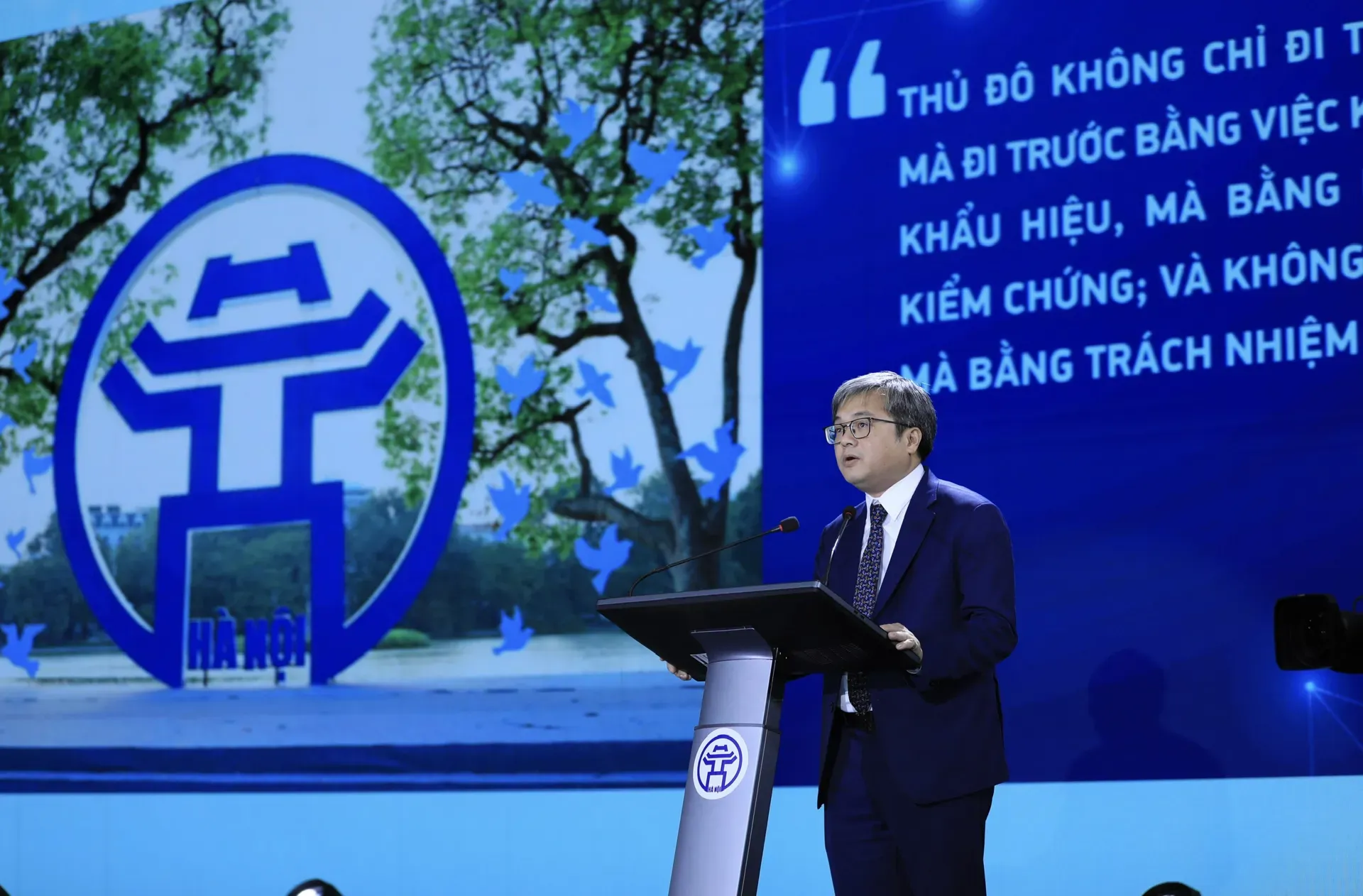
Vice Chairman of the Hanoi People's Committee Truong Viet Dung speaks at the conference - Hanoi site.
Concerning smart city, Dung said Hanoi sees it as a new urban governance model, with data as a strategic resource and a shift toward integrated data-driven and proactive management through carefully piloted and adjusted spatial projects.
With 2026 identified as a pivotal year for implementing Resolution No. 57-NQ/TW, the capital is ready to pilot new mechanisms with clear outputs and accountability, moving first to test new models and help set standards nationwide.