Two-tier governance drives Hanoi's administrative digitalization: Experts
Digital transformation is no longer a choice but a strategic solution to generate value and drive the capital’s advancement.
THE HANOI TIMES — The two-tier local government model presents a golden opportunity for Hanoi to boldly restructure and fully digitize its administrative system.

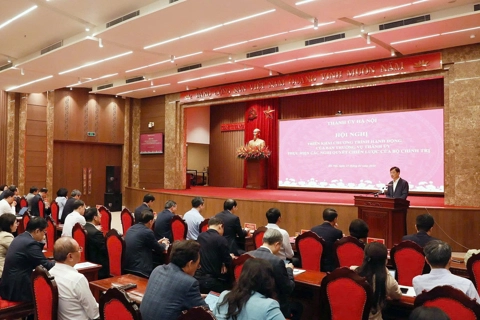
Delegates at the conference on August 11. Photos: Duc Tho/The Hanoi Times
Experts shared this view at a scientific conference held August 11 on “Breakthrough Solutions for Hanoi’s Development in Advancing Digital Government, Economy, and Society.”
Opening the workshop, Deputy Head of the Commission for Communications, Education and Mass Mobilization of the Hanoi Party Committee, Dao Xuan Dung, said the Party and State have identified digital transformation as an inevitable and strategic choice to drive national development.
Resolution No. 57-NQ/TW of the Politburo on breakthroughs in science, technology, innovation, and digital transformation affirms it as “a prerequisite and the best opportunity for our nation to become prosperous and strong in the new era.”
“For Hanoi, this requirement is more urgent than ever,” Dung said.
The documents of the 17th City Party Congress, and especially Politburo Resolution No. 15-NQ/TW, set the goal of building the capital into a smart, modern, green, clean, and beautiful city with influence to lead national development.
According to Dung, the workshop took place at a pivotal moment, as the entire political system is streamlining its apparatus and building an efficient two-tier government model, while facing ambitious economic growth targets and major challenges of a megacity, such as infrastructure pressure, traffic congestion, environmental pollution, and rising public and business expectations.
“In this context, digital transformation is no longer an option but a breakthrough driver to turn challenges into opportunities to help the capital rise,” Dung stressed.

The event was held at the Le Hong Phong Political School.
Nguyen Thi Diem Hang, Deputy Director of the Hanoi Institute for Socio-Economic Development Studies, proposed that Hanoi develop and implement a citywide digital workforce strategy.
She called for mandatory, regular training in digital technology, data management, and information security for officials at all levels; support for high-quality workforce development in the private sector through SME training programs; and widespread digital skills education for citizens, especially disadvantaged groups and suburban residents.
Meanwhile, Do Hong Cuong, Rector of Hanoi Metropolitan University, said digital workforce development must be a long-term priority supported by sustained attention and investment from the city government.
He recommended surveys of IT infrastructure and human resources in state agencies to assess current capabilities, application of IT solutions, and annual workforce needs.
“Stronger support for institutions lacking experience in IT training, provision of advanced programs and technical infrastructure, and the introduction of mandatory IT competency standards for leadership and public service appointments are solutions required for Hanoi to promote a digital workforce,” said Cuong.
Concluding the event, Pham Van Linh, Permanent Vice Chairman of the Central Theoretical Council, emphasized that digital transformation is a comprehensive revolution in which technology is a tool, but people and institutions are the decisive factors.

Residents of Cua Nam Ward experience completing administrative procedures with an AI-powered robot. Photo: Khanh Huy/The Hanoi Times
On the digital economy, he highlighted institutional measures such as piloting controlled “regulatory sandboxes” to test new business models and exploring open banking to promote the digital finance ecosystem.
For the digital society, Linh underlined the central role of the digital citizen, encouraging initiatives such as building a “digital university” model to train high-quality talent on demand, integrating digital skills into general education, and expanding the “digital literacy campaign” to ensure fairness and “leave no one behind.”
Linh stressed the need to urgently improve the institutional framework and create an open legal environment for innovation, particularly through controlled sandbox mechanisms.
He called for targeted investment in digital infrastructure, with priority given to shared data platforms.
“At the same time, we must place people at the center by implementing a comprehensive strategy to develop high-quality human resources and digital citizenship, making this the driver of all breakthroughs,” he concluded.