Hanoi commits to smooth shift from gas motorbikes to EVs
The city is rolling out new support measures while expanding charging stations, parking facilities and public transit to build a safer urban infrastructure as it advances its plan to restrict gasoline motorbikes.
THE HANOI TIMES — Hanoi will fully enforce time-based restrictions on gas motorbikes as part of its plan to create a low-emission zone, with the city pledging a smooth transition to electric vehicles as the shift affects millions of residents and demands major legal, financial and infrastructure preparations.
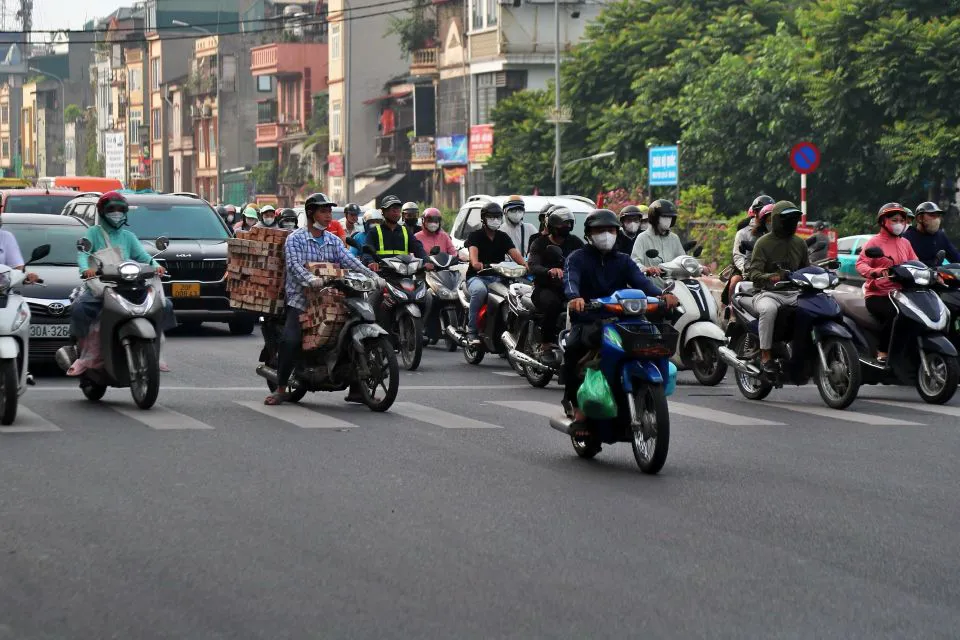
The transition is expected to affect million of residents. Photo: Nguyen Truong/The Hanoi Times
Deputy Director of the Hanoi Department of Construction Dao Viet Long told a December 9 panel discussion that the city is committed to meeting its deadlines on phasing out gas motorbikes and rolling out the low-emission zone.
He said the plan to establish a low-emission zone is tied to two major urban challenges, prolonged traffic congestion and air pollution, which directly affect quality of life and the capital’s socio-economic development.
Resolution 57/2025 of the city’s People’s Council on the low-emission zone, therefore, calls for a coordinated and phased rollout. The city is developing a draft policy to support the shift to clean-energy vehicles.
Under the proposal, residents would receive support equal to 20% of the value of an electric motorbike, up to VND5 million (US$200). Poor households could receive support of up to 100%, capped at VND20 million (US$800); near-poor households 80%, up to VND15 million (US$600).
The city would also cover 30% of interest on installment loans for 12 months and 50% of registration fees, with poor and near-poor households receiving full support.
Hanoi plans to offer lower parking fees for green vehicles and waive charges for the use of roadways and sidewalks for up to five years for businesses operating public electric bicycles and motorbikes.
The city also intends to expand free public transport for students, university students and industrial park workers.
In terms of infrastructure, Hanoi is studying support for public clean-energy stations, including 30% interest coverage, 50% of site clearance costs and a five-year land-lease waiver.
At least 15% of parking spaces in lots within Ring Road 3 must include charging stations before January 1, 2030, while new buildings will be required to reserve at least 30% of parking spots for public charging. Charging stations will be open-access infrastructure rather than tied to specific manufacturers.
Hanoi has assessed 110 potential sites for centralized charging stations inside Ring Road 3 for the pilot phase and is also exploring battery-swap systems for two-wheel electric vehicles. The Department of Construction is advancing plans for mini electric buses in the Old Quarter and surrounding areas and for expanding shared mobility services. By early December 2025, the city had added 500 electric bicycles to its public bike-share system, with the total expected to reach 5,000 before July 2026.
For high-rise residential buildings, the department said issues related to charging points fall under the authority of ward and commune governments.
For now, local authorities will work with building management boards to review and designate separate areas for electric vehicles and install charging posts that meet fire-safety standards.
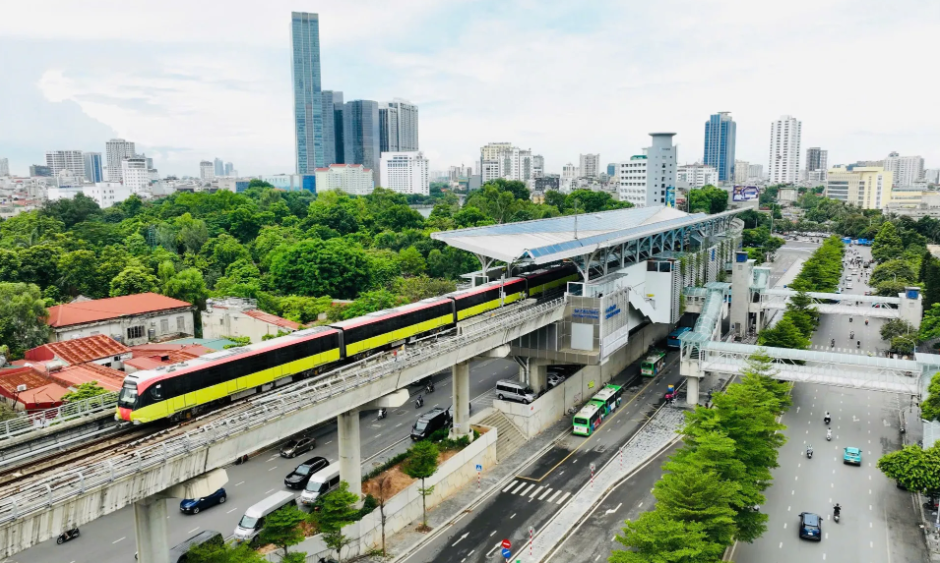
A metro line in Hanoi. Photo: Pham Hung/The Hanoi Times
Public transportation remains key solution
Traffic expert Phan Le Binh added that this is a decisive moment and a chance for Hanoi to encourage people to rely less on private vehicles and shift toward public transportation. However, even if individuals and businesses switch from gasoline to electric vehicles, air pollution may fall, but traffic congestion will remain.
“Hanoi’s two pressing challenges are congestion and air pollution, so the real sustainable shift comes when people move from private vehicles to public transit because it addresses both issues at the same time,” he said.
Binh stated that the gradual expansion of the low-emission zone to Ring Road 2 and Ring Road 3 is appropriate.
With a phased rollout for each area, the implementation in Ring Road 1 will reveal which measures are effective as government support combines with cooperation from businesses and residents. This will help the city identify which actions create strong momentum for behavioral change, which ones are less successful, and what results each approach delivers, so policies can be adjusted before expanding to Ring Road 2.
He emphasized that throughout this process, government agencies will need public feedback to refine policies so the transition remains fair, transparent and practical for everyone.
Hanoi currently has more than eight million vehicles, including about 6.9 million motorbikes, along with more than 1.2 million vehicles from other provinces that circulate regularly. The city estimates that road traffic accounts for 58% to 74% of total air pollution. The low-emission zone resolution is expected to take effect in July 2026.
Studies show that old motorbikes are the main source of urban emissions. Motorbikes produce 94% of hydrocarbons, 87% of CO, 57% of NOx and 33% of PM10 from road traffic, which are concerning levels.
Estimates by the Institute of Transport Science and Technology show motorbikes emit about 470,000 tons of CO a year and 38,000 tons of hydrocarbons a year, equal to the total weight of roughly 31,000 and 2,500 large buses, respectively.
It noted that continued use of millions of old motorbikes harms Hanoi’s environment, degrades air quality and poses health risks to residents, in addition to contributing to traffic accidents.