Hanoi explores underground parking at public parks
Developing underground parking is expected to form part of a broader service economy that benefits communities and ensures equitable access to urban infrastructure.
THE HANOI TIMES — The Hanoi People’s Council has proposed that the city study the development of underground parking facilities in public parks and gardens to ease traffic congestion and make better use of public land.
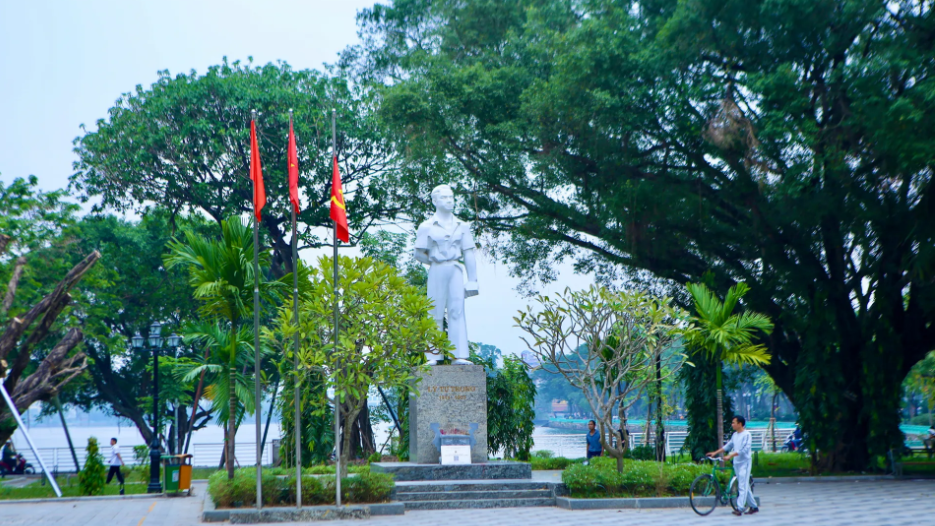
Ly Tu Trong Park in Hanoi. Photo: Duy Minh/The Hanoi Times
Underground projects facing delay
The first batch of underground projects recently approved by the Hanoi People’s Council includes 78 underground parking facilities.
According to the a city report, of the 44 park and garden renovation projects assigned to district-level authorities before the administrative reorganization, many are behind schedule due to planning and site clearance issues.
For example, the Giang Vo Garden awaits approval of the detailed plan for the Giang Vo Residential Complex, while the gardens of Co Tan, Phung Hung (Hoan Kiem Ward), and 19/8 (Cua Nam Ward) have stalled as the city considers adding underground parking facilities beneath them.
Dr. Architect Dao Ngoc Nghiem, Vice Chairman of the Vietnam Urban Planning and Development Association, said that using garden spaces for underground parking was first proposed in the 1990s. Although many projects have since been approved in principle, implementation has yet to begin.
Examples of long-delayed projects include the automatic parking facility at the covered Nguyen Hong Canal, approved in 2017; an underground parking and commercial service project in Thu Le Park, approved in May 2019; and a former high-rise hotel project in Thong Nhat Park, which was converted to underground parking in 2009.
Nghiem attributed the delays to financial issues, as underground facilities with similar capacity can cost two to three times more than surface structures, while Hanoi still lacks attractive incentives for investors.
Architect Tran Huy Anh of the Hanoi Architects Association cited a JICA study on combining an underground station with parking at the Hang Bai–Tran Hung Dao intersection of metro lines 2 and 3, which found that each underground parking space would cost nearly VND4 billion (US$157,000) to build, not including operations and maintenance, which could quadruple the total over the facility’s lifecycle.
Construction in historic urban areas also poses challenges. Hanoi was the first city in Vietnam to approve a general plan for central urban underground space through 2030, with a vision to 2050, but specific regulations are lacking.

Thong Nhat Park from above. Photo: Dinh Hieu/The Hanoi Times
Addressing bottlenecks
Nghiem recommended that the city quickly prepare a detailed plan with clear timelines, funding sources, and preferential financing policies, as well as invest in modern equipment to ensure safety in underground works. He also called for coordinated use of underground space across sectors to protect shared interests.
Anh from the Hanoi Architects Association noted that only about 15% of Hanoi’s parking spaces meet standard requirements, with the remainder being sidewalks, streets, and unused lots, which cost nothing to operate.
This discourages investment, as high construction costs are coupled with uncertain returns. He argued that underground parking is a sound strategy, but the city must carefully choose locations, funding models, and implementation methods.
Anh suggested integrating underground facilities, including parking, into major infrastructure projects such as bridges, metro lines, and large-scale apartment upgrades to maximize investment and support urban renewal.
“For instance, after the demolition of the ‘Shark Jaw’ building and the clearance of East Hoan Kiem to expand public space, the city should commission design proposals for underground facilities there,” he said.
Experts also emphasized that developing underground parking should form part of a broader service economy that benefits communities and ensures equitable access to urban infrastructure.
By taking its broader impacts into account, the project could draw in larger investment sources, including international funding, and encourage the adoption of modern tools like Geographic Information Systems (GIS), Building Information Modeling (BIM), and other advanced technologies to improve project planning and operations, Anh asserted.