Hanoi pushes for underground expansion with incentives and reform
Underground development helps save land resources, supports modern urban planning, and contributes to a new image of Hanoi.
THE HANOI TIMES —The Hanoi People’s Council has approved a resolution listing underground projects for investment, with the realization of this initiative now requiring clear incentives and a consistent legal framework.

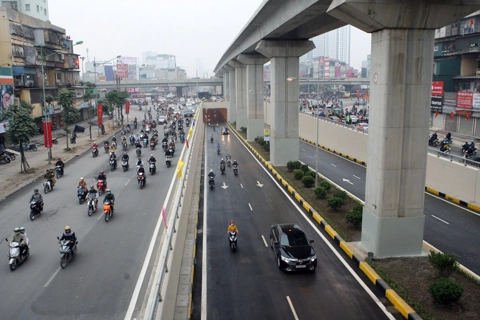
Underpass at the Tran Duy Hung – Ring Road 3 interchange. Photo: Pham Hung/The Hanoi Times
The plan targets key projects such as metro lines, underground stations, and related facilities.
The list also includes passages that connect underground transportation stations with commercial, public, and service spaces, such as underground parking areas, public utilities, and the basements of hotels, shopping centers, restaurants, and sports venues.
The plan outlines eight urban railway lines, totaling approximately 320 kilometers, including 81 kilometers underground. Planned projects include underpasses, underground roads, parking facilities, and underground systems for energy supply and public lighting.
In total, the list includes 85 projects, among them five road underpasses, 78 underground parking sites, and two underground public works projects.
Duong Duc Tuan, Vice Chairman of the Hanoi People’s Committee, said the list puts the 2024 Capital Law into action and aligns with national development strategies through 2030, with a vision to 2045.
"The city is pushing for greater autonomy and tailor-made policies to accelerate the development of strategic infrastructure, especially in transportation and underground planning," Tuan said at the 25th session of the municipal People's Council earlier this month.
According to Article 19 of the Capital Law, underground space must be zoned and managed based on its function. In Hanoi, land users are permitted to utilize underground space vertically within their property boundaries in accordance with government regulations and city planning.
Urgent needs for uniform regulations
The city's growing demand for space makes underground development imperative for strengthening infrastructure and improving the quality of urban life.
According to Dr. Dao Ngoc Nghiem, Vice President of the Vietnam Urban Planning and Development Association, underground development saves land resources, supports modern urban planning, and contributes to Hanoi's new image.
The newly issued list shows that the city now views underground space as a vital part of comprehensive development, covering transportation, technical infrastructure, commerce, services, and public areas.
It also aligns with the updated Hanoi Master Plan for 2045 and the vision for 2065, which emphasizes the efficient use of underground space and land.
Dr. Nguyen Hong Tien, former Director of the Department of Technical Infrastructure under the Ministry of Construction, noted that incentives for underground construction are not a new idea. Decree No. 39/2010/ND-CP called for such policies, yet the issue has not been adequately addressed since then.
"Recent legal updates are seen as a positive sign, especially as the economy grows and long-standing proposals gain momentum. Hanoi’s move to issue this list of priority underground projects is timely and appropriate,” he said.
However, Tien highlighted the need for follow-up steps.
"After releasing the list, the city needs to quickly define detailed incentives, streamlined procedures, and clear timelines for investors," he continued.
To avoid future feasibility issues, related legal frameworks must also be amended and aligned, including the clear assignment of implementation responsibilities.
In fact, the 2024 Capital Law introduces many new and advanced provisions compared to its previous version. To fully realize its goals, relevant agencies must monitor the rollout of tasks assigned under the law to ensure coherence and timely execution.
"While Hanoi is creating mechanisms to attract investment, the supporting legal framework must also be clear and timely. Without synchronized, up-to-date regulations, even well-designed policies will encounter obstacles in practice,” Nghiem stressed.